Looking for classes? Ksquare Career Institute, Bengaluru →

Chemistry
Surface Chemistry
30 questions from 25 papers, each with its answer.
- 30 questions
- 25 papers
- 1.7% of Chemistry
Colloids – Classification Based on Physical State
-
Pumic stone is an example of:
Pumice stone is a solid sol (gas dispersed in a solid).
Pumice stone is an example of solid sol. In this type of colloid, the dispersion medium is solid and the dispersed phase is gas.
Colloids – Coagulation and Hardy-Schulze Rule
-
Given below are two statements: Statement I: In the coagulation of negative sol, the flocculating power of the three given ions is in the order- $Al^{3+}>Ba^{2+}>Na^+$ Statement II: In the coagulation of positive sol, the flocculating power of the three salts is in the order- $NaCl>Na_2SO_4>Na_3PO_4$ In the light of the above statements, choose the most appropriate answer from the options given below:According to the Hardy-Schulze rule, the greater the valence of the flocculating ion, the greater its coagulating power. Statement I: for a negative sol, cations are effective: $Al^{3+} > Ba^{2+} > Na^+$ – correct. Statement II: for a positive sol, anions are effective: $PO_4^{3-} > SO_4^{2-} > Cl^-$, i.e. $Na_3PO_4 > Na_2SO_4 > NaCl$ – so the given order is incorrect. So Statement I is correct but Statement II is incorrect.
Colloids – Electrical Double Layer and Zeta Potential
-
Measuring Zeta potential is useful in determining which property of colloidal solution?The potential difference between the fixed layer and the diffused layer of opposite charge is called the zeta potential (electrokinetic potential). The presence of equal and similar charges on colloidal particles is largely responsible for their stability, so measuring zeta potential is useful in determining the stability of the colloidal particles.
Colloids – Preparation and Charge on Colloidal Particles
-
Which mixture of the solutions will lead to the formation of negatively charged colloidal $[AgI]I^-$ sol.?Generally, the charge on a colloid is due to adsorption of the common ion present in excess in the dispersion medium. For a negatively charged $[AgI]I^-$ sol, $I^-$ must be in excess over $Ag^+$. Millimoles of $AgNO_3$ and KI in each mixture: (1 M, 1.5 M) → 50 and 75; (1 M, 2 M) → 50 and 100; (2 M, 1.5 M) → 100 and 75; (0.1 M, 0.1 M) → 5 and 5. The excess of KI is maximum in 50 mL of 1 M $AgNO_3$ + 50 mL of 2 M KI (100 millimol KI), so $I^-$ is adsorbed on the AgI formed, giving the $[AgI]I^-$ sol.
Charge on colloidal particles
-
Which of the following is a positively charged sol?Methylene blue solution forms a positively charged sol. (Congo red, silver sol, and $Sb_2S_3$ sol are all negatively charged.)
-
In which of the sols, the colloidal particles are with negative charge?Starch sol carries negatively charged colloidal particles. (Hydrated $Al_2O_3$ and haemoglobin form positively charged sols; $TiO_2$ sol particles are also positively charged.)
Adsorption isotherms
-
Shown below are adsorption isotherms for a gas 'X' at temperatures $T_1$, $T_2$ and $T_3$:
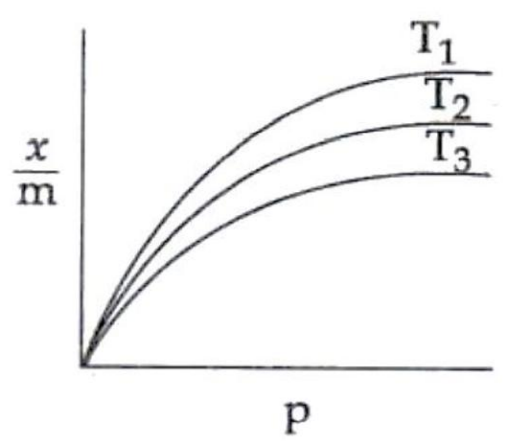 p and $\frac{x}{m}$ represent pressure and extent of adsorption, respectively. The correct order of temperatures for the given adsorption is:Physical adsorption is exothermic, so as the temperature increases the extent of adsorption of a gas on a solid decreases. The lowest curve ($T_3$) is at the highest temperature: $T_3>T_2>T_1$.
Adsorption – thermodynamics
-
Which one of the following characteristics is associated with adsorption?'Out of Syllabus'
Adsorption
-
If x is amount of adsorbate and m is amount of adsorbent, which of the following relations is not related to adsorption process?$\frac{x}{m} = f(p)$ at constant T is the adsorption isotherm (e.g., Freundlich isotherm $\frac{x}{m} = kp^{1/n}$).
$\frac{x}{m} = f(T)$ at constant p is the adsorption isobar.
$p = f(T)$ at constant $\frac{x}{m}$ is the adsorption isostere.
$\frac{x}{m} = p\times T$ would mean that adsorption increases in direct proportion to both pressure and temperature. This is not true: adsorption is exothermic and decreases with rise in temperature.
Hence the relation not related to adsorption is $\frac{x}{m} = p\times T$.
That is every question in Surface Chemistry for this filter.
Want a score?
Answers here are not saved. Practise as a test to be marked and see your progress.
Practise as a test