Looking for classes? Ksquare Career Institute, Bengaluru →

Chemistry
Coordination Compounds
104 questions from 38 papers, each with its answer.
- 104 questions
- 38 papers
- 5.91% of Chemistry
Crystal Field Theory and Colour of Complexes
-
The correct order of the wavelength of light absorbed by the following complexes is:
A. $[\text{Co(NH}_3)_6]^{3+}$
B. $[\text{Co(CN)}_6]^{3-}$
C. $[\text{Cu(H}_2\text{O)}_4]^{2+}$
D. $[\text{Ti(H}_2\text{O)}_6]^{3+}$
Choose the correct answer from the options given below:Crystal field splitting follows $\Delta_o \propto \text{charge on metal} \times \text{ligand strength}$: $\text{CN}^- > \text{NH}_3 > \text{H}_2\text{O}$. Since $\lambda_{\text{abs}} \propto 1/\Delta_o$, the absorbed wavelength order is $\text{B} < \text{A} < \text{D} < \text{C}$.
According to spectrochemical series, ligand field strength is $\text{CN}^- > \text{NH}_3 > \text{H}_2\text{O}$. Higher oxidation state on metal and stronger ligand increase crystal field splitting: $\Delta_o([\text{Co(CN)}_6]^{3-}) > \Delta_o([\text{Co(NH}_3)_6]^{3-}) > \Delta_o([\text{Ti(H}_2\text{O)}_6]^{3+}) > \Delta_o([\text{Cu(H}_2\text{O)}_4]^{2+})$. Since absorbed photon wavelength is inversely related to splitting ($\lambda = \frac{hc}{\Delta}$), the order of absorbed wavelength is $B < A < D < C$.
Crystal Field Theory and Magnetic Behaviour of Complexes
-
Given below are two statements:
Statement I: Both $[Co(NH_3)_6]^{3+}$ and $[CoF_6]^{3-}$ complexes are octahedral but differ in their magnetic behaviour. Statement II: $[Co(NH_3)_6]^{3+}$ is diamagnetic whereas $[CoF_6]^{3-}$ is paramagnetic. In the light of the above statements,
choose the correct answer from the options given below:$[Co(NH_3)_6]^{3+}$ and $[CoF_6]^{3-}$ are both octahedral. In $[Co(NH_3)_6]^{3+}$ ($NH_3$ is a strong field ligand), all electrons are paired ($t_{2g}^6e_g^0$), so it is diamagnetic. In $[CoF_6]^{3-}$ ($F^-$ is a weak field ligand), there are four unpaired electrons ($t_{2g}^4e_g^2$), so it is paramagnetic. So they differ in magnetic behaviour: both Statement I and Statement II are true.
Isomerism in Coordination Compounds
-
Number of possible isomers for the complex $[Co(en)_2Cl_2]Cl$ will be: (en = ethylenediamine)$[Co(en)_2Cl_2]^+$ shows cis and trans geometrical isomers.
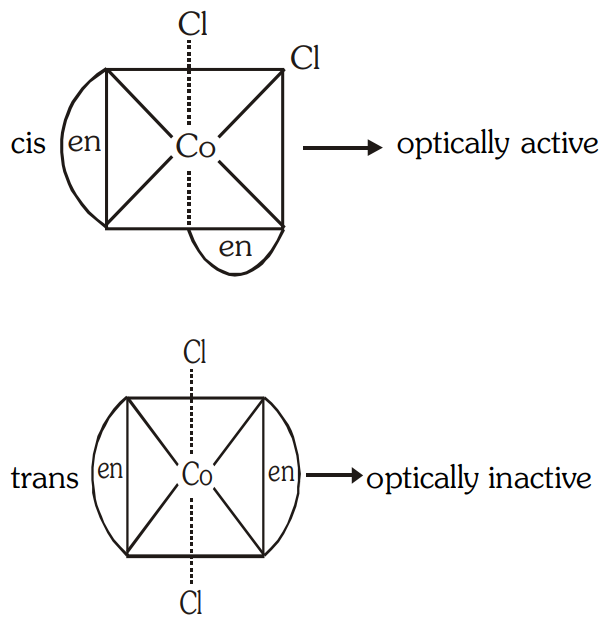
The trans form has a plane of symmetry (optically inactive); the cis form is optically active and exists as a pair of enantiomers.
Total stereoisomers = 2 + 1 = 3 -
The complex, $[Pt(Py)(NH_3)BrCl]$ will have how many geometrical isomers?
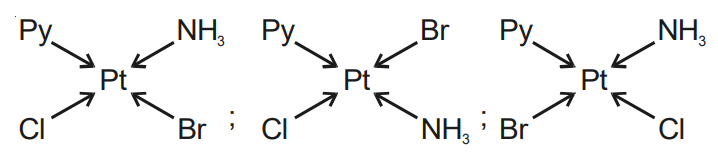
Pt(II) forms square planar complexes; this complex is of the type [Mabcd] with four different monodentate ligands (Py, $NH_3$, Br, Cl).
Fix one ligand, say Py, at one corner. The position trans to it can be occupied by any one of the other three ligands.
Isomer 1: Py trans to $NH_3$ (Br trans to Cl).
Isomer 2: Py trans to Br ($NH_3$ trans to Cl).
Isomer 3: Py trans to Cl ($NH_3$ trans to Br).
So a square planar complex [Mabcd] has 3 geometrical isomers. -
Which one of the following complexes is not expected to exhibit isomerism?$[Ni(NH_3)_4(H_2O)_2]^{2+}$ is octahedral of the type $[MA_4B_2]$; it shows geometrical (cis–trans) isomerism.
$[Pt(NH_3)_2Cl_2]$ is square planar ($dsp^2$) of the type $[MA_2B_2]$; it shows cis–trans isomerism (cis-platin and trans-platin).
$[Ni(en)_3]^{2+}$ is octahedral with three bidentate ligands; it has no plane of symmetry and shows optical isomerism (d and l forms).
$[Ni(NH_3)_2Cl_2]$: $Ni^{2+}$ with these weak field ligands is $sp^3$ hybridised and tetrahedral. In a tetrahedron all four positions are adjacent to one another, so $[MA_2B_2]$ has only one arrangement; there is no geometrical isomerism, and no optical isomerism either, since it has a plane of symmetry.
Hence $[Ni(NH_3)_2Cl_2]$ is not expected to exhibit isomerism. -
Which of the following does not show optical isomerism? (en = ethylenediamine)A complex is optically active if it is chiral, i.e., if it has no plane of symmetry and is not superimposable on its mirror image.
$[Co(en)_3]^{3+}$: three bidentate ligands give a propeller-like structure with no plane of symmetry; it shows optical isomerism.
$[Co(en)_2Cl_2]^+$: the cis isomer has no plane of symmetry and is optically active.
$[Co(en)Cl_2(NH_3)_2]^+$: its cis forms can be chiral and show optical isomerism.
$[Co(NH_3)_3Cl_3]$ is of the type $[MA_3B_3]$ with only monodentate ligands; it shows geometrical isomerism (fac and mer forms), but both forms have planes of symmetry, so neither is optically active.
Hence $[Co(NH_3)_3Cl_3]^0$ does not show optical isomerism. -
$[Co(NH_3)_4(NO_2)_2]Cl$ exhibits :-Linkage isomerism: $NO_2^-$ is an ambidentate ligand. It can bind through nitrogen (nitro, $-NO_2$) or through oxygen (nitrito, $-ONO$), so linkage isomers are possible.
Ionization isomerism: the ligand $NO_2^-$ inside the coordination sphere and the counter ion $Cl^-$ outside can exchange places, giving $[Co(NH_3)_4(NO_2)Cl]NO_2$. So ionization isomerism is possible.
Geometrical isomerism: the complex ion $[Co(NH_3)_4(NO_2)_2]^+$ is octahedral of the type $MA_4B_2$, which exists in cis and trans forms.
Optical isomerism: both the cis and the trans forms of an $MA_4B_2$ complex with monodentate ligands have a plane of symmetry, so the complex is not optically active.
So the compound exhibits linkage isomerism, ionization isomerism and geometrical isomerism. -
Which of the following coordination compounds would exhibit optical isomerismA complex shows optical isomerism if it is chiral, i.e. it has no plane or centre of symmetry, so it is not superimposable on its mirror image.
$[Pt(NH_3)_2Cl_2]$ is square planar. A square planar complex has its molecular plane as a plane of symmetry, so it is optically inactive (it shows only geometrical isomerism).
trans-$[Cr(CN)_2(en)_2]Cl$: in the trans form the two $CN^-$ groups are opposite each other and the two en rings lie in one plane, which is a plane of symmetry. So it is optically inactive (only the cis form is chiral).
$[Co(en)_3]Br_3$: three bidentate en ligands wrap around Co like the blades of a propeller. The arrangement has no plane of symmetry and exists as two non-superimposable mirror images (d and l forms). So it shows optical isomerism.
$[Co(NH_3)_5(NO_2)]I_2$ is of the $MA_5B$ type and has planes of symmetry, so it is optically inactive (it shows linkage isomerism).
So tris(ethylenediamine)cobalt(III) bromide exhibits optical isomerism.
Stability of Coordination Compounds – Chelate Effect
-
Which complex compound is most stable?
Ethylene diamine is a bidentate chelating ligand, which increases stability.
Ethylene diamine, en is bidentate, chelating ligand. Chelating ligands increase stability due to higher entropy factor.
Nomenclature of Coordination Compounds
-
The IUPAC name of the complex- $[Ag(H_2O)_2][Ag(CN)_2]$ is:$[Ag(H_2O)_2][Ag(CN)_2]$: coordination number = 2; oxidation state of Ag = +1 in both ions. Cation $[Ag(H_2O)_2]^+$: diaquasilver(I); anion $[Ag(CN)_2]^-$: dicyanidoargentate(I) IUPAC name: diaquasilver(I) dicyanidoargentate(I)
Coordination Compounds – Tetraamminecopper(II) Complex
-
Urea reacts with water to form A which will decompose to form B. B when passed through $Cu^{2+}$ (aq), deep blue colour solution C is formed. What is the formula of C from the following?$NH_2CONH_2 + 2H_2O \rightarrow (NH_4)_2CO_3$ (A) $(NH_4)_2CO_3 \xrightarrow{\Delta} 2NH_3(g) + CO_2(g) + H_2O(l)$ (B = $NH_3$) $Cu^{2+}(aq) + 4NH_3 \rightarrow [Cu(NH_3)_4]^{2+}$ (C, deep blue solution)
Crystal Field Theory – Spectrochemical Series
-
Which of the following is the correct order of increasing field strength of ligands to form coordination compounds?Spectrochemical series (NCERT): $I^- < Br^- < SCN^- < Cl^- < S^{2-} < F^- < OH^- < C_2O_4^{2-} < H_2O < NCS^- < edta^{4-} < NH_3 < en < CN^- < CO$ So the increasing order of field strength is $SCN^- < F^- < C_2O_4^{2-} < CN^-$.
Crystal Field Theory – d-orbital Splitting in Octahedral Complexes
-
What is the correct electronic configuration of the central atom in $K_4[Fe(CN)_6]$ based on crystal field theory?In $K_4[Fe(CN)_6]$, Fe is in +2 state. Fe ground state: $[Ar]3d^64s^2$; $Fe^{2+}$: $3d^64s^0$ $CN^-$ is a strong field ligand, so in the octahedral field pairing occurs and all 6 electrons go into $t_{2g}$. Configuration: $t_{2g}^6e_g^0$
Spin-only magnetic moment formula, $\mu = \sqrt{n(n+2)}$ BM
-
The calculated 'spin-only' magnetic moment of $Ti^{2+}(3d^2)$ is:$_{22}Ti \rightarrow [Ar]\,4s^2\,3d^2$ ; $Ti^{2+} \rightarrow [Ar]\,3d^2$ Number of unpaired electrons, n = 2 Spin-only magnetic moment $\mu = \sqrt{n(n+2)} = \sqrt{2(2+2)} = \sqrt{8} = 2.84$ BM
Geometry/shapes of coordination complexes
-
Match List I with List II
Pick the matching item from Column II for each row.
Column I
- i. $[Pt(Cl_2)(NH_3)_2]$
- ii. $[Co(NH_3)_6]Cl_3$
- iii. $[NiCl_4]^{2-}$
- iv. $[Fe(CO)_5]$
Column II
- a. Octahedral
- b. Trigonal bipyramidal
- c. Square planar
- d. Tetrahedral
Correct answer: i → c, ii → a, iii → d, iv → b
$[Pt(Cl_2)(NH_3)_2]$: C.N. = 4, $Pt^{2+}$ – $5d^8$, all ligands considered as SFL, so hybridisation is $dsp^2$ – square planar $[Co(NH_3)_6]Cl_3$: C.N. = 6, hybridisation $d^2sp^3$ – octahedral $[NiCl_4]^{2-}$: C.N. = 4, $Ni^{2+}$, $Cl^-$ acts as WFL, no pairing, hence hybridisation is $sp^3$ – tetrahedral $[Fe(CO)_5]$: C.N. = 5, hybridisation $dsp^3$ – trigonal bipyramidal Correct match: i-c, ii-a, iii-d, iv-b.
Types of isomerism in coordination compounds
-
Match List I with List II:
Pick the matching item from Column II for each row.
Column I
- i. $[Pt(NH_3)_2Cl_2]$
- ii. $[Co(en)_3]^{3+}$
- iii. $[Co(NH_3)_5NO_2]Cl_2$
- iv. $[Cr(H_2O)_6]Cl_3$
Column II
- a. Optical
- b. Solvate
- c. Geometrical
- d. Linkage
Correct answer: i → c, ii → a, iii → d, iv → b
$[Pt(NH_3)_2Cl_2]$: square planar $[Ma_2b_2]$, shows geometrical (cis-trans) isomerism $[Co(en)_3]^{3+}$: $[M(AA)_3]$ type, due to presence of bidentate ligand, shows optical isomerism $[Co(NH_3)_5(NO_2)]Cl_2$: $NO_2^-$ is ambidentate ($NO_2$/ONO), so shows linkage isomerism $[Cr(H_2O)_6]Cl_3$: due to presence of $H_2O$ ligand shows hydrate (solvate) isomerism, e.g. $[Cr(H_2O)_5Cl]Cl_2 \cdot H_2O$, $[Cr(H_2O)_4Cl_2]Cl \cdot 2H_2O$ Correct match: i-c, ii-a, iii-d, iv-b.
Denticity of ligands
-
Ethylene diaminetetraacetate ion is a/an:EDTA$^{4-}$ (ethylenediaminetetraacetate) can coordinate to a central metal ion through two nitrogen atoms and four oxygen atoms (from the four carboxylate groups), giving a total of six donor sites — it is a hexadentate ligand.
Ambidentate ligands
-
Which of the following is not an ambidentate ligand?Ambidentate ligands have two different donor atoms, either of which can bind to the metal. $SCN^-$ (S or N), $NO_2^-$ (N or O) and $CN^-$ (C or N) are ambidentate. $C_2O_4^{2-}$ (oxalate) binds only through its oxygen atoms (as a bidentate ligand) and has only one type of donor site, so it is not ambidentate.
Qualitative analysis - identification tests for cations/radicals
-
Match List-I with List-II and choose the correct answer from the options given below:
Pick the matching item from Column II for each row.
Column I
- A. Lake Test
- B. Nessler's Reagent
- C. Potassium sulphocyanide
- D. Brown Ring Test
Column II
- I. NO3-
- II. Fe3+
- III. Al3+
- IV. NH4+
Correct answer: A → III, B → IV, C → II, D → I
Lake Test identifies $Al^{3+}$ (A-III); Nessler's Reagent identifies $NH_4^+$ (B-IV); Potassium sulphocyanide (thiocyanate) identifies $Fe^{3+}$ (C-II); Brown Ring Test identifies $NO_3^-$ (D-I).
Structure of metal carbonyls
-
$[Mn_2(CO)_{10}]$ and $[Co_2(CO)_8]$ structures have A. Metal-Metal linkage B. Terminal CO groups C. Bridging CO groups D. Metal in zero oxidation state. Choose the correct answer from the options given below:Both $[Mn_2(CO)_{10}]$ and $[Co_2(CO)_8]$ have a metal-metal bond (A) and terminal CO groups (B), and in both the metal is in the zero oxidation state (D). $[Mn_2(CO)_{10}]$ has no bridging CO groups (only $[Co_2(CO)_8]$ has bridging CO), so statement C does not hold for both. Hence, only A, B, D.
VBT hybridisation and geometry
-
Match the coordination number and type of hybridisation with distribution of hybrid orbitals in space based on Valence bond theory.
Pick the matching item from Column II for each row.
Column I
- a. 4, sp3
- b. 4, dsp2
- c. 5, sp3d
- d. 6, d2sp3
Column II
- i. trigonal bipyramidal
- ii. octahedral
- iii. tetrahedral
- iv. square planar
Correct answer: a → iii, b → iv, c → i, d → ii
4, $sp^3$ hybridisation gives tetrahedral geometry (a-iii); 4, $dsp^2$ hybridisation gives square planar geometry (b-iv); 5, $sp^3d$ hybridisation gives trigonal bipyramidal geometry (c-i); 6, $d^2sp^3$ hybridisation gives octahedral geometry (d-ii).
Complex salts vs double salts
-
Which of the following forms a set of complex and a double salt, respectively?$K_2PtCl_2\cdot2NH_3$, i.e. $K_2[Pt(NH_3)_2Cl_2]$, is a complex salt (retains a complex ion in solution), while $KAl(SO_4)_2\cdot12H_2O$ (potash alum) is a double salt (dissociates completely into its constituent simple ions in solution).
Solvate (hydrate) isomerism
-
Type of isomerism exhibited by compounds $[Cr(H_2O)_6]Cl_3$, $[Cr(H_2O)_5Cl]Cl_2\cdot H_2O$, $[Cr(H_2O)_4Cl_2]Cl\cdot2H_2O$ and the value of coordination number (CN) of central metal ion in all these compounds, respectively is:These complexes differ in the number of water molecules coordinated directly to the metal versus present as water of crystallisation outside the coordination sphere — this is solvate (hydrate) isomerism. In each case, the coordination number of the central chromium ion is 6.
Bonding in metal carbonyls
-
The metal carbon bond in metal carbonyls possesses both $\sigma$ and $\pi$ character.Reason: The ligand to metal bond is a $\pi$ bond and metal to ligand bond is a $\sigma$ bond.The M-C bond in metal carbonyls has both $\sigma$ and $\pi$ character, so the assertion is correct. The ligand-to-metal bond is a $\sigma$ bond (donation of lone pair of CO to metal) and the metal-to-ligand bond is a $\pi$ bond (back donation into $\pi^*$ of CO). The reason states the reverse, so it is incorrect.
Crystal field splitting - tetrahedral vs octahedral
-
The Crystal Field Stabilisation Energy (CFSE) for $[CoCl_6]^{4-}$ is 18000 cm$^{-1}$. The CFSE for $[CoCl_4]^{2-}$ will be$\Delta_t=\frac{4}{9}\Delta_o=\frac{4}{9}\times18000=8000$ cm$^{-1}$.
Optical isomerism in complexes
-
Given below are two statements: Statement-I: $[Fe(ox)_3]^{3-}$ is chiral. Statement-II: trans-$[Cr(H_2O)_2(ox)_2]^-$ is chiral. (Given: $oxH_2$ = HOOC-COOH) In light of the above statements, choose the most appropriate answer from the options given below:S-I: $[Fe(ox)_3]^{3-}$ is of the type $[M(AA)_3]$, has no plane of symmetry and is optically active, so it is chiral - correct. S-II: trans-$[Cr(H_2O)_2(ox)_2]^-$ has a plane of symmetry (the two ox ligands in one plane, water molecules trans), so it is not optically active, i.e. not chiral - incorrect.
-
Which of the following will give a pair of enantiomorphs?
(en $= NH_2CH_2CH_2NH_2$)Non-superimposable mirror images are called optical isomers and may be described as chiral. They are also called enantiomers (enantiomorphs) and rotate plane polarised light in opposite directions.
$[Co(en)_2Cl_2]^+$ is an octahedral complex with two bidentate en ligands and two chloride ligands. It exists as cis and trans geometrical isomers.
The trans isomer has a plane of symmetry and is optically inactive.
The cis isomer has no plane of symmetry; its mirror image cannot be superimposed on it, so it exists as a pair of enantiomers (d and l forms).
$[Cr(NH_3)_6][Co(CN)_6]$ and $[Pt(NH_3)_4][PtCl_6]$ show coordination isomerism, not optical isomerism.
$[Co(NH_3)_4Cl_2]NO_2$ shows geometrical and ionisation isomerism; with only monodentate ligands both its forms have planes of symmetry.
So the complex that gives a pair of enantiomorphs is $[Co(en)_2Cl_2]Cl$.
Crystal field theory - magnetic moment
-
Among the species given below, the spin-only magnetic moment is highest for (Given: Atomic number of Ti = 22, Mn = 25, Fe = 26 and Co = 27)(1) $[Mn(CN)_6]^{3-}$: $d^2sp^3$, $Mn^{3+}=3d^4$ (low spin) $\Rightarrow$ n = 2. (2) $[Fe(CN)_6]^{3-}$: $Fe^{3+}=3d^5$ (low spin) $\Rightarrow$ n = 1. (3) $[Co(NH_3)_6]^{3+}$: $Co^{3+}=3d^6$ (low spin) $\Rightarrow$ n = 0. (4) $[Ti(H_2O)_6]^{3+}$: $Ti^{3+}=3d^1 \Rightarrow$ n = 1. $[Mn(CN)_6]^{3-}$ has the maximum number of unpaired electrons, so the highest spin-only magnetic moment.
IUPAC nomenclature of coordination compounds
-
According to IUPAC nomenclature sodium nitroprusside is named as :Sodium nitroprusside is $Na_2[Fe(CN)_5NO]$.
The complex anion has five cyanide ligands ($CN^-$) and one nitrosyl ligand. In nitroprusside the NO ligand is present as $NO^+$ (nitrosonium).
Oxidation state of Fe: $x + 5(-1) + (+1) = -2 \Rightarrow x = +2$
The complex is an anion, so the metal name ends in -ate (ferrate). Ligands are named in alphabetical order: cyano before nitrosyl.
So its name is sodium pentacyanonitrosylferrate(II).
Stability of complexes – formation constants
-
$HgCl_2$ and $I_2$ both when dissolved in water containing $I^-$ ions the pair of species formed is
$I^-$ forms $[HgI_4]^{2-}$ with $HgCl_2$ and $I_3^-$ with $I_2$.
In a solution containing $HgCl_2$, $I_2$ and $I^-$, both $HgCl_2$ and $I_2$ compete for $I^-$. Since the formation constant of $[HgI_4]^{2-}$ is $1.9\times10^{30}$, which is very large compared with $I_3^-$ ($K_f = 700$), $I^-$ will preferentially combine with $HgCl_2$. $HgCl_2 + 2I^- \rightarrow HgI_2\downarrow$ (red ppt) $+ 2Cl^-$ $HgI_2 + 2I^- \rightarrow [HgI_4]^{2-}$ (soluble) With excess $I^-$, $I_2$ also forms $I_3^-$, so the pair formed is $HgI_4^{2-}$ and $I_3^-$.
Crystal field theory – spectrochemical series and colour
-
Correct increasing order for the wavelengths of absorption in the visible region for the complexes of $Co^{3+}$ is
Stronger field ligand → larger $\Delta_o$ → shorter absorbed wavelength.
The order of the ligands in the spectrochemical series is $H_2O < NH_3 < en$. Hence the wavelength of the light observed will be in the order $[Co(H_2O)_6]^{3+} < [Co(NH_3)_6]^{3+} < [Co(en)_3]^{3+}$. Thus the wavelength absorbed will be in the opposite order, i.e. $[Co(en)_3]^{3+} < [Co(NH_3)_6]^{3+} < [Co(H_2O)_6]^{3+}$.
Metal carbonyls – synergic bonding
-
Which of the following has longest C–O bond length? (Free C–O bond length in CO is 1.128 Å.)
More negative charge on the metal → more back bonding → longer C–O.
The interaction between a filled metal orbital and a vacant orbital of CO is known as back bonding.
When the metal in a metal carbonyl complex carries a negative charge, back bonding increases; the M–C bond length decreases and the C–O bond length increases.
So $[Fe(CO)_4]^{2-}$ has the longest C–O bond: $[Mn(CO)_6]^+ < Ni(CO)_4 < [Co(CO)_4]^- < [Fe(CO)_4]^{2-}$
Werner's theory
-
An excess of $AgNO_3$ is added to 100 mL of a 0.01 M solution of dichlorotetraaquachromium(III) chloride. The number of moles of AgCl precipitated would be:The complex is $[Cr(H_2O)_4Cl_2]Cl$, which has one ionisable chloride ion per formula unit.
Moles of complex $= 0.1\ L\times0.01\ M = 0.001$ mol
So 0.001 mol of AgCl is precipitated.
Crystal field theory
-
Which of these statements about $[Co(CN)_6]^{3-}$ is true?$Co^{3+}$: $[Ar]3d^6$
$CN^-$ is a strong field ligand, so $\Delta_o$ is large and the electrons pair up in the $t_{2g}$ level.
[add image: $3d^6$ splitting into $t_{2g}^6 e_g^0$ under a strong field]
Configuration $t_{2g}^6e_g^0$: no unpaired electrons, low-spin complex. -
Among the following complexes the one which shows zero crystal field stabilization energy (CFSE):$Fe^{3+}$ is $d^5$ and $H_2O$ is a weak field ligand, so the complex is high spin: $t_{2g}^3e_g^2$.
CFSE $= 3(-0.4\Delta_o) + 2(0.6\Delta_o) = 0$ -
Low spin complex of $d^6$-cation in an octahedral field will have the following energy: ($\Delta_0$ = Crystal Field Splitting Energy in an octahedral field, P = Electron pairing energy)In a low spin $d^6$ octahedral complex all six electrons are paired in the $t_{2g}$ orbitals: $t_{2g}^6e_g^0$.
Each $t_{2g}$ electron is stabilised by $-\frac{2}{5}\Delta_0$ ($= -0.4\Delta_0$) and each $e_g$ electron is destabilised by $+\frac{3}{5}\Delta_0$.
Energy from splitting $= 6\times\left(-\frac{2}{5}\Delta_0\right) + 0 = -\frac{12}{5}\Delta_0$
There are three electron pairs, so the pairing energy is 3P.
Total energy $= -\frac{12}{5}\Delta_0 + 3P$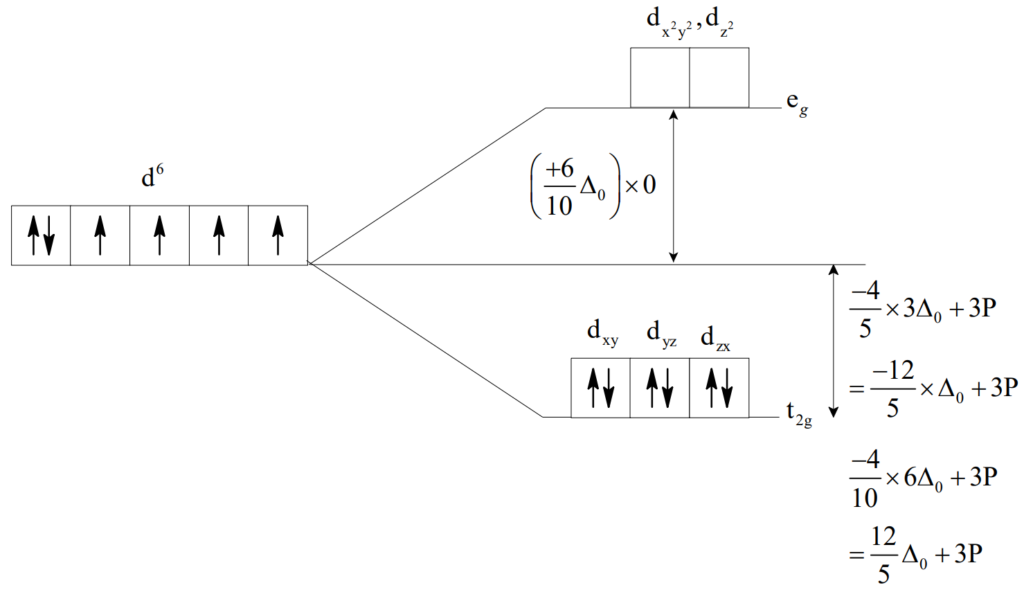
-
Crystal field stabilization energy for high spin $d^4$ octahedral complex isIn an octahedral field the d orbitals split into $t_{2g}$ (each electron stabilised by $-0.4\Delta_0$) and $e_g$ (each electron destabilised by $+0.6\Delta_0$).
High spin $d^4$ means the fourth electron goes to $e_g$ instead of pairing: configuration $t_{2g}^3e_g^1$.
CFSE = $3\times(-0.4\Delta_0) + 1\times(+0.6\Delta_0)$
CFSE = $-1.2\Delta_0 + 0.6\Delta_0$
CFSE = $-0.6\Delta_0$
(No pairing energy term appears, because no electrons are paired.) -
$[Cr(H_2O)_6]Cl_3$ (at. no. of Cr = 24) has a magnetic moment of 3.83 B.M. The correct distribution of 3d electrons in the chromium of the complex is :-In $[Cr(H_2O)_6]Cl_3$ chromium is in the +3 oxidation state. Cr is $[Ar]3d^5 4s^1$, so $Cr^{3+}$ is $3d^3$.
Magnetic moment $\mu = \sqrt{n(n + 2)}$ BM. For $n = 3$: $\mu = \sqrt{15} = 3.87$ BM, which agrees with the observed value of 3.83 BM. So there are three unpaired electrons.
The complex is octahedral. In an octahedral field the five d orbitals split into a lower energy $t_{2g}$ set ($d_{xy}$, $d_{yz}$, $d_{xz}$) and a higher energy $e_g$ set ($d_{x^2-y^2}$, $d_{z^2}$).
The $t_{2g}$ orbitals point between the ligands, so they are lower in energy and are filled first.
The three electrons occupy the three $t_{2g}$ orbitals singly (Hund's rule): $t_{2g}^3\,e_g^0$.
So the distribution is $3d^1_{xy}$, $3d^1_{yz}$, $3d^1_{xz}$.
Valence bond theory
-
The hybridization involved in complex $[Ni(CN)_4]^{2-}$ is (At. No. Ni = 28)

Oxidation state of Ni: $x - 4 = -2 \Rightarrow x = +2$; $Ni^{2+}$: $[Ar]3d^84s^0$
$CN^-$ is a strong field ligand, so the two unpaired 3d electrons pair up, leaving one 3d orbital empty.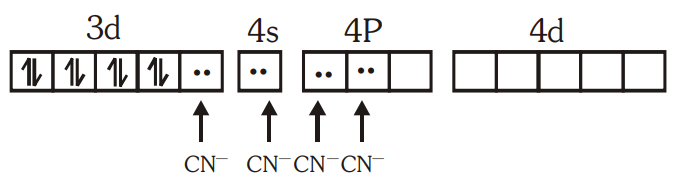
One 3d, one 4s and two 4p orbitals hybridise: $dsp^2$ (square planar). -
Which one of the following is an outer orbital complex and exhibits paramagnetic behaviour?$Ni^{2+}$: $3d^8$. Two vacant 3d orbitals are not available even after pairing, so the 4s, 4p and two 4d orbitals are used: $sp^3d^2$ (outer orbital). It has 2 unpaired electrons, so it is paramagnetic.

$[Co(NH_3)_6]^{3+}$ ($d^6$) is $d^2sp^3$, inner orbital and diamagnetic.
$[Cr(NH_3)_6]^{3+}$ ($d^3$) is $d^2sp^3$, inner orbital.
$[Zn(NH_3)_6]^{2+}$ ($d^{10}$) is outer orbital but diamagnetic.
So $[Ni(NH_3)_6]^{2+}$ is the outer orbital, paramagnetic complex. -
Of the following complex ions, which is diamagnetic in nature?$[Ni(CN)_4]^{2-}$: $Ni^{2+}$ is $3d^8$. $CN^-$ is a strong field ligand and pairs up the 3d electrons, leaving one 3d orbital empty; the hybridisation is $dsp^2$ (square planar) and there are no unpaired electrons, so it is diamagnetic.
$[NiCl_4]^{2-}$: $Ni^{2+}$ is $3d^8$. $Cl^-$ is a weak field ligand, no pairing occurs; hybridisation is $sp^3$ (tetrahedral) with 2 unpaired electrons, so it is paramagnetic.
$[CoF_6]^{3-}$: $Co^{3+}$ is $3d^6$. $F^-$ is a weak field ligand; hybridisation is $sp^3d^2$ with 4 unpaired electrons, so it is paramagnetic.
$[CuCl_4]^{2-}$: $Cu^{2+}$ is $3d^9$ with 1 unpaired electron, so it is paramagnetic.
Hence the diamagnetic ion is $[Ni(CN)_4]^{2-}$. -
Which one of the following is an inner orbital complex as well as diamagnetic in behaviour -An inner orbital complex uses the inner $(n-1)d$ orbitals in hybridisation ($d^2sp^3$); a diamagnetic complex has no unpaired electrons.
$[Co(NH_3)_6]^{3+}$: $Co^{3+}$ is $3d^6$. $NH_3$ pairs up the six electrons in three of the 3d orbitals, leaving two 3d orbitals empty for $d^2sp^3$ hybridisation. So it is an inner orbital, low spin complex with no unpaired electron, i.e. diamagnetic.
$[Zn(NH_3)_6]^{2+}$: $Zn^{2+}$ is $3d^{10}$; no inner d orbital is free, so it would use $sp^3d^2$ (outer orbital), although it is diamagnetic.
$[Ni(NH_3)_6]^{2+}$: $Ni^{2+}$ is $3d^8$; it uses $sp^3d^2$ (outer orbital) hybridisation and has two unpaired electrons, so it is paramagnetic.
$[Cr(NH_3)_6]^{3+}$: $Cr^{3+}$ is $3d^3$; it is an inner orbital ($d^2sp^3$) complex but has three unpaired electrons, so it is paramagnetic.
So the complex that is both inner orbital and diamagnetic is $[Co(NH_3)_6]^{3+}$.
Applications of coordination compounds
-
Red precipitate is obtained when ethanol solution of dimethylglyoxime is added to ammoniacal Ni(II). Which of the following statements is not true?The red precipitate is bis(dimethylglyoximato)nickel(II).
Each dimethylglyoximate ion binds through its two nitrogen atoms (bidentate), and the two ligands are held together by symmetrical O–H···O hydrogen bonds.
$Ni^{2+}$ ($d^8$) is $dsp^2$ hybridised here, so the complex is square planar and diamagnetic.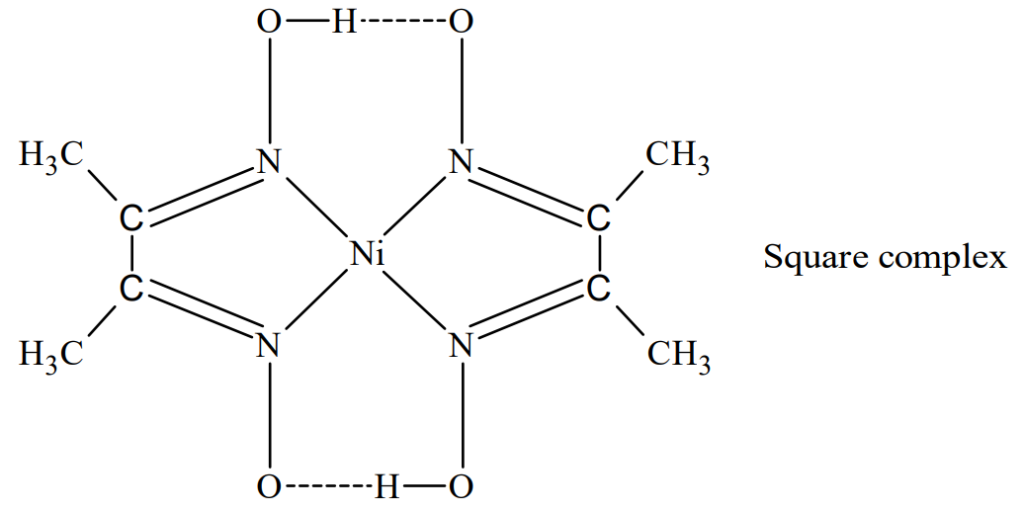
So the statement that it has a tetrahedral geometry is not true.
Magnetic properties of complexes
-
A magnetic moment of 1.73 BM will be shown by one among the following:$\mu = \sqrt{n(n+2)}$ BM = 1.73 gives n = 1 unpaired electron.
$[CoCl_6]^{4-}$: $Co^{2+}$, $d^7$, $Cl^-$ is a weak field ligand, $t_{2g}^5e_g^2$ — 3 unpaired electrons.
$[Cu(NH_3)_4]^{2+}$: $Cu^{2+}$, $d^9$, $dsp^2$ hybridisation — 1 unpaired electron.
$[Ni(CN)_4]^{2-}$: $Ni^{2+}$, $d^8$, $CN^-$ is a strong field ligand, $dsp^2$ — 0 unpaired electrons.
$TiCl_4$: $Ti^{4+}$, $d^0$ — 0 unpaired electrons. -
Which of the following complex compounds will exhibit highest paramagnetic behaviour? (At. No. Ti = 22, Cr = 24, Co = 27, Zn = 30)Paramagnetism increases with the number of unpaired electrons: $\mu = \sqrt{n(n + 2)}$ BM.
$[Co(NH_3)_6]^{3+}$: $Co^{3+}$ is $3d^6$; $NH_3$ causes pairing here ($t_{2g}^6$, inner orbital $d^2sp^3$ complex), so there are 0 unpaired electrons (diamagnetic).
$[Zn(NH_3)_6]^{2+}$: $Zn^{2+}$ is $3d^{10}$, 0 unpaired electrons (diamagnetic).
$[Ti(NH_3)_6]^{3+}$: $Ti^{3+}$ is $3d^1$, 1 unpaired electron.
$[Cr(NH_3)_6]^{3+}$: $Cr^{3+}$ is $3d^3$ ($t_{2g}^3$), 3 unpaired electrons.
Hence $[Cr(NH_3)_6]^{3+}$ shows the highest paramagnetic behaviour. -
The d-electron configurations of $Cr^{2+}$, $Mn^{2+}$, $Fe^{2+}$ and $Co^{2+}$ are $d^4$, $d^5$, $d^6$ and $d^7$ respectively. Which one of the following will exhibit minimum paramagnetic behaviour? (At. nos. Cr = 24, Mn = 25, Fe = 26, Co = 27)$H_2O$ is a weak field ligand, so all these octahedral complexes are high spin and the electrons are not forced to pair.
$Cr^{2+}$ ($d^4$): $t_{2g}^3e_g^1$, 4 unpaired electrons.
$Mn^{2+}$ ($d^5$): $t_{2g}^3e_g^2$, 5 unpaired electrons.
$Fe^{2+}$ ($d^6$): $t_{2g}^4e_g^2$, 4 unpaired electrons.
$Co^{2+}$ ($d^7$): $t_{2g}^5e_g^2$, 3 unpaired electrons.
Paramagnetism increases with the number of unpaired electrons ($\mu = \sqrt{n(n+2)}$ BM).
$[Co(H_2O)_6]^{2+}$ has the fewest unpaired electrons and shows minimum paramagnetic behaviour. -
Atomic number of Cr and Fe are respectively 24 and 26, which of the following is paramagnetic with the spin of electron : -$[Cr(CO)_6]$: Cr(0), $3d^6$ with strong field CO; all electrons pair up ($t_{2g}^6$), diamagnetic.
$[Fe(CO)_5]$: Fe(0), $3d^8$ with CO; all paired, diamagnetic.
$[Fe(CN)_6]^{4-}$: $Fe^{2+}$, $3d^6$ with strong field $CN^-$; low spin $t_{2g}^6$, diamagnetic.
$[Cr(NH_3)_6]^{3+}$: $Cr^{3+}$, $3d^3$. Three electrons occupy the three $t_{2g}$ orbitals singly ($t_{2g}^3$), whatever the ligand strength. So it has 3 unpaired electrons and is paramagnetic ($\mu \approx 3.87$ BM).
So $[Cr(NH_3)_6]^{3+}$ is paramagnetic.
Colour of coordination compounds
-
Which of the following complex ions is not expected to absorb visible light?A complex absorbs visible light (and so appears coloured) when it has unpaired d electrons that can undergo d–d transitions of suitable energy.
$[Ni(CN)_4]^{2-}$: $Ni^{2+}$ is $3d^8$; the strong field ligand $CN^-$ pairs all the electrons ($dsp^2$, square planar), leaving no unpaired electron. With the large splitting it does not absorb in the visible region.
$[Ni(H_2O)_6]^{2+}$: $Ni^{2+}$ ($3d^8$) with a weak field ligand has 2 unpaired electrons; it is green.
$[Cr(NH_3)_6]^{3+}$: $Cr^{3+}$ ($3d^3$) has 3 unpaired electrons; it is coloured.
$[Fe(H_2O)_6]^{2+}$: $Fe^{2+}$ ($3d^6$, high spin) has 4 unpaired electrons; it is pale green.
Hence $[Ni(CN)_4]^{2-}$ is not expected to absorb visible light.
Organometallic Compounds
-
Among the following which is not the $\pi$-bonded organometallic compound :In $\pi$-bonded organometallic compounds, the metal is bonded to the $\pi$ electrons of an unsaturated organic molecule. The symbol $\eta^n$ (hapticity) shows how many carbon atoms are bonded to the metal.
$K[PtCl_3(\eta^2-C_2H_4)]$ (Zeise's salt): Pt is bonded to both carbons of ethylene through its $\pi$ electrons; $\pi$-bonded.
$Fe(\eta^5-C_5H_5)_2$ (ferrocene): Fe is sandwiched between two cyclopentadienyl rings, using their $\pi$ electrons; $\pi$-bonded.
$Cr(\eta^6-C_6H_6)_2$ (dibenzene chromium): Cr is sandwiched between two benzene rings; $\pi$-bonded.
$(CH_3)_4Sn$ (tetramethyltin): each methyl group is attached to Sn by an ordinary Sn–C $\sigma$ bond; it is a $\sigma$-bonded organometallic compound.
So $(CH_3)_4Sn$ is not a $\pi$-bonded organometallic compound.
Crystal Field Theory and Spectrochemical Series
-
$CN^-$ is a strong field ligand. This is due to the fact that :-A strong field ligand produces a large crystal field splitting ($\Delta_o$).
$CN^-$ donates a lone pair from carbon to the metal (a $\sigma$ bond). In addition, it has empty $\pi^*$ antibonding orbitals that can accept electron density back from the filled metal $t_{2g}$ d orbitals (back bonding, $\pi$-acceptor behaviour).
This metal-to-ligand $\pi$ back donation lowers the energy of the $t_{2g}$ orbitals and increases $\Delta_o$. That is why $CN^-$ (like CO) is at the strong end of the spectrochemical series.
Being a pseudohalide or carrying a negative charge does not make a ligand strong field ($Cl^-$ and $F^-$ are negative but weak field). Strong field ligands form low spin complexes, not high spin ones.
So $CN^-$ is a strong field ligand because it can accept electrons from the metal species ($\pi$-acceptor).
Valence Bond Theory: Hybridisation
-
Among $[Ni(CO)_4]$, $[Ni(CN)_4]^{2-}$, $[NiCl_4]^{2-}$ species, the hybridization states at the Ni atom are, respectively :- (At. No. of Ni = 28)Ni (Z = 28): $[Ar]\,3d^8\,4s^2$
$[Ni(CO)_4]$: Ni is in the 0 state. CO is a strong field ligand, so the two 4s electrons are paired into 3d, giving $3d^{10}$. The empty 4s and three 4p orbitals give $sp^3$ hybridisation; tetrahedral and diamagnetic.
$[Ni(CN)_4]^{2-}$: $Ni^{2+} = 3d^8$. $CN^-$ is a strong field ligand, so the eight d electrons pair up into four d orbitals, leaving one 3d orbital empty. One 3d, one 4s and two 4p orbitals give $dsp^2$ hybridisation; square planar and diamagnetic.
$[NiCl_4]^{2-}$: $Ni^{2+} = 3d^8$. $Cl^-$ is a weak field ligand, so no pairing occurs and two electrons stay unpaired. The 4s and three 4p orbitals give $sp^3$ hybridisation; tetrahedral and paramagnetic.
So the hybridisation states are $sp^3$, $dsp^2$ and $sp^3$ respectively.
Applications of Coordination Compounds: Electroplating
-
In the silver plating of copper, $K[Ag(CN)_2]$ is used instead of $AgNO_3$. The reason is : -Copper is more reactive than silver. With $AgNO_3$ solution, copper would directly displace silver: $Cu + 2Ag^+ \rightarrow Cu^{2+} + 2Ag$. This gives a loose, uneven deposit instead of a smooth plating.
In $K[Ag(CN)_2]$, silver is held in the stable complex ion $[Ag(CN)_2]^-$, so the concentration of free $Ag^+$ ions is very low.
Copper cannot displace silver from this complex, and $Ag^+$ is supplied slowly during electrolysis. This gives a smooth, even and firmly adhering coating.
So $K[Ag(CN)_2]$ is used because of less availability of $Ag^+$ ions, as Cu cannot displace Ag from the $[Ag(CN)_2]^-$ ion.
Complex Formation
-
$CuSO_4$ when reacts with KCN forms CuCN, which is insoluble in water. It is soluble in excess of KCN, due to formation of the following complex : -$Cu^{2+}$ first forms $Cu(CN)_2$, which decomposes to insoluble cuprous cyanide and cyanogen:
$2CuSO_4 + 4KCN \rightarrow 2CuCN + (CN)_2 + 2K_2SO_4$
With excess KCN, CuCN dissolves by forming a soluble complex of Cu(I):
$CuCN + 3KCN \rightarrow K_3[Cu(CN)_4]$
In $[Cu(CN)_4]^{3-}$, Cu is +1 and the charge is $+1 + 4(-1) = -3$, balanced by three $K^+$.
So the complex formed is $K_3[Cu(CN)_4]$.
Valence Bond Theory: Magnetic Behaviour
-
Which statement is incorrect : -$Ni(CO)_4$: Ni(0) is $3d^8\,4s^2$. CO is a strong field ligand, so the 4s electrons pair into 3d ($3d^{10}$). $sp^3$ hybridisation gives a tetrahedral, diamagnetic complex.
So '$Ni(CO)_4$ – tetrahedral, paramagnetic' is incorrect, and '$Ni(CO)_4$ – tetrahedral, diamagnetic' is correct.
$[Ni(CN)_4]^{2-}$: $Ni^{2+}$, $3d^8$ with strong field $CN^-$; all electrons pair, $dsp^2$, square planar and diamagnetic; correct.
$[NiCl_4]^{2-}$: $Ni^{2+}$, $3d^8$ with weak field $Cl^-$; two unpaired electrons, $sp^3$, tetrahedral and paramagnetic; correct.
So the incorrect statement is '$Ni(CO)_4$ – tetrahedral, paramagnetic'.
That is every question in Coordination Compounds for this filter.
Want a score?
Answers here are not saved. Practise as a test to be marked and see your progress.
Practise as a test