Looking for classes? Ksquare Career Institute, Bengaluru →

Chemistry
Coordination Compounds
104 questions from 38 papers, each with its answer.
- 104 questions
- 38 papers
- 5.91% of Chemistry
Magnetic Properties and Hybridisation
-
Which of the following are paramagnetic?
A. $[\text{NiCl}_4]^{2-}$
B. $\text{Ni(CO)}_4$
C. $[\text{Ni(CN)}_4]^{2-}$
D. $[\text{Ni(H}_2\text{O)}_6]^{2+}$
E. $\text{Ni(PPh}_3)_4$
Choose the correct answer from the options given below:$[\text{NiCl}_4]^{2-}$ (tetrahedral, $sp^3$) and $[\text{Ni(H}_2\text{O)}_6]^{2+}$ (octahedral, $sp^3d^2$) both have two unpaired electrons ($d^8$ high-spin) and are paramagnetic.
$\text{Ni}^{2+}$ has $3d^8$ electronic configuration. With weak field ligands: $[\text{NiCl}_4]^{2-}$ is tetrahedral ($sp^3$) with 2 unpaired electrons (paramagnetic); $[\text{Ni(H}_2\text{O)}_6]^{2+}$ is octahedral ($sp^3d^2$) with 2 unpaired electrons (paramagnetic). With strong field ligand: $[\text{Ni(CN)}_4]^{2-}$ undergoes pairing to form square planar ($dsp^2$) low-spin with 0 unpaired electrons (diamagnetic). For $\text{Ni}(0)$ complexes $\text{Ni(CO)}_4$ and $\text{Ni(PPh}_3)_4$, configuration is $3d^{10}$ (all paired, diamagnetic). Thus only A and D are paramagnetic.
Werner's Theory and Electrolytic Conductance
-
Out of the following complex compounds, which of the compound will be having the minimum conductance in solution?
$[\text{Co(NH}_3)_3\text{Cl}_3]$ is a neutral coordination complex that does not ionize in water, giving minimum electrical conductance.
Electrical conductance in aqueous solution is directly proportional to the number of free ions produced per formula unit. $[\text{Co(NH}_3)_6]\text{Cl}_3$ produces 4 ions; $[\text{Co(NH}_3)_5\text{Cl}]\text{Cl}_2$ produces 3 ions; $[\text{Co(NH}_3)_4\text{Cl}_2]\text{Cl}$ produces 2 ions. $[\text{Co(NH}_3)_3\text{Cl}_3]$ is a neutral non-electrolyte complex that does not dissociate into ions in water, exhibiting minimum (near zero) electrical conductance.
Homoleptic and Heteroleptic Complexes
-
Given below are two statements: Statement I: $[Co(NH_3)_6]^{3+}$ is a homoleptic complex whereas $[Co(NH_3)_4Cl_2]^{+}$ is a heteroleptic complex. Statement II: Complex $[Co(NH_3)_6]^{3+}$ has only one kind of ligands but $[Co(NH_3)_4Cl_2]^{+}$ has more than one kind of ligands. In the light of the above statements, choose the correct answer from the options given below:$[Co(NH_3)_6]^{3+}$ has only one type of ligand ($NH_3$), so it is a homoleptic complex. $[Co(NH_3)_4Cl_2]^+$ has more than one type of ligand ($NH_3$ and $Cl^-$), so it is a heteroleptic complex. So both Statement I and Statement II are true.
Isomerism in Coordination Compounds
-
The type of isomerism shown by the complex $[CoCl_2(en)_2]$ is
$[MA_2(AA)_2]$ octahedral complexes show cis–trans isomerism.
In $[CoCl_2(en)_2]$, the coordination number of Co is 6 and the compound has octahedral geometry. [add image: cis and trans isomers of $[CoCl_2(en)_2]$] Among the given options, the type of isomerism shown is geometrical isomerism. -
The complexes $[Co(NH_3)_6][Cr(CN)_6]$ and $[Cr(NH_3)_6][Co(CN)_6]$ are the examples of which type of isomerism?In both compounds the cation and the anion are complex ions.
In the first, $NH_3$ ligands are bound to Co and $CN^-$ ligands to Cr; in the second, $NH_3$ ligands are bound to Cr and $CN^-$ ligands to Co.
The ligands have been interchanged between the cationic and anionic coordination entities of the two different metal ions.
This type of isomerism is called coordination isomerism.
Linkage isomerism needs an ambidentate ligand bound through different atoms, and ionisation isomerism involves exchange of a ligand with the counter ion, which is not the case here. -
The existence of two different coloured complexes with the composition of $[Co(NH_3)_4Cl_2]^+$ is due to$[Co(NH_3)_4Cl_2]^+$ is an octahedral complex of the type $[MA_4B_2]$.
The two $Cl^-$ ligands can occupy adjacent positions ($90^\circ$ apart, cis isomer) or opposite positions ($180^\circ$ apart, trans isomer).
These are geometrical isomers; the cis form is violet and the trans form is green.
Ionisation isomerism needs exchange of a ligand with a counter ion, linkage isomerism needs an ambidentate ligand, and coordination isomerism needs both cation and anion to be complexes; none applies to this single complex ion.
Hence the two coloured forms are due to geometrical isomerism.
Nomenclature and Types of Complexes
-
Homoleptic complex from the following complexes is:
A homoleptic complex has only one kind of ligand.
Homoleptic complexes have all ligands identical. Potassium trioxalatoaluminate (III) is $K_3[Al(C_2O_4)_3]$ which has only oxalate ion as ligand. All others have more than one type of ligands.
Ligands – Denticity
-
Ethylene diaminetetraacetate (EDTA) ion is:EDTA ion has two N donor atoms and four $-COO^-$ (O) donor atoms.
So it is a hexadentate ligand with four 'O' and two 'N' donor atoms.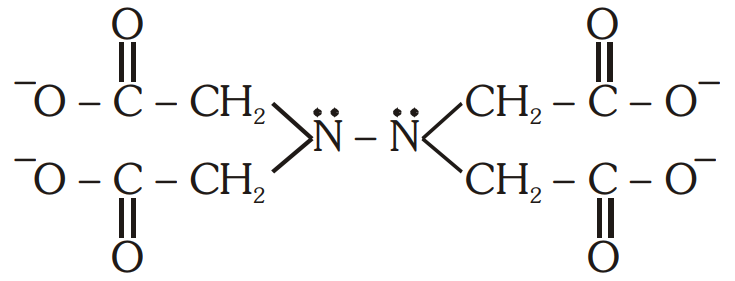
Types of ligands - ambidentate ligands
-
Which one of the following is an ambidentate ligand?Ambidentate ligand: has more than one donor atom but at a time only one can form a coordinate bond with the central metal atom. Thiocyanate can bind through S ($SCN^-$) or through N ($NCS^-$), so it is ambidentate.
Structural isomerism in coordination compounds
-
Match List - I (Complexes) with List - II (Types). Choose the correct answer.
Pick the matching item from Column II for each row.
Column I
- A. $[Co(NH_3)_5NO_2]Cl_2$ and $[Co(NH_3)_5ONO]Cl_2$
- B. $[Cr(NH_3)_6][Co(CN)_6]$ and $[Cr(CN)_6][Co(NH_3)_6]$
- C. $[Co(NH_3)_5(SO_4)]Br$ and $[Co(NH_3)_5Br]SO_4$
- D. $[Cr(H_2O)_6]Cl_3$ and $[Cr(H_2O)_5Cl]Cl_2\cdot H_2O$
Column II
- I. ionisation isomerism
- II. coordination isomerism
- III. linkage isomerism
- IV. solvate isomerism
Correct answer: A → III, B → II, C → I, D → IV
(a) $NO_2^-$ vs $ONO^-$ bonding: linkage isomerism (ambidentate ligand). (b) Exchange of ligands between cationic and anionic coordination spheres: coordination isomerism. (c) Different ions formed on ionisation: ionisation isomerism. (d) Water present as ligand vs water of crystallisation: solvate (hydrate) isomerism.
Optical isomerism in complexes
-
Which one of the following is expected to exhibit optical isomerism ?
(en = ethylenediamine)A complex shows optical isomerism if it has no plane of symmetry, so that its mirror image cannot be superimposed on it.
cis-$[Co(en)_2Cl_2]^+$ is octahedral with the two chloride ions adjacent to each other; the two en rings are arranged like the blades of a propeller.
It has no plane of symmetry, so it exists as a pair of enantiomers (d and l forms).
trans-$[Co(en)_2Cl_2]^+$ has the two chloride ions opposite each other and has a plane of symmetry, so it is optically inactive.
$[Pt(NH_3)_2Cl_2]$ is square planar; both its cis and trans forms lie in a plane, which is a plane of symmetry, so neither is optically active.
So the complex expected to exhibit optical isomerism is cis-$[Co(en)_2Cl_2]$.
Spectrochemical series
-
According to crystal field theory, the correct order of ligands with respect to their decreasing order of field strength isSpectrochemical series (decreasing field strength): $CO>NH_3>H_2O>Cl^-$.
IUPAC nomenclature of coordination compounds
-
The formula of tetraammineaquachloridocobalt(III) chloride isTetraammine = $(NH_3)_4$, aqua = $H_2O$, chlorido = Cl as ligands; cobalt(III) needs two chloride counter ions: $[Co(NH_3)_4(H_2O)Cl]Cl_2$.
Geometrical isomerism - fac and mer
-
The complex which has facial and meridional isomers is (Given: py = pyridine and en = $H_2N-CH_2-CH_2-NH_2$)$[Cr(py)_3Cl_3]$ is of the type $[Ma_3b_3]$, which shows facial and meridional isomers.
Werner's theory - ionisation
-
A 1 : 3 electrolyte in an aqueous solution is$[Co(NH_3)_6]Cl_3\rightarrow[Co(NH_3)_6]^{3+}+3Cl^-$, a 1 : 3 electrolyte.
Metal carbonyls
-
Iron carbonyl, $Fe(CO)_5$ is
One Fe atom per molecule means mononuclear.
Based on the number of metal atoms present in a complex, they are classified into mononuclear, dinuclear, trinuclear and so on. e.g. $Fe(CO)_5$: mononuclear; $Co_2(CO)_8$: dinuclear; $Fe_3(CO)_{12}$: trinuclear So $Fe(CO)_5$ is mononuclear. -
Shape of $Fe(CO)_5$ is :In $Fe(CO)_5$, Fe is in the zero oxidation state: $[Ar]\,3d^6\,4s^2$. With strong field CO, the electrons pair up to give $3d^8$, leaving one 3d, one 4s and three 4p orbitals for bonding.
These form five $dsp^3$ hybrid orbitals, which accept lone pairs from five CO ligands.
$dsp^3$ hybridisation gives a trigonal bipyramidal shape (3 equatorial and 2 axial CO groups). The complex is diamagnetic.
So the shape of $Fe(CO)_5$ is trigonal bipyramidal.
Valence bond theory – hybridisation and magnetism
-
The geometry and magnetic behaviour of the complex $[Ni(CO)_4]$ are
$Ni(0)$, $3d^{10}$, $sp^3$ → tetrahedral and diamagnetic.
$Ni(28) : [Ar]\,3d^8 4s^2$
$\because$ CO is a strong field ligand, the 4s electrons pair into 3d, giving $3d^{10}$.
For four CO ligands the hybridisation is $sp^3$, and thus the complex is diamagnetic with tetrahedral geometry.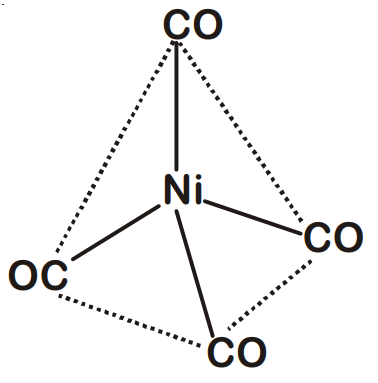
Werner's theory – ionisable chloride
-
The correct order of the stoichiometries of AgCl formed when $AgNO_3$ in excess is treated with the complexes: $CoCl_3\cdot6NH_3$, $CoCl_3\cdot5NH_3$, $CoCl_3\cdot4NH_3$ respectively is
Only counter-ion chlorides precipitate with $AgNO_3$.
The complexes are respectively $[Co(NH_3)_6]Cl_3$, $[Co(NH_3)_5Cl]Cl_2$ and $[Co(NH_3)_4Cl_2]Cl$. Only ionisable (outside-sphere) $Cl^-$ precipitates as AgCl: 3, 2 and 1 respectively.
Organometallic compounds – sigma and pi bonded
-
An example of a sigma bonded organometallic compound is:
RMgX has a Mg–C $\sigma$ bond.
Grignard's reagent, i.e. RMgX, is a $\sigma$-bonded organometallic compound (the others are $\pi$-bonded sandwich compounds).
Valence bond theory – hybridisation and geometry
-
Pick out the correct statement with respect $[Mn(CN)_6]^{3-}$:
Strong-field $CN^-$ pairs electrons leaving two inner d orbitals for $d^2sp^3$.
In $[Mn(CN)_6]^{3-}$, Mn(III) $= [Ar]\,3d^4$
$CN^-$, being a strong field ligand, forces pairing of electrons, giving $t_{2g}^4e_g^0$.
$\because$ Coordination number of Mn = 6, the hybridisation is $d^2sp^3$ and the structure is octahedral.
Werner's theory
-
Cobalt (III) chloride forms several octahedral complexes with ammonia. Which of the following will not give test for chloride ions with silver nitrate at $25^\circ C$?$CoCl_3\cdot 3NH_3$ is $[Co(NH_3)_3Cl_3]$: all three chlorides are coordinated inside the sphere.
No chloride ion is ionisable, so $[Co(NH_3)_3Cl_3] \xrightarrow{AgNO_3}$ no precipitate.
Crystal field theory
-
In which of the following co-ordination entities the magnitude of $\Delta_0$ (CFSE in octahedral field) will be maximum ?
(Atomic number of Co = 27)In all four complexes cobalt is in the +3 oxidation state ($3d^6$) in an octahedral field, so the metal ion and the geometry are the same.
The CFSE in an octahedral field then depends only upon the nature of the ligands: stronger the ligand, larger will be the value of $\Delta_{oct}$.
Spectrochemical series (increasing field strength): $I^- \lt Br^- \lt Cl^- \lt F^- \lt OH^- \lt C_2O_4^{2-} \lt H_2O \lt NH_3 \lt en \lt CN^- \lt CO$
Among the given ligands the order of field strength is: $C_2O_4^{2-} \lt H_2O \lt NH_3 \lt CN^-$
$CN^-$ is the strongest field ligand here, so it causes the largest splitting.
Hence $\Delta_0$ is maximum for $[Co(CN)_6]^{3-}$. -
Considering $H_2O$ as a weak field ligand, the number of unpaired electrons in $[Mn(H_2O)_6]^{2+}$ will be – (At. no. of Mn = 25)Electronic configuration of Mn (Z = 25): $[Ar]\,3d^5\,4s^2$
In $[Mn(H_2O)_6]^{2+}$, Mn is in the +2 state: $Mn^{2+} = [Ar]\,3d^5$
$H_2O$ is a weak field ligand, so the crystal field splitting $\Delta_o$ is smaller than the pairing energy. Electrons occupy the $t_{2g}$ and $e_g$ orbitals singly before pairing (high spin).
Configuration: $t_{2g}^3\,e_g^2$, with all five electrons unpaired.
So the number of unpaired electrons is five (magnetic moment about 5.92 BM).
IUPAC nomenclature of complexes
-
The name of complex ion, $[Fe(CN)_6]^{3-}$ is:Six cyanide ligands → hexacyanido; anionic complex of iron → ferrate; oxidation state of Fe = +3.
Name: hexacyanidoferrate(III) ion.
Valence bond theory
-
In an octahedral structure, the pair of d orbitals involved in $d^2sp^3$ hybridization is :-In an octahedral complex the six ligands approach the metal along the $\pm x$, $\pm y$ and $\pm z$ axes.
The hybrid orbitals must point along these axes. Among the d orbitals, only $d_{x^2-y^2}$ (lobes along x and y axes) and $d_{z^2}$ (lobes along the z axis) point along the axes.
$d_{xy}$, $d_{yz}$ and $d_{xz}$ have their lobes between the axes, so they are not used.
So in $d^2sp^3$ hybridization the two d orbitals are $d_{x^2-y^2}$ and $d_{z^2}$ (together with one s and three p orbitals).
Coordination number and oxidation state
-
The sum of coordination number and oxidation number of the metal M in the complex $[M(en)_2(C_2O_4)]Cl$ (where en is ethylenediamine) is:Oxidation state: $x + 0 - 2 = +1 \Rightarrow x = +3$
Coordination number: two en (bidentate) + one oxalate (bidentate) = 6
Sum = 3 + 6 = 9
Applications of coordination compounds
-
Which of the following complexes is used to be as an anticancer agent?$cis\text{-}[PtCl_2(NH_3)_2]$ (cisplatin) is used as an anticancer agent.
Magnetic properties of complexes
-
The d electron configurations of $Cr^{2+}$, $Mn^{2+}$, $Fe^{2+}$ and $Ni^{2+}$ are $3d^4$, $3d^5$, $3d^6$ and $3d^8$ respectively. Which one of the following aqua complexes will exhibit the minimum paramagnetic behaviour?
(At. No. Cr = 24, Mn = 25, Fe = 26, Ni = 28)Lesser the number of unpaired electrons, smaller will be the paramagnetic behaviour ($\mu = \sqrt{n(n + 2)}$ BM).
$H_2O$ is a weak field ligand, so no pairing of electrons takes place and the complexes are high spin; the number of unpaired electrons is the same as in the free ion.
$Cr^{2+}$ ($3d^4$) = 4 unpaired electrons
$Mn^{2+}$ ($3d^5$) = 5 unpaired electrons
$Fe^{2+}$ ($3d^6$) = 4 unpaired electrons
$Ni^{2+}$ ($3d^8$) = 2 unpaired electrons
As $Ni^{2+}$ has the minimum number of unpaired electrons, $[Ni(H_2O)_6]^{2+}$ is the least paramagnetic.
Colour of coordination compounds
-
Which of the following complex ions is expected to absorb visible light? (At. no. Zn = 30, Sc = 21, Ti = 22, Cr = 24)A complex absorbs visible light when the metal ion has a partly filled d subshell, so that d–d transitions are possible.
$Zn^{2+}$: $3d^{10}$, completely filled; no d–d transition, colourless.
$Sc^{3+}$: $3d^0$; no d electrons, colourless.
$Ti^{4+}$: $3d^0$; no d electrons, colourless.
$Cr^{3+}$: $3d^3$, with three unpaired electrons in $t_{2g}$; $t_{2g} \rightarrow e_g$ transitions absorb visible light.
Hence $[Cr(NH_3)_6]^{3+}$ is expected to absorb visible light.
Isomerism
-
Which one of the following pairs represents stereoisomerism :-Isomerism is broadly of two kinds: structural isomerism and stereoisomerism.
Structural isomers differ in the way the atoms are connected; chain isomerism, linkage isomerism, ionisation isomerism and so on are types of structural isomerism.
Stereoisomers have the same connectivity of atoms but differ in the spatial arrangement of the atoms or groups.
The two types of stereoisomerism are geometrical isomerism (cis-trans) and optical isomerism (non-superimposable mirror images).
So the pair that represents stereoisomerism is optical isomerism and geometrical isomerism.
Organometallic Compounds
-
Which of the following does not have a metal-carbon bond :-An organometallic compound contains at least one direct metal-carbon bond.
$C_2H_5MgBr$ (Grignard reagent): the ethyl group is attached directly to Mg, so there is a Mg–C bond.
$K[Pt(C_2H_4)Cl_3]$ (Zeise's salt): ethylene is bonded to Pt through its $\pi$ electrons, so Pt–C bonding is present.
$Ni(CO)_4$ (nickel tetracarbonyl): each CO is bonded to Ni through carbon, so there are Ni–C bonds.
$Al(OC_2H_5)_3$ (aluminium ethoxide): each ethyl group is attached to oxygen, and oxygen is attached to Al. The linkage is Al–O–C, so there is no direct Al–C bond.
So aluminium ethoxide, $Al(OC_2H_5)_3$, does not have a metal-carbon bond.
Importance and Applications of Coordination Compounds
-
Which of the following is considered to be an anticancer species :-The anticancer drug cisplatin is cis-diamminedichloridoplatinum(II), cis-$[Pt(NH_3)_2Cl_2]$.
It is a square planar complex in which the two $NH_3$ ligands are adjacent (cis) and the two $Cl^-$ ligands are adjacent.
Inside the cell the Cl ligands are replaced by water, and the platinum binds to two neighbouring guanine bases of DNA. This cross-linking distorts the DNA and stops replication of the rapidly dividing cancer cells.
The trans isomer cannot bind to two neighbouring bases in this way and is not an effective anticancer drug.
$[PtCl_4]^{2-}$ and Zeise's salt anion $[PtCl_3(C_2H_4)]^-$ are not used as anticancer drugs.
So the anticancer species is the cis isomer of $[Pt(NH_3)_2Cl_2]$ (cisplatin).
Crystal Field Theory: High Spin Complexes
-
The number of unpaired electrons in the complex ion $[CoF_6]^{3-}$ is : (At. No. of Co = 27)Co (Z = 27): $[Ar]\,3d^7\,4s^2$
In $[CoF_6]^{3-}$: $x + 6(-1) = -3 \Rightarrow x = +3$. $Co^{3+} = [Ar]\,3d^6$.
$F^-$ is a weak field ligand, so $\Delta_o$ is less than the pairing energy. The electrons occupy the orbitals singly first (high spin): $t_{2g}^4\,e_g^2$.
In $t_{2g}^4$ one orbital is doubly filled and two are singly filled; both $e_g$ orbitals are singly filled. Unpaired electrons $= 2 + 2 = 4$.
($[CoF_6]^{3-}$ is an outer orbital $sp^3d^2$ complex and is paramagnetic.)
So the number of unpaired electrons is 4.
Geometrical Isomerism
-
Which one of the following octahedral complexes will not show geometric isomerism ? (A and B are monodentate ligands)$[MA_4B_2]$ and $[MA_2B_4]$: the two identical minority ligands can be adjacent (cis) or opposite (trans), so they show cis–trans isomerism.
$[MA_3B_3]$: the three A ligands can lie on one face of the octahedron (facial, fac) or along a meridian (mer), so it shows fac–mer isomerism.
$[MA_5B]$: there is only one B ligand. Whichever of the six positions it occupies, all arrangements are identical, so there is only one form.
So $[MA_5B]$ will not show geometric isomerism.
Importance of Coordination Compounds in Biological Systems
-
Vitamin $B_{12}$ contains :Vitamin $B_{12}$ (cyanocobalamin) is a coordination compound of cobalt.
The cobalt is held in a corrin ring (similar to a porphyrin ring) by four nitrogen atoms, with a cyanide group and a nitrogen base as the other two ligands.
Cobalt is in the +3 oxidation state, Co(III).
Iron is present in haemoglobin, magnesium in chlorophyll, zinc in carbonic anhydrase.
So vitamin $B_{12}$ contains Co(III).
Writing Formulas from IUPAC Names
-
The hypothetical complex chlorodiaquatriamminecobalt (III) chloride can be represented as : -Ligands in the name: chloro (one $Cl^-$), diaqua (two $H_2O$), triammine (three $NH_3$). Total coordination number $= 1 + 2 + 3 = 6$.
Co is in the +3 state. Charge on the complex ion $= +3 + (-1) + 0 + 0 = +2$.
So two $Cl^-$ ions are needed outside the coordination sphere to balance the charge (the word 'chloride' at the end).
Formula: $[CoCl(NH_3)_3(H_2O)_2]Cl_2$
Coordination Number and Denticity
-
Coordination number of Ni in $[Ni(C_2O_4)_3]^{4-}$ isThe oxalate ion, $C_2O_4^{2-}$, is a bidentate ligand: it binds to the metal through two oxygen atoms.
There are three oxalate ligands, each forming two bonds with Ni.
Coordination number $= 3 \times 2 = 6$
(Charge check: $x + 3(-2) = -4 \Rightarrow x = +2$, so Ni is $Ni^{2+}$.)
Ionisation of Complexes
-
Which of the following will exhibit maximum ionic conductivity : -Ionic conductivity increases with the number of ions (and charges) produced in solution.
$K_4[Fe(CN)_6] \rightarrow 4K^+ + [Fe(CN)_6]^{4-}$: 5 ions
$[Co(NH_3)_6]Cl_3 \rightarrow [Co(NH_3)_6]^{3+} + 3Cl^-$: 4 ions
$[Cu(NH_3)_4]Cl_2 \rightarrow [Cu(NH_3)_4]^{2+} + 2Cl^-$: 3 ions
$[Ni(CO)_4]$ is a neutral complex and gives no ions.
So $K_4[Fe(CN)_6]$ exhibits the maximum ionic conductivity.
That is every question in Coordination Compounds for this filter.
Want a score?
Answers here are not saved. Practise as a test to be marked and see your progress.
Practise as a test