Looking for classes? Ksquare Career Institute, Bengaluru →

Chemistry
Chemical Bonding and Molecular Structure
108 questions from 38 papers, each with its answer.
- 108 questions
- 38 papers
- 6.14% of Chemistry
Molecular Orbital Theory - Bond Order
-
Given below are two statements:
Statement I: A hypothetical diatomic molecule with bond order zero is quite stable.
Statement II: As bond order increases, the bond length increases.
In the light of the above statements, choose the most appropriate answer from the options given below:Both statements are false: bond order zero implies no chemical bond (molecule does not exist), and bond length is inversely proportional to bond order.
In Molecular Orbital Theory, a bond order of zero indicates that bonding electrons equal antibonding electrons, meaning no net attractive bonding exists and the molecule is completely unstable/does not exist (Statement I is false). As bond order increases, atoms are pulled closer by stronger shared electron density, so bond length decreases (Statement II is false). Hence, both statements are false. -
Identify a molecule which does not exist.$He_2$: electronic configuration $\sigma 1s^2\,\sigma^*1s^2$ Bond order $= \frac{1}{2}(N_b - N_a) = \frac{1}{2}(2 - 2) = 0$ Since the bond order is zero, the $He_2$ molecule does not exist.
-
Which one of the following pairs of species have the same bond order?
14-electron species have bond order 3.
$CN^-$ and CO have bond order 3 each (both are isoelectronic with $N_2$, 14 electrons).
Molecular Orbital Theory
-
The highest occupied molecular orbital for $Ne_2$ is$Ne_2$ has 20 electrons: $\sigma1s^2\,\sigma^*1s^2\,\sigma2s^2\,\sigma^*2s^2\,\sigma2p_z^2\,\pi2p_x^2=\pi2p_y^2\,\pi^*2p_x^2=\pi^*2p_y^2\,\sigma^*2p_z^2$. The highest occupied molecular orbital (HOMO) is $\sigma^*2p_z$.
-
Which of the following options represents the correct bond order?Bond orders: $O_2^-$ = 1.5, $O_2$ = 2, $O_2^+$ = 2.5
So $O_2^- < O_2 < O_2^+$. -
Decreasing order of stability of $O_2$, $O_2^-$, $O_2^+$ and $O_2^{2-}$ is:Electrons: $O_2^+$ = 15, $O_2$ = 16, $O_2^-$ = 17, $O_2^{2-}$ = 18
Bond orders: $O_2^+$ = 2.5, $O_2$ = 2, $O_2^-$ = 1.5, $O_2^{2-}$ = 1
Stability ∝ bond order, so $O_2^+ > O_2 > O_2^- > O_2^{2-}$ -
Which of the following is paramagnetic?$O_2^-$ has 17 electrons, with one unpaired electron in an antibonding $\pi^*$ molecular orbital, so it is paramagnetic.
$NO^+$, CO and $CN^-$ each have 14 electrons, all paired. -
Bond order of 1.5 is shown by:Bond order $= \frac{1}{2}(N_b - N_a)$
$O_2$ (16 e⁻): $\frac{1}{2}(10 - 6) = 2$
$O_2^+$ (15 e⁻): $\frac{1}{2}(10 - 5) = 2.5$
$O_2^-$ (17 e⁻): $\frac{1}{2}(10 - 7) = 1.5$
$O_2^{2-}$ (18 e⁻): $\frac{1}{2}(10 - 8) = 1$
So $O_2^-$ has bond order 1.5. -
During change of $O_2$ to $O_2^-$ ion, the electron adds on which one of the following orbitals?$O_2$ (16 e⁻): $\sigma1s^2\,\sigma^*1s^2\,\sigma2s^2\,\sigma^*2s^2\,\sigma2p_z^2\,\pi2p_x^2 = \pi2p_y^2\,\pi^*2p_x^1 = \pi^*2p_y^1$
The $\pi^*2p$ orbitals are only half filled, so the extra electron of $O_2^-$ enters a $\pi^*$ orbital.
Intermolecular Forces
-
Intermolecular forces are forces of attraction and repulsion between interacting particles that will include: A. dipole-dipole forces. B. dipole - induced dipole forces, C. hydrogen bonding. D. covalent bonding. E. dispersion forces. Choose the most appropriate answer from the options given below:
Covalent bonding is not an intermolecular force.
Covalent bonding is NOT an intermolecular force while rest all are considered as intermolecular forces.
VSEPR Theory
-
Which one of the following species has plane triangular shape?$NO_3^-$ has $sp^2$ hybridisation with no lone pair on N, so it is plane triangular.
-
$XeF_2$ is isostructural with:$XeF_2$ is $sp^3d$ hybridised with three lone pairs and is linear.
$ICl_2^-$ also has $sp^3d$ hybridisation with three lone pairs on iodine and is linear, so the two are isostructural. -
Which of the following species contains three bond pairs and one lone pair around the central atom?$PCl_3$: P has 5 valence electrons; 3 form bonds with Cl and 2 remain as one lone pair → 3 bond pairs + 1 lone pair.
$H_2O$: 2 bond pairs + 2 lone pairs.
$BF_3$: 3 bond pairs + 0 lone pairs.
$NH_2^-$: 2 bond pairs + 2 lone pairs.
So the species is $PCl_3$.
Hybridisation and Octet Rule Exceptions
-
$BF_3$ is planar and electron deficient compound. Hybridization and number of electrons around the central atom, respectively are:In $BF_3$, B forms three B–F bonds with no lone pair: $sp^2$ hybridised, trigonal planar. Number of electrons around B = 3 × 2 = 6 (electron deficient).
VSEPR Theory – Shapes of Molecules
-
Identify the incorrect statement related to $PCl_5$ from the following:$PCl_5$ has trigonal bipyramidal geometry. Three equatorial P–Cl bonds make an angle of $120^\circ$ with each other – true. Two axial P–Cl bonds make an angle of $180^\circ$ with each other – true. Axial bonds (240 pm) are longer than equatorial bonds (202 pm) – true. Due to the longer and hence weaker axial bonds, $PCl_5$ is a reactive molecule. So \"$PCl_5$ molecule is non-reactive\"" is the incorrect statement."
Dipole Moment
-
Which of the following molecules has the maximum dipole moment?$CO_2$ and $CH_4$ are symmetrical, so $\mu = 0$.
In $NH_3$ the bond dipoles add to the lone pair moment ($\mu$ = 1.4 D); in $NF_3$ they oppose it ($\mu$ = 0.23 D).
So $NH_3$ has the maximum dipole moment. -
Which of the following is a polar molecule?An unsymmetrical distribution of the electron cloud makes a molecule polar.
$XeF_4$ (square planar), $BF_3$ (trigonal planar) and $SiF_4$ (tetrahedral) are symmetrical, $\mu = 0$.
$SF_4$ has a see-saw shape with one lone pair, so $\mu \ne 0$.
VSEPR theory - molecular shapes
-
Match List - I (molecules) with List - II (shape). Choose the correct answer.
Pick the matching item from Column II for each row.
Column I
- A. $NH_3$
- B. $ClF_3$
- C. $PCl_5$
- D. $BrF_5$
Column II
- I. square pyramidal
- II. trigonal bipyramidal
- III. trigonal pyramidal
- IV. T-shape
Correct answer: A → III, B → IV, C → II, D → I
$NH_3\rightarrow$ trigonal pyramidal; $ClF_3\rightarrow$ T-shape; $PCl_5\rightarrow$ trigonal bipyramidal; $BrF_5\rightarrow$ square pyramidal.
Bond angles and lone pair repulsion
-
The correct order of bond angles in the following compounds/species is:$CO_2$: $180^\circ$; $NH_4^+$: $109.5^\circ$; $NH_3$: $107^\circ$ (one lone pair on N); $H_2O$: $104.5^\circ$ (two lone pairs on O). Lone pair-lone pair repulsion decreases the angle in water the most.
Molecular orbital theory - magnetic behaviour
-
Which of the following is paramagnetic?According to MOT, $O_2$ has two unpaired electrons in the $\pi^*2p$ orbitals and is paramagnetic; $N_2$, $H_2$ and $Li_2$ have all electrons paired.
-
Which species does not exhibit paramagnetism :Paramagnetism requires unpaired electrons.
$N_2^+$ (13 electrons), $O_2^-$ (17 electrons) and NO (15 electrons) have an odd number of electrons, so each has an unpaired electron and is paramagnetic.
CO has 14 electrons (isoelectronic with $N_2$), all paired in its molecular orbitals, so it is diamagnetic.
So CO does not exhibit paramagnetism.
VSEPR theory - shapes
-
Match the species in List-I with their geometry in List-II.
Pick the matching item from Column II for each row.
Column I
- A. $PCl_5$
- B. $BrF_5$
- C. $BF_4^-$
- D. $[Ni(CN)_4]^{2-}$
Column II
- I. Tetrahedral
- II. Square Planar
- III. Trigonal bipyramidal
- IV. Square pyramidal
Correct answer: A → III, B → IV, C → I, D → II
(A) $PCl_5$: $sp^3d$, trigonal bipyramidal. (B) $BrF_5$: $sp^3d^2$ with 1 lone pair, square pyramidal. (C) $BF_4^-$: $sp^3$, tetrahedral. (D) $[Ni(CN)_4]^{2-}$: $dsp^2$, square planar.
VSEPR theory – shape of interhalogen compounds
-
In the structure of $ClF_3$, the number of lone pair of electrons on central atom 'Cl' is
$ClF_3$ is $sp^3d$ with 3 bond pairs and 2 lone pairs (T-shaped).
Cl has 7 valence electrons; 3 are used in bonding with F, leaving 4 electrons = 2 lone pairs.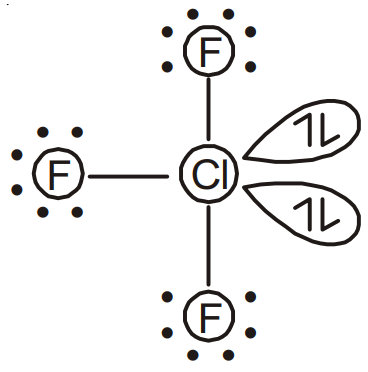
The number of lone pairs of electrons on central Cl is 2.
Isoelectronic and isostructural species – VSEPR
-
Which of the following pairs of compounds is isoelectronic and isostructural?
Both have 3 lone pairs and 2 bond pairs on the central atom (linear).
$IBr_2^-$ and $XeF_2$: the total number of valence electrons is equal in both species and both are linear.
VSEPR theory – shapes and bond angles
-
The species, having bond angles of $120^\circ$ is
$BCl_3$ is $sp^2$ trigonal planar.
$BCl_3$ is trigonal planar ($sp^2$ B, no lone pair), with Cl–B–Cl bond angles of $120^\circ$.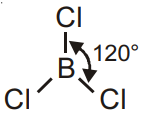
VSEPR theory – order of repulsions
-
Predict the correct order among the following.
lp–lp > lp–bp > bp–bp.
According to VSEPR theory, lone pairs of electrons are more diffused than bond pairs. So the order of repulsion is: lone pair–lone pair > lone pair–bond pair > bond pair–bond pair.
VSEPR – bond angles
-
Consider the molecules $CH_4$, $NH_3$ and $H_2O$. Which of the given statements is false?
Bond angle: $CH_4$ > $NH_3$ > $H_2O$.
Lone pairs are more diffused than bond pairs. According to VSEPR theory, repulsion order: lp–lp > lp–bp > bp–bp.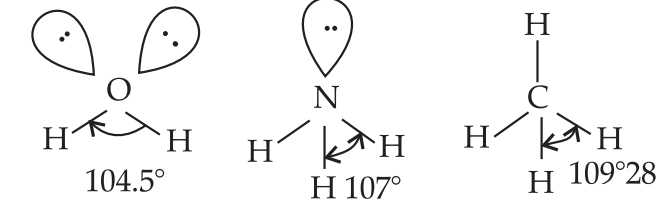
Therefore the H–O–H bond angle in $H_2O$ (104.5°) is smaller than the H–C–H bond angle in $CH_4$ (109°28'), so the first statement is false.
Hybridisation of nitrogen species
-
The hybridizations of atomic orbitals of nitrogen in $NO_2^+$, $NO_3^-$ and $NH_4^+$ respectively are
Linear, trigonal planar and tetrahedral.
$NO_2^+$ = sp (linear)
$NO_3^-$ = $sp^2$ (trigonal planar)
$NH_4^+$ = $sp^3$ (tetrahedral)
Sigma and pi bonds
-
Which one of the following molecules contains no $\pi$ bond?$H_2O$ has only two O–H $\sigma$ bonds. $NO_2$, $CO_2$ and $SO_2$ all contain double bonds, i.e. $\pi$ bonds.
-
Which of the following statements is not correct for sigma- and pi- bonds formed between two carbon atoms :A $\sigma$ bond is formed by head-on (axial) overlap of orbitals, which is more extensive than the sideways overlap that forms a $\pi$ bond. So a $\sigma$ bond is stronger than a $\pi$ bond; true.
The C–C $\sigma$ bond energy is about 347 kJ/mol. The C=C double bond is about 611 kJ/mol, so the extra $\pi$ bond contributes only about 264 kJ/mol.
So the $\sigma$ bond energy is about 347 kJ/mol and the $\pi$ bond energy about 264 kJ/mol. The statement giving them the other way round (264 for $\sigma$ and 347 for $\pi$) is not correct.
Free rotation is possible about a $\sigma$ bond (cylindrically symmetric) but not about a $\pi$ bond, because rotation would break the sideways overlap; true.
The $\sigma$ bond fixes the direction (bond axis) between the carbon atoms, and the $\pi$ bond simply lies above and below this axis; true.
So the incorrect statement is the one about bond energies.
Fajans' rules
-
Which of the following compounds has the lowest melting point?All four compounds have the same cation, $Ca^{2+}$; only the anion changes.
By Fajans' rules, the larger the anion, the more easily it is polarised by the cation and the greater the covalent character of the compound.
Anion size: $F^- < Cl^- < Br^- < I^-$, so covalent character: $CaF_2 < CaCl_2 < CaBr_2 < CaI_2$.
Also, the lattice energy decreases as the anion becomes larger.
Greater covalent character and lower lattice energy mean a lower melting point.
Hence $CaI_2$ has the lowest melting point. -
The correct sequence of increasing covalent character is represented by -According to Fajans' rules, the covalent character of an ionic compound increases with the polarising power of the cation, which is high for a small cation with a high charge.
All three compounds have the same anion, $Cl^-$, so the cation decides the order.
$Na^+$ is the largest and has a single charge, so it has the least polarising power; NaCl is the most ionic.
$Li^+$ is much smaller than $Na^+$, so LiCl has more covalent character than NaCl.
$Be^{2+}$ is very small and doubly charged, so it has the highest polarising power; $BeCl_2$ is essentially covalent.
So the increasing order of covalent character is $NaCl \lt LiCl \lt BeCl_2$.
Bond parameters
-
The correct order of increasing bond length of C–H, C–O, C–C and C=C isTypical bond lengths: C–H = 107 pm, C=C = 133 pm, C–O = 143 pm, C–C = 154 pm.
C–H is the shortest because hydrogen is the smallest atom.
A double bond is shorter than a single bond, so C=C is shorter than both C–O and C–C.
Oxygen is smaller than carbon, so C–O is shorter than C–C.
Increasing order of bond length: C–H < C=C < C–O < C–C
Hybridisation
-
In which of the following molecules does the central atom not have $sp^3$ hybridization?Count σ bonds + lone pairs on the central atom.
$CH_4$: 4 bond pairs + 0 lone pairs = 4, so $sp^3$.
$BF_4^-$: 4 bond pairs + 0 lone pairs = 4, so $sp^3$.
$NH_4^+$: 4 bond pairs + 0 lone pairs = 4, so $sp^3$.
$SF_4$: sulphur has 6 valence electrons; 4 are used in bonds and 2 remain as one lone pair. 4 bond pairs + 1 lone pair = 5, so $sp^3d$ (see-saw shape).
Hence the central atom is not $sp^3$ hybridised in $SF_4$. -
In which of the following pairs of molecules/ions, the central atoms have $sp^2$ hybridization?Steric number = number of σ bonds + number of lone pairs on the central atom; steric number 3 means $sp^2$ and 4 means $sp^3$.
$BF_3$: 3 σ bonds + 0 lone pairs = 3, so $sp^2$.
$NO_2^-$: 2 σ bonds + 1 lone pair = 3, so $sp^2$.
$NH_2^-$: 2 σ bonds + 2 lone pairs = 4, so $sp^3$.
$NH_3$: 3 σ bonds + 1 lone pair = 4, so $sp^3$.
$H_2O$: 2 σ bonds + 2 lone pairs = 4, so $sp^3$.
Hence both central atoms are $sp^2$ hybridised in $BF_3$ and $NO_2^-$. -
In which of the following molecules/ions $BF_3$, $NO_2^-$, $NH_2^-$ and $H_2O$, the central atom is $sp^2$ hybridized?Steric number = σ bonds + lone pairs on the central atom; 3 means $sp^2$ and 4 means $sp^3$.
$BF_3$: 3 σ bonds + 0 lone pairs = 3, so $sp^2$.
$NO_2^-$: 2 σ bonds + 1 lone pair = 3, so $sp^2$.
$NH_2^-$: 2 σ bonds + 2 lone pairs = 4, so $sp^3$.
$H_2O$: 2 σ bonds + 2 lone pairs = 4, so $sp^3$.
Hence the central atom is $sp^2$ hybridised in $BF_3$ and $NO_2^-$.
Hybridisation and shapes of molecules
-
Some of the properties of the two species, $NO_3^-$ and $H_3O^+$, are described below. Which one of them is correct?$NO_3^-$: nitrogen has 3 σ bonds and no lone pair (steric number 3), so it is $sp^2$ hybridised and the ion is trigonal planar.
$H_3O^+$: oxygen has 3 σ bonds and one lone pair (steric number 4), so it is $sp^3$ hybridised and the ion is pyramidal.
So the two species differ both in the hybridisation of the central atom ($sp^2$ and $sp^3$) and in shape (planar and pyramidal).
Hence they are dissimilar in hybridization for the central atom, with different structures.
Resonance and Structure of Ozone
-
The angular shape of ozone molecule ($O_3$) consists of -In ozone the central oxygen atom is $sp^2$ hybridised and the molecule is angular (bent) with a bond angle of about $117^\circ$.
Each resonance structure is written as $O=O^+-O^-$: the central oxygen forms one double bond and one single bond.
The single bond is one sigma bond.
The double bond consists of one sigma bond and one pi bond.
The central oxygen also carries one lone pair.
Total: 2 sigma bonds and 1 pi bond.
The two resonance structures make both O-O bonds equal in length (about 128 pm), but the count of bonds remains 2 sigma and 1 pi.
VSEPR Theory and Shapes of Molecules
-
Which of the following species has a linear shape :-$NO_2^+$ (nitronium ion): the nitrogen has two double bonds and no lone pair, $O=\overset{+}{N}=O$. It is $sp$ hybridised, hence linear, with a bond angle of $180^\circ$. It is isoelectronic with $CO_2$.
$NO_2^-$: the nitrogen is $sp^2$ hybridised with one lone pair, so the ion is bent (about $115^\circ$).
$SO_2$: the sulphur is $sp^2$ hybridised with one lone pair, so the molecule is bent (about $119^\circ$).
$O_3$: the central oxygen is $sp^2$ hybridised with one lone pair, so the molecule is bent (about $117^\circ$).
So the species with a linear shape is $NO_2^+$. -
Which of the following molecules has trigonal planar geometry :$BF_3$: boron has three valence electrons and forms three B-F bonds with no lone pair. It is $sp^2$ hybridised, so the molecule is trigonal planar with bond angles of $120^\circ$.
$NH_3$: three bond pairs and one lone pair on nitrogen ($sp^3$), so it is trigonal pyramidal.
$PCl_3$: three bond pairs and one lone pair on phosphorus, so it is also trigonal pyramidal.
$IF_3$: three bond pairs and two lone pairs on iodine ($sp^3d$), so it is T-shaped.
So the molecule with trigonal planar geometry is $BF_3$.
VSEPR Theory and Resonance
-
Which of the following is not a correct statement :-The shape of an $AB_5$ molecule depends on whether the central atom has lone pairs.
An $AB_5$ molecule with no lone pair on the central atom, such as $PCl_5$, is $sp^3d$ hybridised and has a trigonal bipyramidal structure.
Only an $AB_5$ molecule with one lone pair on the central atom, such as $BrF_5$ or $IF_5$ ($sp^3d^2$), has a square pyramidal structure.
So the statement that every $AB_5$ molecule has a square pyramid structure is not correct.
Electron-deficient molecules such as $BF_3$ and $AlCl_3$ accept electron pairs and act as Lewis acids; this is correct.
Canonical (resonating) structures are hypothetical; only the resonance hybrid has real existence; this is correct.
A multiple bond is shorter than the corresponding single bond (C-C 154 pm, C=C 134 pm, C$\equiv$C 120 pm); this is correct.
Dipole Moment and Molecular Shape
-
$H_2O$ is dipolar, whereas $BeF_2$ is not. It is because:-Both O–H bonds and Be–F bonds are polar. Whether the molecule as a whole has a dipole moment depends on its shape, because bond dipoles are vectors.
$BeF_2$: Be has 2 bond pairs and no lone pair ($sp$ hybridisation), so the molecule is linear (F–Be–F at $180^\circ$). The two equal bond dipoles point in opposite directions and cancel, so $\mu = 0$.
$H_2O$: O has 2 bond pairs and 2 lone pairs ($sp^3$), so the molecule is angular (bent, bond angle about $104.5^\circ$). The two bond dipoles do not cancel, and $\mu = 1.85$ D.
So $H_2O$ is dipolar because it is angular, while $BeF_2$ is non-polar because it is linear.
Shapes of Molecules: Octahedral Geometry
-
In a regular octahedral molecule, $MX_6$ the number of X–M–X bonds at $180^\circ$ is :-In a regular octahedron, the six X atoms lie along the $+x$, $-x$, $+y$, $-y$, $+z$ and $-z$ axes around M.
An X–M–X angle of $180^\circ$ occurs only between two X atoms on opposite ends of the same axis (trans positions).
The pairs are: $+x$ and $-x$, $+y$ and $-y$, $+z$ and $-z$.
All other pairs of X atoms (cis pairs, 12 in number) make $90^\circ$ angles.
So the number of X–M–X bonds at $180^\circ$ is three.
VSEPR Theory: Bond Angles
-
In which of the following bond angle is maximum :$NH_4^+$: 4 bond pairs, no lone pair, regular tetrahedron, bond angle $109^\circ 28'$.
$NH_3$: 3 bp + 1 lp, the lone pair compresses the angle to about $107^\circ$.
$PCl_3$: 3 bp + 1 lp, angle about $100^\circ$ (P is larger and less electronegative).
$SCl_2$: 2 bp + 2 lp, angle about $103^\circ$.
So the bond angle is maximum in $NH_4^+$.
That is every question in Chemical Bonding and Molecular Structure for this filter.
Want a score?
Answers here are not saved. Practise as a test to be marked and see your progress.
Practise as a test