Looking for classes? Ksquare Career Institute, Bengaluru →

Chemistry
The p-Block Elements
77 questions from 28 papers, each with its answer.
- 77 questions
- 28 papers
- 4.38% of Chemistry
Group 15 Elements - Hydrides and Oxides
-
Given below are two statements:
Statement I: Like nitrogen that can form ammonia, arsenic can form arsine.
Statement II: Antimony cannot form antimony pentoxide.
In the light of the above statements, choose the most appropriate answer from the options given below:Statement I is correct (arsenic forms arsine $\text{AsH}_3$). Statement II is incorrect because antimony forms antimony pentoxide $\text{Sb}_2\text{O}_5$.
Group 15 elements form hydrides of formula $\text{EH}_3$ ($\text{NH}_3, \text{PH}_3, \text{AsH}_3$ / arsine, $\text{SbH}_3, \text{BiH}_3$). Therefore, Statement I is correct. All elements of Group 15 form two types of oxides: trioxides ($\text{E}_2\text{O}_3$) and pentoxides ($\text{E}_2\text{O}_5$). Antimony forms antimony pentoxide ($\text{Sb}_2\text{O}_5$), which makes Statement II incorrect.
Boiling Points of Group 16 Hydrides and Hydrogen Bonding
-
Given below are two statements: Statement I: The boiling point of hydrides of Group 16 elements follow the order $H_2O > H_2Te > H_2Se > H_2S$. Statement II: On the basis of molecular mass, $H_2O$ is expected to have lower boiling point than the other members of the group but due to the presence of extensive H-bonding in $H_2O$, it has higher boiling point. In the light of the above statements, choose the correct answer from the options given below:For $H_2S$, $H_2Se$ and $H_2Te$, the boiling point increases with molecular mass. On the basis of molecular mass, $H_2O$ should have the lowest boiling point, but due to extensive intermolecular hydrogen bonding in water, $H_2O$ has the highest boiling point. So the order $H_2O > H_2Te > H_2Se > H_2S$ is correct and the explanation is correct: both statements are true.
Important compounds of boron
-
Match List - I (Compounds) with List - II (Molecular formula). Choose the correct answer.
Pick the matching item from Column II for each row.
Column I
- A. Borax
- B. Kernite
- C. Orthoboric acid
- D. Borax bead
Column II
- I. $NaBO_2$
- II. $Na_2B_4O_7\cdot4H_2O$
- III. $H_3BO_3$
- IV. $Na_2B_4O_7\cdot10H_2O$
Correct answer: A → IV, B → II, C → III, D → I
Borax $\rightarrow Na_2B_4O_7\cdot10H_2O$; Kernite $\rightarrow Na_2B_4O_7\cdot4H_2O$; Orthoboric acid $\rightarrow H_3BO_3$; Borax bead $\rightarrow NaBO_2$ (with $B_2O_3$).
Nitric acid - Ostwald's process
-
Which of the following reactions is a part of the large scale industrial preparation of nitric acid?On a large scale nitric acid is prepared by Ostwald's process: (i) $4NH_3+5O_2\xrightarrow[500\ K,\ 9\ bar]{Pt/Rh\ gauze}4NO+6H_2O$; (ii) $2NO+O_2\rightarrow2NO_2$; (iii) $3NO_2+H_2O\rightarrow2HNO_3+NO$.
Borax - action of heat
-
$Na_2B_4O_7\xrightarrow{heat}X+NaBO_2$. In the above reaction the product 'X' is:On strong heating borax gives boric anhydride and sodium metaborate: $Na_2B_4O_7\xrightarrow{heat}B_2O_3+2NaBO_2$.
Oxidising power of halogens
-
Which reaction is not feasible : -The oxidising power of halogens decreases down the group: $F_2 \gt Cl_2 \gt Br_2 \gt I_2$.
A halogen can displace (oxidise) a halide ion of a halogen below it in the group.
$Br_2$ oxidises $I^-$ to $I_2$: feasible. $Cl_2$ oxidises $Br^-$ to $Br_2$: feasible. $F_2$ oxidises water to $O_2$: feasible.
$I_2$ is a weaker oxidising agent than $Br_2$, so it cannot oxidise $Br^-$ to $Br_2$.
So the reaction $2KBr + I_2 \rightarrow 2KI + Br_2$ is not feasible.
Silicones - uses
-
Which of the following compounds is used in cosmetic surgery?
Phosphine - preparation and properties
-
A compound 'X' upon reaction with $H_2O$ produces a colorless gas 'Y' with rotten fish smell. Gas 'Y' is absorbed in a solution of $CuSO_4$ to give $Cu_3P_2$ as one of the products. Predict the compound 'X'$Ca_3P_2+6H_2O\rightarrow3Ca(OH)_2+2PH_3$ (colourless gas Y). $3CuSO_4+2PH_3\rightarrow Cu_3P_2+3H_2SO_4$. Hence X is calcium phosphide, $Ca_3P_2$.
Oxoacids of phosphorus
-
Which of the following oxoacids of phosphorus has strongest reducing property?Reducing property $\propto$ number of P-H bonds. $H_3PO_2$ has two P-H bonds, the maximum among these.
-
Strong reducing behaviour of $H_3PO_2$ is due to:Oxoacids of phosphorus that contain P–H bonds act as reducing agents.
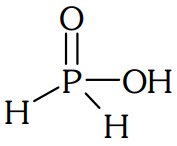
$H_3PO_2$ has one –OH group and two P–H bonds, which make it a strong reducing agent. -
Oxidation states of P in $H_4P_2O_5$, $H_4P_2O_6$, $H_4P_2O_7$ are respectivelyTake H = +1, O = −2 and let the oxidation state of P be x.
$H_4P_2O_5$: $4(+1) + 2x + 5(-2) = 0$, so $2x = 6$, x = +3
$H_4P_2O_6$: $4(+1) + 2x + 6(-2) = 0$, so $2x = 8$, x = +4
$H_4P_2O_7$: $4(+1) + 2x + 7(-2) = 0$, so $2x = 10$, x = +5
The oxidation states are +3, +4, +5 respectively.
Oxoacids of sulphur
-
Identify the correct formula of oleum from the followingOleum is pyrosulphuric acid, $H_2S_2O_7$.
Potash alum
-
In potash alum, the ratio of $K^+$ and $SO_4^{2-}$ ions isPotash alum is $K_2SO_4\cdot Al_2(SO_4)_3\cdot24H_2O$. $K^+:SO_4^{2-}=2:4=1:2$.
Anomalous behaviour of boron - covalency
-
The correct statement isB = [He] $2s^22p^1$. In the first excited state ($2s^12p^2$) boron has one 2s and three 2p orbitals, i.e. 4 valence orbitals that can participate in bonding, so its maximum covalency is four (e.g. $BF_4^-$).
Oxides of nitrogen and sulphur
-
Nitrogen dioxide and sulphur dioxide have some properties in common. Which property is shown by one of these compounds, but not by the other?Both oxides form acid rain, act as reducing agents and dissolve in water.
Only sulphur dioxide is used as a food preservative.
Group 13 elements
-
The stability of +1 oxidation state among Al, Ga, In and Tl increases in the sequence:Due to the inert pair effect, the stability of the +1 oxidation state increases down group 13: Al < Ga < In < Tl.
-
The stability of +1 oxidation state increases in the sequenceGroup 13 elements have the configuration $ns^2np^1$ and can show +1 and +3 oxidation states.
Down the group the $ns^2$ electrons become increasingly reluctant to take part in bonding, because the intervening d and f electrons shield the nuclear charge poorly. This is the inert pair effect.
As a result the +1 state becomes more and more stable on going down the group, while the +3 state becomes less stable.
Stability of the +1 state: Al < Ga < In < Tl (for thallium, +1 is the predominant state).
Hydrogen halides
-
The variation of the boiling points of the hydrogen halides is in the order HF > HI > HBr > HCl. What explains the higher boiling point of hydrogen fluoride?HF molecules are associated through strong hydrogen bonding, so HF has the highest boiling point: HF > HI > HBr > HCl.
Hydrides of group 16
-
Acidity of diprotic acids in aqueous solutions increases in the order:On moving down the group the bond length increases, so the H–E bond breaks more easily and the tendency to release $H^+$ increases.
So acidity: $H_2S < H_2Se < H_2Te$
Boron hydrides
-
Which of the following is electron-deficient?$(BH_3)_2$ is $B_2H_6$, which has 3-centre-2-electron (B–H–B) bridge bonds.
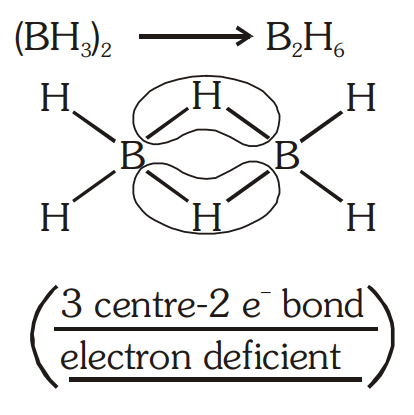
So it is electron deficient. -
Which of the following is the electron deficient molecule -An electron deficient molecule does not have enough valence electrons to form normal two-centre two-electron bonds between all its bonded atoms.
Diborane, $B_2H_6$, has only 12 valence electrons (3 from each B and 1 from each H), but it would need 14 electrons to form seven normal B-H and B-B bonds.
Its structure has four terminal B-H bonds (normal two-electron bonds) and two bridging B-H-B bonds, each of which is a three-centre two-electron (banana) bond.
So diborane is an electron deficient molecule and acts as a Lewis acid.
$C_2H_6$, $SiH_4$ and $PH_3$ have normal electron-precise bonds (and $PH_3$ is electron rich, with a lone pair).
So the electron deficient molecule is $B_2H_6$.
Silicates
-
The basic structural unit of silicates is:Silicates are salts of silicic acid, $H_4SiO_4$.
$Si(OH)_4 \xrightarrow{-4H^+} SiO_4^{4-}$ (silicate ion, tetrahedral)
Boron compounds
-
Which of the following structure is similar to graphite?Boron nitride (BN) has a layered structure of hexagonal rings like graphite, and is called inorganic graphite.
Sulphur dioxide
-
Roasting of sulphides gives the gas X as a by-product. This is a colourless gas with choking smell of burnt sulphur and causes great damage to respiratory organs as a result of acid rain. Its aqueous solution is acidic, acts as a reducing agent and its acid has never been isolated. The gas X is:Roasting of sulphide ores gives $SO_2$, a colourless gas with a choking smell that causes acid rain.
Its aqueous solution, sulphurous acid ($H_2SO_3$), is a reducing agent and has never been isolated.
Oxoacids
-
Which is the strongest acid in the following?Acid strength increases with the oxidation state and electronegativity of the central atom.
In $HClO_4$ chlorine is in the +7 state and $ClO_4^-$ is the most stabilised conjugate base, so it is the strongest acid.
Reactions of chlorine
-
When $Cl_2$ gas reacts with hot and concentrated sodium hydroxide solution, the oxidation number of chlorine changes from$3Cl_2 + 6NaOH$ (hot, conc.) $\rightarrow 5NaCl + NaClO_3 + 3H_2O$
In $Cl_2$ the oxidation number of Cl is 0.
In NaCl it is −1, and in $ClO_3^-$ it is +5.
So chlorine changes from zero to −1 and from zero to +5 (disproportionation).
Group 14 elements
-
Which of the following oxides is amphoteric?An amphoteric oxide reacts with both acids and bases.
Among the dioxides of group 14, $CO_2$, $SiO_2$ and $GeO_2$ are acidic, whereas $SnO_2$ and $PbO_2$ are amphoteric.
$SnO_2$ reacts with a base: $SnO_2 + 2NaOH \rightarrow Na_2SnO_3 + H_2O$
$SnO_2$ reacts with an acid: $SnO_2 + 4HCl \rightarrow SnCl_4 + 2H_2O$
CaO is the oxide of an alkaline earth metal and is basic.
Hence the amphoteric oxide is $SnO_2$.
Compounds of chlorine
-
Which one of the following is present as an active ingredient in bleaching powder for bleaching action?Bleaching powder is made by passing chlorine over dry slaked lime: $2Ca(OH)_2 + 2Cl_2 \rightarrow Ca(OCl)_2 + CaCl_2 + 2H_2O$
Its composition is $Ca(OCl)_2\cdot CaCl_2\cdot Ca(OH)_2\cdot2H_2O$.
The bleaching action is due to the hypochlorite ion, $OCl^-$, which is an oxidising agent and releases available chlorine.
$CaCl_2$ has no bleaching action.
Hence the active ingredient is calcium hypochlorite, $Ca(OCl)_2$.
Group 17 elements
-
Among the following which is the strongest oxidizing agent?An oxidising agent accepts electrons; the higher its standard reduction potential, the stronger it is.
$E^\circ(X_2/X^-)$: $F_2$ = +2.87 V, $Cl_2$ = +1.36 V, $Br_2$ = +1.09 V, $I_2$ = +0.54 V
Fluorine has the highest value because of its low F–F bond dissociation enthalpy and the very high hydration enthalpy of the small $F^-$ ion, even though its electron gain enthalpy is less negative than that of chlorine.
Oxidising power: $F_2 > Cl_2 > Br_2 > I_2$
Hence the strongest oxidising agent is $F_2$.
Group 14: Inert Pair Effect
-
Which of the following oxidation states are the most characteristic for lead and tin respectively?All the group 14 elements show tetravalency, which can be explained by the shifting of one electron from $ns$ to the vacant $np$ orbital; the four orbitals then give four $sp^3$ hybrid orbitals.
When the $ns^2$ electrons of the outermost shell do not participate in bonding, they are called an inert pair, and the effect is called the inert pair effect.
The last three elements of the group, Ge, Sn and Pb, have a tendency to form divalent as well as tetravalent ions.
The inert pair effect increases from Ge to Pb, so the stability of the tetravalent state decreases and that of the divalent state increases down the group.
That is why $Pb^{2+}$ is more stable than $Pb^{4+}$ (Pb(IV) compounds are strong oxidising agents), while $Sn^{4+}$ is more stable than $Sn^{2+}$ (Sn(II) compounds are reducing agents).
So the most characteristic oxidation states are +2 for lead and +4 for tin.
Oxoacids of Halogens
-
Which one of the following orders correctly represents the increasing acid strengths of the given acids?Oxidation numbers of chlorine: $HOCl$ (+1), $HOClO$ (+3), $HOClO_2$ (+5), $HOClO_3$ (+7).
As the oxidation number of the central atom increases, the strength of the oxoacid also increases.
More oxygen atoms on chlorine pull electron density away from the O-H bond, so the proton is released more easily.
Also, the negative charge of the conjugate base is delocalised over more oxygen atoms: $ClO^- \lt ClO_2^- \lt ClO_3^- \lt ClO_4^-$ in stability.
A more stable conjugate base means a stronger acid.
Increasing acid strength: $HOCl \lt HOClO \lt HOClO_2 \lt HOClO_3$ -
The correct order of acid strength is -Oxidation numbers of chlorine: HClO (+1), $HClO_2$ (+3), $HClO_3$ (+5), $HClO_4$ (+7).
As the oxidation number of the central atom increases, the number of oxygen atoms attached to it increases, and the O-H bond becomes more polar.
The conjugate bases are also stabilised more by the delocalisation of the negative charge over more oxygen atoms: $ClO^- \lt ClO_2^- \lt ClO_3^- \lt ClO_4^-$ in stability.
The more stable the conjugate base, the stronger the acid.
So the correct order of acid strength is $HClO \lt HClO_2 \lt HClO_3 \lt HClO_4$.
Nature of Oxides
-
Which of the following is the most basic oxide :-The basic character of oxides increases with the metallic character of the element, which increases down a group.
$SeO_2$ is the oxide of a non-metal and is acidic.
$Al_2O_3$ is amphoteric.
$Sb_2O_3$ is amphoteric (antimony is a metalloid).
$Bi_2O_3$ is the oxide of bismuth, the most metallic element of group 15, and it is basic.
In group 15 the oxides of the type $E_2O_3$ change from acidic (N, P) through amphoteric (As, Sb) to basic (Bi).
So the most basic oxide is $Bi_2O_3$.
Oxides of Chlorine
-
Which one of the following oxides is expected to exhibit paramagnetic behaviour -A substance is paramagnetic if it has one or more unpaired electrons.
Count the valence electrons. $ClO_2$: Cl has 7 and each O has 6, so total $= 7 + 2 \times 6 = 19$, an odd number.
A molecule with an odd number of electrons must have at least one unpaired electron, so $ClO_2$ is an odd electron molecule and is paramagnetic.
$CO_2$ (16 valence electrons), $SO_2$ (18) and $SiO_2$ (a network solid with all electrons paired) have no unpaired electrons, so they are diamagnetic.
So the paramagnetic oxide is $ClO_2$.
Group 17 Elements: Halogens
-
Which of the following statements is not true :Iodide is the most powerful reducing halide ion, since $I^-$ is the largest and loses its electron most easily (and $I_2$ is the weakest oxidant); true.
Fluorine, the most electronegative element with no d orbitals, shows only the –1 state; true.
In the hypohalous acids HOX, a more electronegative X pulls electron density from the O–H bond, so HOCl ($K_a \approx 3 \times 10^{-8}$) is stronger than HOBr; true.
Among hydrogen halides, acid strength increases HF $\lt$ HCl $\lt$ HBr $\lt$ HI, because the H–X bond becomes weaker. The H–F bond is very strong and HF is a weak acid in water, while HCl is a strong acid.
So the statement that is not true is: HF is a stronger acid than HCl.
Borax
-
In borax bead test which compound is formedOn heating, borax loses water and swells, then melts into a transparent glassy bead of sodium metaborate and boric anhydride:
$Na_2B_4O_7 \cdot 10H_2O \xrightarrow{\Delta} Na_2B_4O_7 \rightarrow 2NaBO_2 + B_2O_3$
When this bead is heated with a coloured metal salt, the metal oxide combines with $B_2O_3$ to form a coloured metaborate, e.g. $CuO + B_2O_3 \rightarrow Cu(BO_2)_2$ (blue), $CoO + B_2O_3 \rightarrow Co(BO_2)_2$ (blue).
So in the borax bead test, a metaborate is formed.
Group 13: Electron Deficient Compounds
-
Which of the following compound is electron deficient :In $BCl_3$, boron has only 6 electrons in its valence shell (3 bond pairs), two less than an octet. So it is electron deficient and acts as a Lewis acid (e.g. $BCl_3 + NH_3 \rightarrow Cl_3B \leftarrow NH_3$).
$CCl_4$ has a complete octet, and $PCl_5$ has an expanded octet (10 electrons).
$BeCl_2$ (4 electrons around Be in the monomer) is also electron deficient, but the standard example and the key's answer is $BCl_3$.
So, as per the answer key, $BCl_3$ is the electron deficient compound.
That is every question in The p-Block Elements for this filter.
Show all 77 questions Next: Salt Analysis (Qualitative Inorganic Analysis)
Want a score?
Answers here are not saved. Practise as a test to be marked and see your progress.
Practise as a test