Looking for classes? Ksquare Career Institute, Bengaluru →

Chemistry
Amines
61 questions from 36 papers, each with its answer.
- 61 questions
- 36 papers
- 3.47% of Chemistry
Diazonium Salts - Preparation and Reactions
-
Given below are two statements:
Statement I: Benzenediazonium salt is prepared by the reaction of aniline with nitrous acid at 273-278 K. It decomposes easily in the dry state.
Statement II: Insertion of iodine into the benzene ring is difficult and hence iodobenzene is prepared through the reaction of benzenediazonium salt with KI.
In the light of the above statements, choose the most appropriate answer from the options given below:Both statements are correct: diazotization occurs at $0-5^\circ\text{C}$ and dry diazonium salt is explosive; direct iodination is reversible, so iodobenzene is prepared by treating diazonium salt with KI.
Statement I is correct: Aniline reacts with nitrous acid ($\text{NaNO}_2 + \text{HCl}$) at $273-278\text{ K}$ ($0-5^\circ\text{C}$) to form benzenediazonium chloride; in the dry solid state, diazonium salts are dangerously unstable and explode upon mild disturbance. Statement II is correct: Direct electrophilic iodination of benzene is reversible due to the generation of reducing agent HI and requires strong oxidizing agents ($\text{HNO}_3, \text{HIO}_3$); hence iodobenzene is conveniently prepared by treating benzenediazonium chloride solution with aqueous potassium iodide (KI).
Preparation of Amines
-
Acetamide is treated with the following reagents separately. Which one of these would yield methyl amine?An amide treated with bromine and aqueous or ethanolic NaOH gives a primary amine with one carbon atom less (Hoffmann bromamide degradation).
$CH_3CONH_2 + Br_2 + 4NaOH \rightarrow CH_3NH_2 + Na_2CO_3 + 2NaBr + 2H_2O$
Acetamide has two carbons; the carbonyl carbon is lost as carbonate and the product is methyl amine.
$PCl_5$ dehydrates acetamide to acetonitrile ($CH_3CN$); soda lime and hot conc. $H_2SO_4$ do not give methyl amine (the latter hydrolyses it to acetic acid).
Hence the reagent is $NaOH-Br_2$. -
Which one of the following on reduction with lithium aluminium hydride yields a secondary amine?Reduction of alkyl isocyanides in the presence of $LiAlH_4$ yields secondary amines containing methyl as one of the alkyl groups.
$R-N\equiv C + 4[H] \xrightarrow{LiAlH_4} R-NH-CH_3$ ($2^\circ$ amine)
For methyl isocyanide: $CH_3-N\equiv C + 4[H] \xrightarrow{LiAlH_4} CH_3-NH-CH_3$ (dimethylamine)
The carbon of the isocyanide group is attached to nitrogen, so after reduction it becomes a methyl group on nitrogen, giving a secondary amine.
Alkyl cyanides give $1^\circ$ amines on reduction: $CH_3-C\equiv N + 4[H] \rightarrow CH_3CH_2NH_2$
Acetamide also gives a primary amine: $CH_3CONH_2 + 4[H] \rightarrow CH_3CH_2NH_2 + H_2O$
Nitroethane gives the primary amine $CH_3CH_2NH_2$.
So the compound that yields a secondary amine is methyl isocyanide.
Diazonium Salts
-
Which of the following will be most stable diazonium salt $RN_2^+X^-$?Primary aliphatic amines form highly unstable alkyldiazonium salts.
Primary aromatic amines form arenediazonium salts, which are stable for a short time in solution at low temperature (273–278 K).
The stability of the arenediazonium ion is explained by resonance.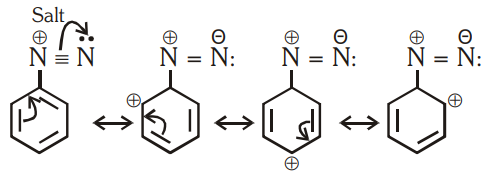
Basic Character of Amines
-
Which of the following is more basic than aniline :-The basic strength of an amine depends on the availability of the lone pair on nitrogen for accepting a proton.
In aniline, $C_6H_5NH_2$, the lone pair on nitrogen is delocalised into the benzene ring by resonance ($+M$ effect), so it is less available.
In benzylamine, $C_6H_5CH_2NH_2$, the nitrogen is attached to a $CH_2$ group and not directly to the ring, so its lone pair is localised and cannot be delocalised into the ring.
Benzylamine therefore behaves like an aliphatic primary amine and is much more basic than aniline.
In diphenylamine and triphenylamine the lone pair is delocalised over two and three benzene rings respectively, so they are weaker bases than aniline.
In p-nitroaniline the electron withdrawing $-NO_2$ group pulls the lone pair further into the ring, so it is also weaker than aniline.
So the compound more basic than aniline is benzylamine.
Preparation of Benzene and Reactions of Diazonium Salts
-
Which one of the following reactions does NOT give benzene as the product?
Hydrolysis of benzenediazonium chloride with warm water yields phenol ($\text{C}_6\text{H}_5\text{OH}$), not benzene.
Reaction (1) is decarboxylation of sodium benzoate giving benzene. Reaction (2) is aromatization of n-hexane over $\text{Mo}_2\text{O}_3$ catalyst giving benzene. Reaction (3) is cyclic polymerization of ethyne forming benzene. Reaction (4) is warming benzenediazonium chloride with water, which undergoes nucleophilic substitution to yield phenol: $\text{C}_6\text{H}_5\text{N}_2^+\text{Cl}^- + \text{H}_2\text{O} \xrightarrow{\Delta} \text{C}_6\text{H}_5\text{OH} + \text{N}_2 + \text{HCl}$. Thus, reaction (4) does not yield benzene.
Test for Unsaturation and Bromine Water Reaction
-
Which one of the following compounds does not decolourize bromine water?
Cyclohexane is a saturated cycloalkane that does not react with bromine water. Phenol, aniline, and styrene rapidly decolourize bromine water.
Bromine water is decolourized by unsaturated hydrocarbons via electrophilic addition (e.g. styrene adds $\text{Br}_2$ across its vinyl double bond) or by strongly activated aromatic rings via rapid electrophilic aromatic substitution (e.g. phenol forms 2,4,6-tribromophenol white precipitate, and aniline forms 2,4,6-tribromoaniline). Saturated alkanes like cyclohexane lack both unsaturation and activation, and thus do not decolourize bromine water in the absence of UV light.
Electrophilic substitution in aniline – nitration
-
Nitration of aniline in strong acidic medium also gives m-nitroaniline because
Protonated $-NH_3^+$ is meta-directing.
$C_6H_5NH_2 + H^+ \rightleftharpoons C_6H_5\overset{+}{N}H_3$ (anilinium ion) $-\overset{+}{N}H_3$ is m-directing, hence besides para (51%) and ortho (2%), the meta product (47%) is also formed in significant yield. So m-nitroaniline forms because aniline exists as the anilinium ion in strongly acidic medium.
Basic character of aromatic amines
-
The correct increasing order of basic strength for the following compounds is:
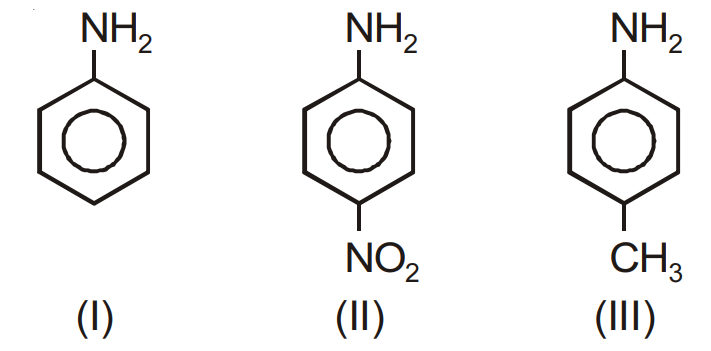
Electron-withdrawing groups reduce, and donating groups increase, amine basicity.
$-NO_2$ has a strong –R effect, which decreases the basicity; $-CH_3$ shows +R (hyperconjugation) and +I effects, which increase the basicity.
Order of basic strength: p-nitroaniline < aniline < p-toluidine, i.e. II < I < III.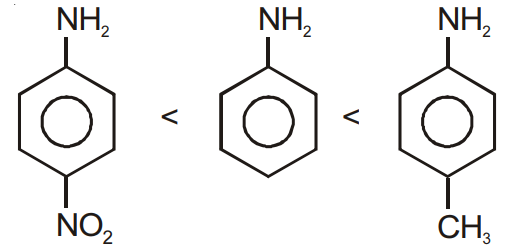
Hoffmann bromamide degradation
-
Which of the following reactions is appropriate for converting acetamide to methanamine?
Amide → amine with one carbon less.
$CH_3-CO-NH_2 + Br_2 + 4NaOH \xrightarrow{\Delta} CH_3-NH_2 + 2NaBr + Na_2CO_3 + 2H_2O$ This is the Hoffmann bromamide reaction.
Basic character of amines – aryl vs alkyl
-
The correct statement regarding the basicity of arylamines is
Delocalisation of the N lone pair into the ring lowers basicity.
In alkylamines ($R\rightarrow\ddot{N}H_2$), the electron-releasing alkyl group increases electron density on nitrogen, so alkylamines donate the lone pair readily and are more basic.
In arylamines ($Ar-\ddot{N}H_2$), the lone pair on nitrogen is in conjugation with the ring (+M effect overpowers –I); it is delocalised into the ring and stabilised by resonance.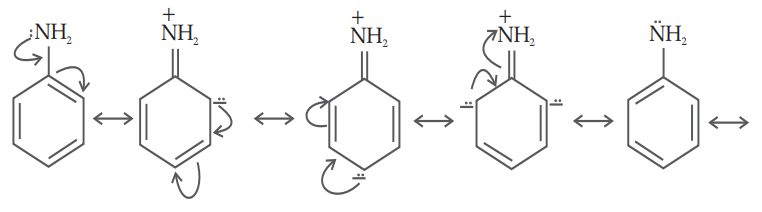
Therefore the tendency to donate the lone pair decreases, i.e. arylamines are less basic than alkylamines.
Isomerism in amines
-
The number of structural isomers possible from the molecular formula $C_3H_9N$ is:1° amines: $CH_3CH_2CH_2NH_2$ and $(CH_3)_2CH-NH_2$
2° amine: $CH_3CH_2-NH-CH_3$
3° amine: $(CH_3)_3N$
Total = 4 structural isomers.
Reactions of amines
-
The following reaction
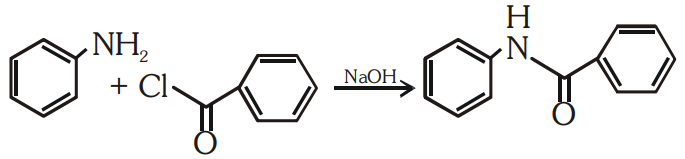 is known by the name:Benzoylation of aniline with benzoyl chloride in the presence of aqueous NaOH is the Schotten–Baumann reaction.
-
Which of the following statements about primary amines is 'False'?Alkyl groups release electrons (+I effect) and increase the electron density on nitrogen, so alkyl amines are stronger bases than ammonia (true).
In aryl amines the lone pair on nitrogen is delocalised into the benzene ring, so they are weaker bases than alkyl amines (true).
Primary aliphatic amines react with nitrous acid to give unstable aliphatic diazonium salts, which decompose to alcohols with evolution of nitrogen: $RNH_2 + HNO_2 \rightarrow ROH + N_2 + H_2O$ (true).
Primary aromatic amines react with nitrous acid at 273–278 K to form arenediazonium salts, which are stable at this temperature: $C_6H_5NH_2 + NaNO_2 + 2HCl \rightarrow C_6H_5N_2^+Cl^- + NaCl + 2H_2O$. Phenol is not the product of this reaction.
Hence the false statement is that aryl amines react with nitrous acid to produce phenols.
Diazonium Salts: Coupling Reactions
-
Aniline when diazotized in cold and then treated with dimethyl aniline gives a coloured product. Its structure would be :-Diazotisation: aniline reacts with nitrous acid ($NaNO_2 + HCl$) at 273–278 K to give benzenediazonium chloride:
$C_6H_5NH_2 + NaNO_2 + 2HCl \xrightarrow{273-278\,K} C_6H_5N_2^+Cl^- + NaCl + 2H_2O$
Coupling: the diazonium ion is an electrophile. It attacks the para position of N,N-dimethylaniline, which is strongly activated by the $-N(CH_3)_2$ group:
$C_6H_5N_2^+Cl^- + C_6H_5N(CH_3)_2 \rightarrow C_6H_5-N=N-C_6H_4-N(CH_3)_2\,(p) + HCl$
The product, p-(dimethylamino)azobenzene (butter yellow), is a coloured azo dye because of the extended conjugation through the $-N=N-$ group.
So its structure is $(CH_3)_2N-C_6H_4-N=N-C_6H_5$.
Electrophilic Substitution: Activating and Deactivating Groups
-
The correct order of reactivity towards the electrophilic substitution of the compounds aniline (I), benzene (II) and nitrobenzene (III) isThe $-NH_2$ group of aniline donates electrons to the ring by resonance (+R effect), increasing the electron density, especially at ortho and para positions. So aniline is much more reactive than benzene towards electrophiles.
The $-NO_2$ group of nitrobenzene withdraws electrons from the ring by both $-I$ and $-R$ effects, decreasing the electron density. So nitrobenzene is much less reactive than benzene.
Order of reactivity: aniline $\gt$ benzene $\gt$ nitrobenzene.
So I $\gt$ II $\gt$ III.
That is every question in Amines for this filter.
Want a score?
Answers here are not saved. Practise as a test to be marked and see your progress.
Practise as a test