Looking for classes? Ksquare Career Institute, Bengaluru →

Chemistry
Hydrocarbons
75 questions from 35 papers, each with its answer.
- 75 questions
- 35 papers
- 4.26% of Chemistry
Free Radical Halogenation of Alkanes
-
How many products (including stereoisomers) are expected from monochlorination of the following compound?
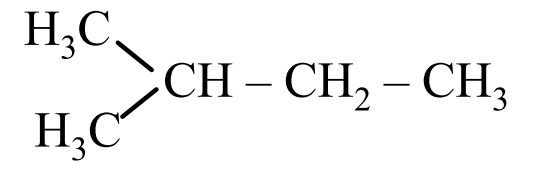
Monochlorination yields 4 constitutional isomers: 1-chloro-2-methylbutane (2 stereoisomers: d, l), 2-chloro-2-methylbutane (1 achiral), 2-chloro-3-methylbutane (2 stereoisomers: d, l), and 1-chloro-3-methylbutane (1 achiral). Total $= 2 + 1 + 2 + 1 = 6$.
Monochlorination of 2-methylbutane produces substitution at 4 distinct carbon positions: 1. At C-1 (or C-1'): $\text{CH}_2\text{Cl}-\text{CH}(\text{CH}_3)-\text{CH}_2-\text{CH}_3$ (1-chloro-2-methylbutane, C-2 is chiral $\implies$ 2 enantiomers). 2. At C-2: $\text{CH}_3-\text{C(Cl)}(\text{CH}_3)-\text{CH}_2-\text{CH}_3$ (2-chloro-2-methylbutane, achiral $\implies$ 1 product). 3. At C-3: $\text{CH}_3-\text{CH}(\text{CH}_3)-\text{CH(Cl)}-\text{CH}_3$ (2-chloro-3-methylbutane, C-3 is chiral $\implies$ 2 enantiomers). 4. At C-4: $\text{CH}_3-\text{CH}(\text{CH}_3)-\text{CH}_2-\text{CH}_2\text{Cl}$ (1-chloro-3-methylbutane, achiral $\implies$ 1 product). Total products including stereoisomers $= 2 + 1 + 2 + 1 = 6$. -
Which of the following is a free radical substitution reaction?Methane reacting with $Br_2$ in the presence of UV light ($h\nu$) proceeds via a free radical substitution mechanism (initiation, propagation, termination steps), replacing hydrogen atoms with bromine.
Preparation of Alkanes – Decarboxylation
-
Weight (g) of two moles of the organic compound, which is obtained by heating sodium ethanoate with sodium hydroxide in presence of calcium oxide is:
Soda-lime decarboxylation gives methane (molar mass 16), so two moles weigh 32 g.
Sodium ethanoate is $CH_3COONa$ and the given process is soda-lime decarboxylation. $CH_3COONa+NaOH\xrightarrow{CaO}CH_4+Na_2CO_3$ Methane is obtained having molar mass 16. Two moles would be 32 g.
Aromaticity – Huckel's Rule
-
Which compound amongst the following is not an aromatic compound?
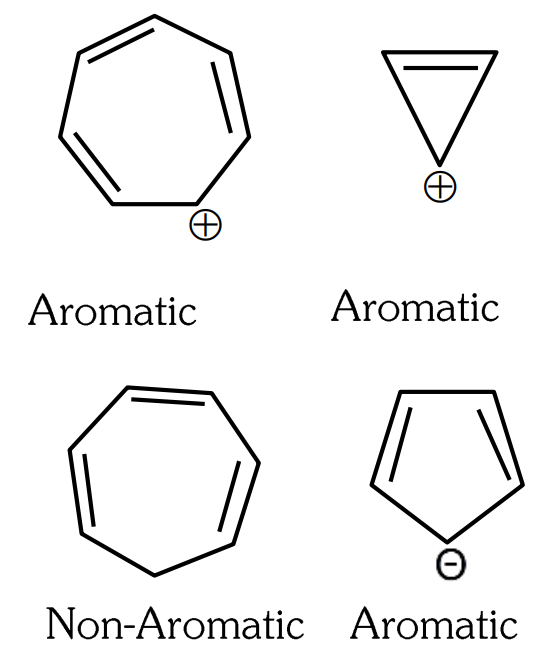
Tropylium cation (6 $\pi$e), cyclopropenyl cation (2 $\pi$e) and cyclopentadienyl anion (6 $\pi$e) are planar, fully conjugated and obey Huckel's (4n + 2) rule – aromatic.
Cycloheptatriene has an $sp^3$ ($CH_2$) carbon, so it is not fully conjugated – non-aromatic.
Reactions of Alkenes – Ozonolysis
-
Compound X on reaction with $O_3$ followed by $Zn/H_2O$ gives formaldehyde and 2-methyl propanal as products. The compound X is:$CH_3-CH(CH_3)-CH=CH_2 \xrightarrow[(ii)\ Zn/H_2O]{(i)\ O_3} (CH_3)_2CH-CHO + HCHO$ 2-methylpropanal + formaldehyde So X is 3-methylbut-1-ene.
-
An alkene on ozonolysis gives methanal as one of the product. Its structure is:
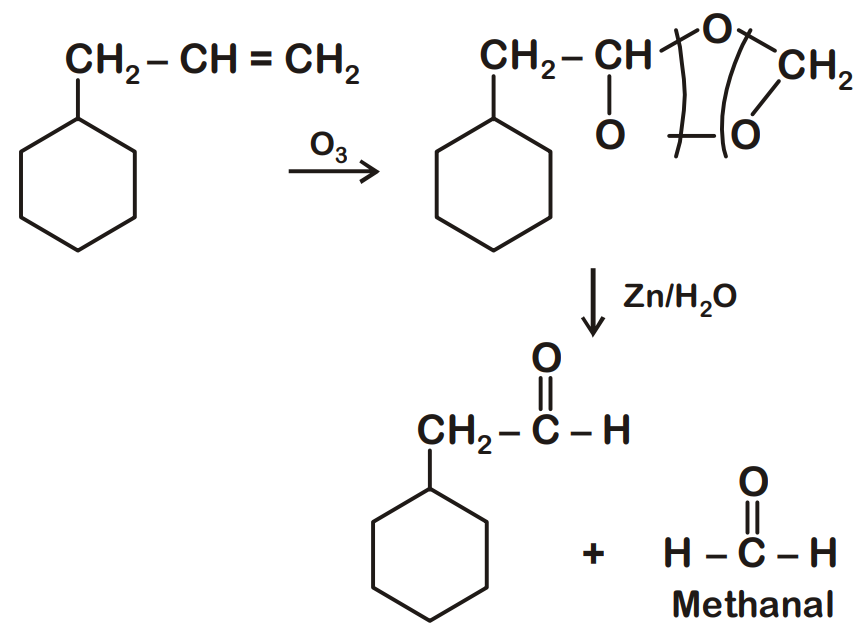
Ozonolysis gives methanal (HCHO) only if the alkene has a terminal $=CH_2$ group.
$C_6H_{11}-CH_2-CH=CH_2 \xrightarrow[(ii)\ Zn/H_2O]{(i)\ O_3} C_6H_{11}-CH_2-CHO + HCHO$
So the alkene is allylcyclohexane (cyclohexyl–$CH_2$–CH=$CH_2$).
Addition Reactions of Alkenes – Peroxide Effect
-
The major product of the following chemical reaction is: $(CH_3)_2CH-CH=CH_2+HBr\xrightarrow{(C_6H_5CO)_2O_2}$ ?$(CH_3)_2CH-CH=CH_2 + HBr \xrightarrow{(C_6H_5CO)_2O_2} (CH_3)_2CH-CH_2-CH_2-Br$ In the presence of peroxide, HBr adds to unsymmetrical alkenes against Markovnikov's rule (peroxide effect/Kharasch effect).
Preparation of Alkanes – Wurtz Reaction
-
Which of the following alkane cannot be made in good yield by Wurtz reaction?The Wurtz reaction is used to prepare symmetrical alkanes: $R-X + 2Na + X-R \xrightarrow{dry\ ether} R-R + 2NaX$ If $R_1$ and $R_2$ are different, a mixture of alkanes ($R_1-R_1$, $R_1-R_2$, $R_2-R_2$) is obtained. n-Heptane (odd number of carbons, $C_3 + C_4$) is unsymmetrical, so it cannot be made in good yield. 2,3-Dimethylbutane, n-butane and n-hexane are symmetrical.
Reactions of Alkynes – Partial Reduction (Lindlar Catalyst)
-
The most suitable reagent for the following conversion is: $H_3C-C\equiv C-CH_3\rightarrow$ cis-2-butene
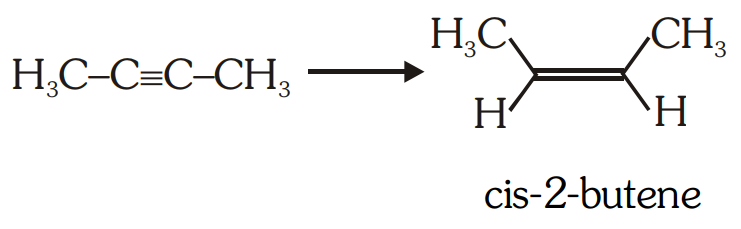 Partial hydrogenation of an alkyne with Lindlar-type catalyst ($H_2$, Pd/C, quinoline) gives a cis-alkene by syn addition. $H_3C-C\equiv C-CH_3\xrightarrow{H_2,\ Pd/C,\ quinoline}$ cis-2-butene (Na/liquid $NH_3$ would give trans-2-butene.)
Aromatic Hydrocarbons – Electrophilic Substitution
-
Among the following, the reaction that proceeds through an electrophilic substitution is:Chlorination of benzene with $Cl_2$ in presence of anhydrous $AlCl_3$ proceeds through electrophilic substitution: $C_6H_6+Cl_2\xrightarrow{AlCl_3}C_6H_5Cl+HCl$ Generation of electrophile: $Cl-Cl+AlCl_3\rightarrow Cl^++AlCl_4^-$ $Cl^+$ attacks the benzene ring to form the arenium ion (σ-complex), which loses $H^+$ to give chlorobenzene. (The Sandmeyer reaction is not an electrophilic substitution, $Cl_2$/UV light gives an addition product, and $C_6H_5CH_2OH$ + HCl is nucleophilic substitution.)
Electrophilic substitution vs free-radical addition halogenation of benzene
-
The number of chlorine atoms present in the organic products X and Y of the following reactions, respectively, are:
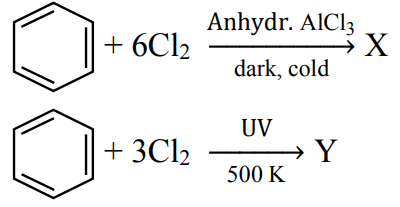 Benzene $+ 6Cl_2 \xrightarrow[dark,\ cold]{Anhydr.\ AlCl_3} C_6Cl_6$ (X, hexachlorobenzene – electrophilic substitution of all six H) Benzene $+ 3Cl_2 \xrightarrow[500K]{UV} C_6H_6Cl_6$ (Y, benzene hexachloride – free-radical addition) Number of chlorine atoms in X and Y are 6 and 6 respectively.
Friedel-Crafts alkylation, nitration, and separation of positional isomers
-
Two products X and Y are formed in the following reaction sequence
 The suitable method that can be used for the separation of products X and Y is:
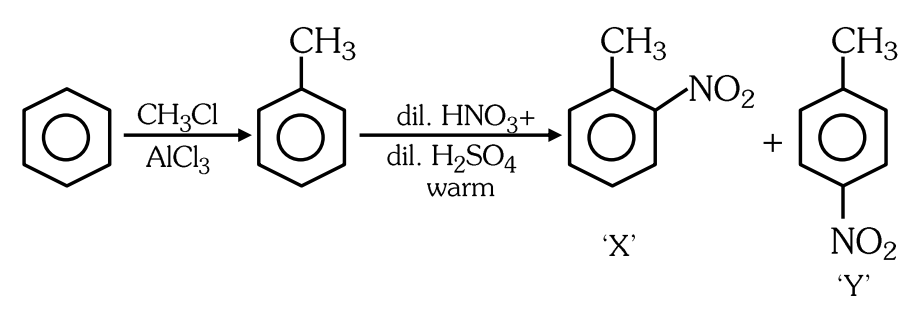 Benzene $\xrightarrow[AlCl_3]{CH_3Cl}$ Toluene (W) (Friedel-Crafts alkylation)
Toluene $\xrightarrow[dil.\ H_2SO_4,\ warm]{dil.\ HNO_3}$ o-nitrotoluene (X) + p-nitrotoluene (Y)
X and Y are positional isomers with different boiling points, so they can be separated by fractional distillation.
Test for unsaturation - Baeyer's reagent
-
Baeyer's reagent is:Baeyer's reagent is a cold, dilute, aqueous solution of potassium permanganate, used as a test for unsaturation (alkenes/alkynes), which decolourises it.
Oxidation of alkanes having tertiary hydrogen
-
The alkane that can be oxidized to the corresponding alcohol by
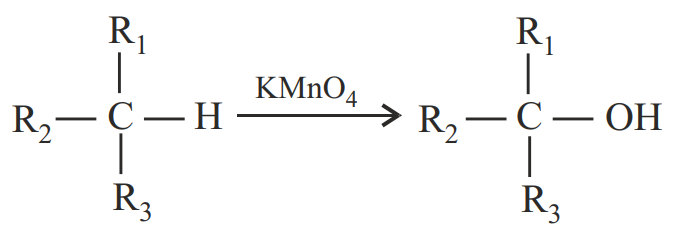 is, when:Alkanes generally resist oxidation, but an alkane with a tertiary C–H bond can be oxidised to the corresponding tertiary alcohol by $KMnO_4$. This requires all three R groups to be alkyl groups, i.e. $R_1=R_2=R_3=CH_3$ (tertiary carbon).
Geometrical (cis-trans) isomerism in alkenes
-
Which amongst the following compounds will show geometrical isomerism?For geometrical isomerism, each doubly-bonded carbon must bear two different substituents. In 3,4-dimethylhex-3-ene, $CH_3-CH_2-C(CH_3)=C(CH_3)-CH_2-CH_3$, each $sp^2$ carbon bears two different groups (ethyl and methyl), so this compound shows geometrical isomerism. (Pent-1-ene, 2,3-dimethylbut-2-ene, and 2-methylprop-1-ene each have a doubly bonded carbon with two identical substituents.)
Preparation of alkenes
-
Which of the following compounds shall not produce propene by reaction with HBr followed by elimination or direct only elimination reaction?
Ketene gives acetyl bromide, not propene.
Cyclopropane $\xrightarrow{HBr} CH_3CH_2CH_2Br \xrightarrow{Elimination} CH_3-CH=CH_2$
$CH_3CH_2CH_2OH \xrightarrow{HBr} \xrightarrow{Elimination} CH_3-CH=CH_2$
$CH_2=C=O \xrightarrow{HBr} H_2C=C(Br)-OH \rightleftharpoons CH_3-CO-Br$ (no propene)
$CH_3CH_2CH_2Br \xrightarrow{Elimination} CH_3-CH=CH_2$
Cyclic polymerisation of alkynes
-
In the following reaction, $H_3C-C\equiv CH\xrightarrow[873\ K]{red\ hot\ iron\ tube}A$ the number of sigma ($\sigma$) bonds present in the product A is:Propyne trimerises in a red hot iron tube at 873 K to give mesitylene (1,3,5-trimethylbenzene, $C_9H_{12}$). $\sigma$ bonds: 6 ring C-C + 3 C-$CH_3$ + 12 C-H = 21.
Aromatic hydrocarbons – directive influence of substituents
-
The compound $C_7H_8$ undergoes the following reactions:
$C_7H_8 \xrightarrow{3Cl_2/\Delta} A \xrightarrow{Br_2/Fe} B \xrightarrow{Zn/HCl} C$.
The product 'C' isThe $-CCl_3$ group directs Br to the meta position before reduction back to $-CH_3$.
$C_6H_5CH_3\ (C_7H_8) \xrightarrow{3Cl_2/\Delta} C_6H_5CCl_3\ (A)$ (side-chain chlorination)
$-CCl_3$ is meta-directing: $C_6H_5CCl_3 \xrightarrow{Br_2/Fe} m-BrC_6H_4CCl_3\ (B)$
$m-BrC_6H_4CCl_3 \xrightarrow{Zn/HCl} m-BrC_6H_4CH_3\ (C)$
So C is m-bromotoluene.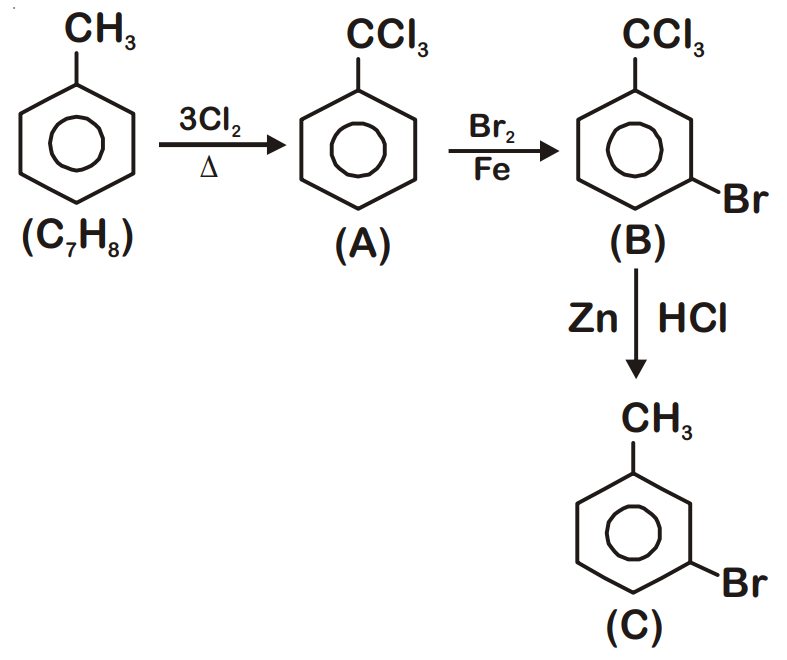
Conformations of ethane
-
Dihedral angle in staggered form of ethane is :The dihedral (torsional) angle is the angle between a C–H bond on the front carbon and a C–H bond on the back carbon, seen in a Newman projection.
In the eclipsed form, the hydrogens of the two carbons are directly behind one another: dihedral angle $0^\circ$.
In the staggered form, each back hydrogen lies exactly between two front hydrogens: the nearest dihedral angle is $60^\circ$.
So the dihedral angle in the staggered form of ethane is $60^\circ$ (it is the more stable conformation).
Alkynes – acidity and alkylation of acetylides
-
In the reaction, $H-C\equiv CH \xrightarrow[(ii)\ CH_3CH_2Br]{(i)\ NaNH_2/liq.NH_3} X \xrightarrow[(ii)\ CH_3CH_2Br]{(i)\ NaNH_2/liq.NH_3} Y$, X and Y are
Two successive ethylations of acetylene.
$HC\equiv CH \xrightarrow{NaNH_2/liq.NH_3} HC\equiv C^-Na^+ \xrightarrow{CH_3CH_2Br} CH_3CH_2C\equiv CH$ (X = but-1-yne)
$CH_3CH_2C\equiv CH \xrightarrow{NaNH_2/liq.NH_3} CH_3CH_2C\equiv C^-Na^+ \xrightarrow{CH_3CH_2Br} CH_3CH_2C\equiv CCH_2CH_3$ (Y = hex-3-yne)
Electrophilic substitution – nitration of benzene
-
Consider the nitration of benzene using mixed conc. $H_2SO_4$ and $HNO_3$. If a large amount of $KHSO_4$ is added to the mixture, the rate of nitration will be
Common ion $HSO_4^-$ suppresses $NO_2^+$ formation.
Nitration of benzene is an electrophilic substitution in which the electrophile is the nitronium ion ($NO_2^+$).
$2H_2SO_4 + HNO_3 \rightarrow 2HSO_4^- + NO_2^+ + H_3O^+$
When a large amount of $KHSO_4$ is added, the common ion effect of $HSO_4^-$ lowers the concentration of $NO_2^+$, so the rate of nitration decreases.
Friedel–Crafts alkylation
-
Using anhydrous $AlCl_3$ as catalyst, which one of the following reactions produces ethylbenzene (PhEt) :-Ethylbenzene, $C_6H_5CH_2CH_3$, needs an ethyl group to be attached to the benzene ring.
Ethylene in the presence of $AlCl_3$ (with a trace of HCl) gives the ethyl carbocation, $CH_3CH_2^+$, which attacks benzene (electrophilic substitution):
$CH_2=CH_2 + C_6H_6 \xrightarrow{anhyd.\ AlCl_3,\ HCl} C_6H_5CH_2CH_3$
This is the industrial method for making ethylbenzene (for styrene manufacture).
Propene would give the more stable isopropyl carbocation and so form isopropylbenzene (cumene), not ethylbenzene.
Ethane is a saturated alkane and does not produce a carbocation with $AlCl_3$. Ethanol reacts with and deactivates $AlCl_3$, so it is not used with this catalyst.
So ethylbenzene is produced from $H_2C=CH_2 + C_6H_6$.
Friedel–Crafts alkylation with alkenes
-
In the given reaction:
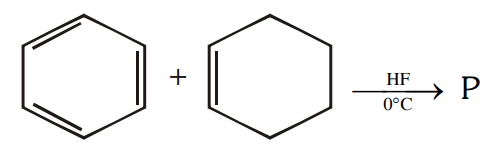 the product P is:
Protonated alkene alkylates benzene.
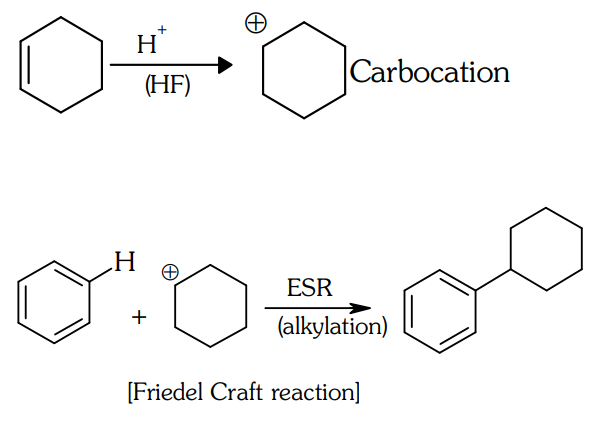
Cyclohexene $\xrightarrow{H^+ (HF)}$ cyclohexyl carbocation
Benzene + cyclohexyl carbocation $\xrightarrow{ESR\ (alkylation)}$ cyclohexylbenzene (Friedel–Crafts reaction)
So P is cyclohexylbenzene.
Allylic substitution
-
The compound that will react most readily with gaseous bromine has the formula
Propene has allylic hydrogens for radical substitution.
Gaseous bromine reacts with an alkene having allylic H to give an allylic substituted product by a free radical mechanism.
$CH_3-CH=CH_2 \xrightarrow{Br_2(gas)} BrCH_2-CH=CH_2$
Electrophilic addition to alkenes
-
The reaction of $C_6H_5CH=CHCH_3$ with HBr produces$H^+$ adds to the terminal carbon of the double bond to give the more stable benzylic carbocation $C_6H_5\overset{+}{C}HCH_2CH_3$.
$Br^-$ then attacks this carbon.
Product: $C_6H_5CH(Br)CH_2CH_3$ -
$H_2C=CH-CH(CH_3)-CH_3 + HBr \rightarrow (X)$
Here (X) (predominantly) is :The alkene is 3-methylbut-1-ene. The addition of HBr is an electrophilic addition that proceeds through a carbocation.
Step 1: $H^+$ adds to the terminal $CH_2$ carbon (Markovnikov's rule) to give a secondary carbocation.
$CH_2=CH-CH(CH_3)-CH_3 + H^+ \rightarrow CH_3-\overset{+}{C}H-CH(CH_3)-CH_3$ ($2^\circ$ carbocation, less stable)
Step 2: a 1,2-hydride shift from the adjacent carbon converts it into a more stable tertiary carbocation.
$CH_3-\overset{+}{C}H-CH(CH_3)-CH_3 \xrightarrow{1,2\text{-hydride shift}} CH_3-CH_2-\overset{+}{C}(CH_3)-CH_3$ ($3^\circ$ carbocation, more stable)
Step 3: $Br^-$ attacks the tertiary carbocation.
$CH_3-CH_2-\overset{+}{C}(CH_3)_2 + Br^- \rightarrow CH_3-C(Br)(CH_3)-CH_2CH_3$
The major product (X) is 2-bromo-2-methylbutane, $CH_3-C(Br)(CH_3)-CH_2CH_3$.
Ozonolysis
-
A single compound of the structure
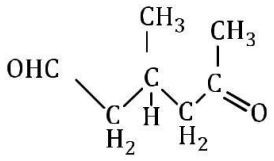 is obtainable from ozonolysis of which of the following cyclic compoundsOzonolysis of a cyclic alkene opens the ring and gives a single dicarbonyl compound.
The ring carbon bearing a methyl group on the double bond becomes the $CH_3-CO-$ end, the other alkene carbon becomes the $-CHO$ end, and the second methyl sits on the middle carbon.
So the compound is 1,4-dimethylcyclopentene.
Stability of alkenes and aromatic compounds
-
Given
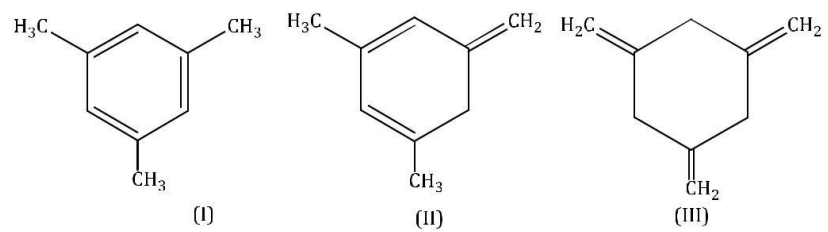
The enthalpy of hydrogenation of these compounds will be in the order as:Enthalpy of hydrogenation $\propto \frac{1}{\text{stability}}$ (each compound takes up the same number of $H_2$).
I (mesitylene) is aromatic and most stable; II has two conjugated ring double bonds; III has three isolated exocyclic double bonds and is least stable.
So the enthalpy of hydrogenation is III > II > I.
Carbocation rearrangement
-
2,3-Dimethyl-2-butene can be prepared by heating which of the following compounds with a strong acid?$H^+$ adds to $(CH_3)_3C-CH=CH_2$ to give the secondary carbocation $(CH_3)_3C-\overset{+}{C}H-CH_3$.
A 1,2-methyl shift ($\sim CH_3$) gives the more stable tertiary carbocation $(CH_3)_2\overset{+}{C}-CH(CH_3)-CH_3$.
Loss of $H^+$ gives $(CH_3)_2C=C(CH_3)_2$, i.e. 2,3-dimethyl-2-butene.
Markovnikov's rule
-
In the reaction with HCl, an alkene reacts in accordance with the Markovnikov's rule, to give a product 1-chloro-1-methylcyclohexane. The possible alkene is:Methylenecyclohexane + $H^+$ → 1-methylcyclohexyl (tertiary) carbocation → + $Cl^-$ → 1-chloro-1-methylcyclohexane.
1-Methylcyclohexene + $H^+$ → the same tertiary carbocation → + $Cl^-$ → 1-chloro-1-methylcyclohexane.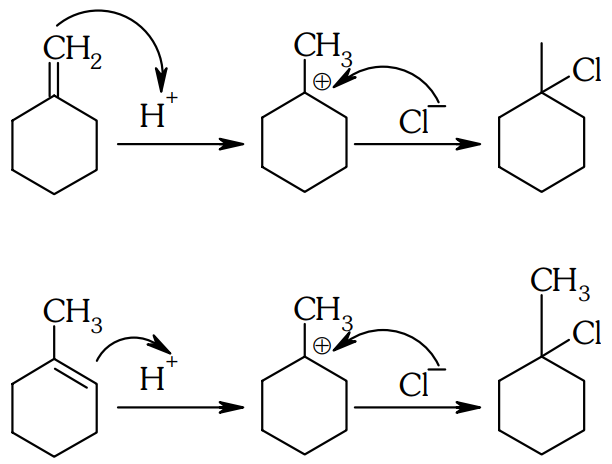
So both (A) and (B) give the product.
Reactions of benzene
-
Nitrobenzene can be prepared from benzene by using a mixture of conc. $HNO_3$ and conc. $H_2SO_4$. In the mixture, nitric acid acts as a/anIn the nitrating mixture, sulphuric acid is the stronger acid and donates a proton to nitric acid.
$HNO_3 + H_2SO_4 \rightleftharpoons H_2NO_3^+ + HSO_4^-$
The protonated nitric acid loses water to give the electrophile, the nitronium ion: $H_2NO_3^+ \rightarrow NO_2^+ + H_2O$
Since nitric acid accepts a proton from sulphuric acid, it behaves as a Brønsted base in this mixture.
Hence nitric acid acts as a base.
Electrophilic substitution
-
What products are formed when the following compound is treated with $Br_2$ in the presence of $FeBr_3$?
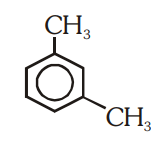
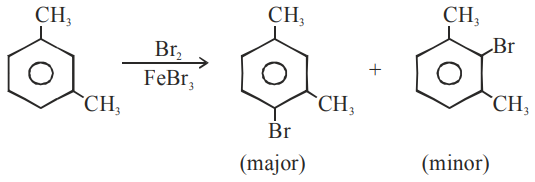
Attack at the two positions that are ortho to one $CH_3$ and para to the other gives the same compound, the major product.
Attack at the position between the two $CH_3$ groups is much less favoured because of high steric hindrance, so that product forms in a very small amount.
Products: 4-bromo-1,3-dimethylbenzene and 2-bromo-1,3-dimethylbenzene.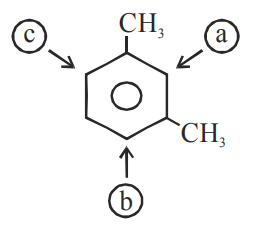
Directive influence of substituents
-
Some meta-directing substituents in aromatic substitution are given. Which one is most deactivating?Deactivating power: $-NO_2 > -C\equiv N > -SO_3H > -COOH$
Preparation and reactions of alkenes
-
In the following reactions,
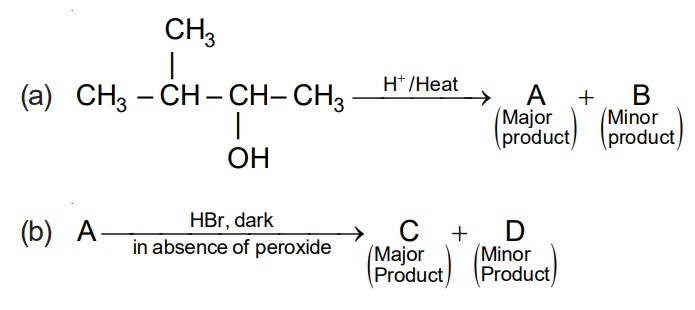
The major products (A) and (C) are respectively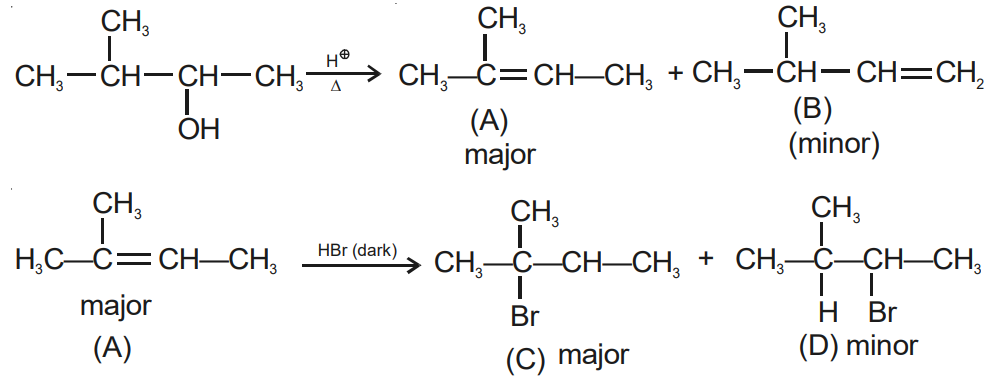
(a) Acid-catalysed dehydration of 3-methylbutan-2-ol: protonation of –OH and loss of water gives a carbocation, which then loses a proton.
By Saytzeff's rule the more substituted alkene is the major product: A = $CH_3-C(CH_3)=CH-CH_3$ (2-methylbut-2-ene, trisubstituted).
The minor product is B = $CH_3-CH(CH_3)-CH=CH_2$ (3-methylbut-1-ene).
(b) In the dark and in the absence of peroxide, HBr adds to A by the ionic mechanism following Markovnikov's rule.
$H^+$ adds to the CH carbon so as to form the more stable tertiary carbocation $CH_3-\overset{+}{C}(CH_3)-CH_2-CH_3$; $Br^-$ then attacks it.
C = $CH_3-C(CH_3)(Br)-CH_2-CH_3$ (2-bromo-2-methylbutane, major); D = $CH_3-CH(CH_3)-CH(Br)-CH_3$ (minor).
So A is $CH_3-C(CH_3)=CH-CH_3$ and C is $CH_3-C(CH_3)(Br)-CH_2-CH_3$.
Reactions of arenes
-
The reaction of toluene with $Cl_2$ in presence of $FeCl_3$ gives X and reaction in presence of light gives Y. Thus, X and Y areWith $Cl_2$ in the presence of the Lewis acid $FeCl_3$, the electrophile $Cl^+$ is generated and electrophilic substitution occurs on the ring.
The $-CH_3$ group is ortho/para directing, so X is a mixture of o-chlorotoluene and p-chlorotoluene.
With $Cl_2$ in the presence of light, chlorine free radicals are formed and substitution occurs on the side chain (benzylic hydrogens) by a free radical mechanism.
Successive substitution gives benzyl chloride, benzal chloride and finally benzotrichloride: $C_6H_5CH_3 \xrightarrow{Cl_2/h\nu} C_6H_5CH_2Cl \rightarrow C_6H_5CHCl_2 \rightarrow C_6H_5CCl_3$. So Y is trichloromethyl benzene.
Hence X = o- and p-chlorotoluene and Y = trichloromethyl benzene.
Note: the source prints the last option as 'Y = o- and p-chlorotoluene, Y = ...'; the first 'Y' is a misprint for X.
Acidity of Alkynes, Alkenes and Alkanes
-
Base strength of :
(i) $H_3C-\overset{\ominus}{C}H_2$
(ii) $H_2C=\overset{\ominus}{C}H$ and
(iii) $H-C\equiv C^{\ominus}$
is in the order of -Acidic character of the parent hydrocarbons: $H-C\equiv C-H \gt CH_2=CH_2 \gt CH_3-CH_3$
The carbon atoms are $sp$, $sp^2$ and $sp^3$ hybridised respectively.
Greater the s-character of the hybrid orbital (50 percent in $sp$, 33 percent in $sp^2$, 25 percent in $sp^3$), more electronegative is the carbon and more easily the proton is lost.
The conjugate bases of these acids are: $HC\equiv C^{\ominus}$, $CH_2=CH^{\ominus}$ and $CH_3-CH_2^{\ominus}$.
The conjugate base of a stronger acid is weaker, and vice-versa.
Basic character: $HC\equiv C^{\ominus} \lt CH_2=CH^{\ominus} \lt CH_3-CH_2^{\ominus}$
So the base strength is in the order (i) > (ii) > (iii).
Addition Reactions of Alkynes
-
Predict the product C obtained in the following reaction of butyne-1.
$CH_3CH_2-C\equiv CH + HCl \rightarrow B \xrightarrow{HI} C$The reaction occurs according to Markovnikov's rule: when an unsymmetrical alkene or alkyne undergoes hydrohalogenation, the negative part of the reagent goes to that carbon atom which carries the lesser number of hydrogen atoms.
Step 1: addition of HCl to but-1-yne. H adds to the terminal carbon and Cl to the inner carbon.
$CH_3-CH_2-C\equiv CH + HCl \rightarrow CH_3-CH_2-C(Cl)=CH_2$ (B, 2-chlorobut-1-ene)
Step 2: addition of HI to B. Again H adds to the $CH_2$ carbon (which has more hydrogens) and I adds to the carbon carrying Cl; the intermediate carbocation is stabilised by the lone pair of chlorine.
$CH_3-CH_2-C(Cl)=CH_2 + HI \rightarrow CH_3-CH_2-C(I)(Cl)-CH_3$ (C)
The product C is 2-chloro-2-iodobutane, $CH_3CH_2-C(I)(Cl)-CH_3$.
Catalytic Hydrogenation of Alkenes
-
Which one of the following alkenes will react faster with $H_2$ under catalytic hydrogenation conditions :-
[R = Alkyl substituent]In catalytic hydrogenation the alkene is adsorbed on the surface of the metal catalyst (Pt, Pd or Ni), and hydrogen atoms are added from the catalyst surface to the same face of the double bond (syn addition).
The rate depends on how easily the double bond can approach and lie flat on the catalyst surface, so bulky alkyl groups around the double bond slow the reaction.
So the more substituted the double bond, the slower the hydrogenation: tetrasubstituted $\lt$ trisubstituted $\lt$ disubstituted.
The tetrasubstituted and trisubstituted alkenes are therefore the slowest.
Among the disubstituted alkenes, the cis-isomer $RCH=CHR$ has one face of its double bond free of substituents and is also the less stable (higher energy) isomer, so it adsorbs readily and is hydrogenated fastest according to the answer key.
So the alkene that reacts fastest is the cis-disubstituted alkene $RCH=CHR$.
Oxidative Cleavage of Alkenes
-
The compound $CH_3-C(CH_3)=CH-CH_3$ on reaction with $NaIO_4$ in the presence of $KMnO_4$ gives :$NaIO_4$ with a small amount of $KMnO_4$ (Lemieux–von Rudloff reagent) cleaves a C=C double bond. $KMnO_4$ first forms a diol, which $NaIO_4$ cleaves; $NaIO_4$ also regenerates the permanganate.
The compound is 2-methylbut-2-ene, $(CH_3)_2C=CH-CH_3$.
Cleavage at the double bond gives $(CH_3)_2C=O$ from the left part and $CH_3CH=O$ from the right part.
The ketone (acetone) is not oxidised further, but the aldehyde fragment is oxidised by permanganate to a carboxylic acid: $CH_3CHO \rightarrow CH_3COOH$.
$(CH_3)_2C=CHCH_3 \xrightarrow{NaIO_4/KMnO_4} CH_3COCH_3 + CH_3COOH$
So the products are $CH_3COCH_3 + CH_3COOH$.
Free Radical Halogenation
-
Which one of the following is a free-radical substitution reaction :Chlorination of toluene in the side chain takes place when chlorine is passed into boiling toluene (in light, without a Lewis acid). It is a free radical chain reaction:
Initiation: $Cl_2 \xrightarrow{h\nu\ or\ heat} 2\dot{C}l$
Propagation: $C_6H_5CH_3 + \dot{C}l \rightarrow C_6H_5\dot{C}H_2 + HCl$, then $C_6H_5\dot{C}H_2 + Cl_2 \rightarrow C_6H_5CH_2Cl + \dot{C}l$
The benzyl radical is resonance stabilised, which is why substitution occurs in the side chain.
Friedel-Crafts alkylation of benzene is an electrophilic substitution; the reaction of benzyl chloride with $AgNO_2$ is a nucleophilic substitution; addition of HCN to acetaldehyde is a nucleophilic addition.
So the free radical substitution reaction is the chlorination of boiling toluene to benzyl chloride.
Electrophilic Substitution: Effect of Substituents
-
Increasing order of electrophilic substitution for following compounds :
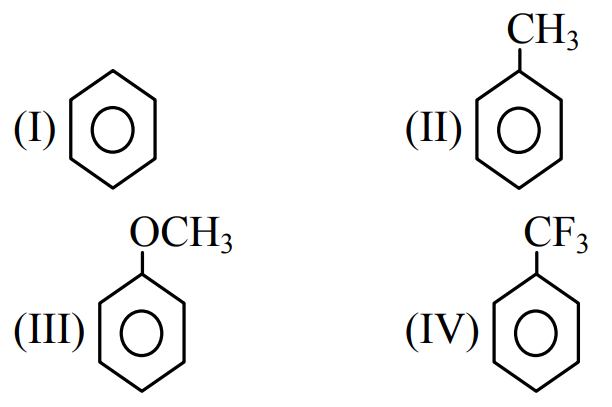 Groups that donate electrons to the ring increase its reactivity towards electrophiles; groups that withdraw electrons decrease it.
$-CF_3$ is a strong electron withdrawing group ($-I$ effect of three F atoms), so benzotrifluoride (IV) is less reactive than benzene.
$-CH_3$ donates electrons by +I effect and hyperconjugation, so toluene (II) is more reactive than benzene (I).
$-OCH_3$ donates electrons strongly by resonance (+R effect), so anisole (III) is the most reactive.
Increasing order: IV $\lt$ I $\lt$ II $\lt$ III.
Stability of Alkenes
-
Correct order of stability is :More substituted alkenes are more stable, because of hyperconjugation by the alkyl groups. 2-Butene (disubstituted) is more stable than 1-butene (monosubstituted).
Between the two 2-butenes, the trans isomer is more stable than the cis isomer, because in the cis form the two methyl groups are on the same side and repel each other (steric strain).
This is confirmed by heats of hydrogenation: 1-butene 127, cis-2-butene 120 and trans-2-butene 116 kJ/mol (less heat means more stable).
So the order is trans-2-butene $\gt$ cis-2-butene $\gt$ 1-butene.
That is every question in Hydrocarbons for this filter.
Want a score?
Answers here are not saved. Practise as a test to be marked and see your progress.
Practise as a test