Looking for classes? Ksquare Career Institute, Bengaluru →

Which one of the following is a free-radical substitution reaction :
A
- 
B
- 
C
- 
D
$CH_3CHO + HCN \rightarrow CH_3CH(OH)CN$
Detailed Solution
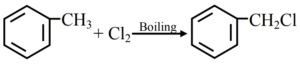
Chlorination of toluene in the side chain takes place when chlorine is passed into boiling toluene (in light, without a Lewis acid). It is a free radical chain reaction:
Initiation: $Cl_2 \xrightarrow{h\nu\ or\ heat} 2\dot{C}l$
Propagation: $C_6H_5CH_3 + \dot{C}l \rightarrow C_6H_5\dot{C}H_2 + HCl$, then $C_6H_5\dot{C}H_2 + Cl_2 \rightarrow C_6H_5CH_2Cl + \dot{C}l$
The benzyl radical is resonance stabilised, which is why substitution occurs in the side chain.
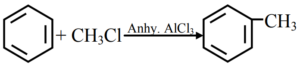
Friedel-Crafts alkylation of benzene is an electrophilic substitution; the reaction of benzyl chloride with $AgNO_2$ is a nucleophilic substitution; addition of HCN to acetaldehyde is a nucleophilic addition.
So the free radical substitution reaction is the chlorination of boiling toluene to benzyl chloride.
Initiation: $Cl_2 \xrightarrow{h\nu\ or\ heat} 2\dot{C}l$
Propagation: $C_6H_5CH_3 + \dot{C}l \rightarrow C_6H_5\dot{C}H_2 + HCl$, then $C_6H_5\dot{C}H_2 + Cl_2 \rightarrow C_6H_5CH_2Cl + \dot{C}l$
The benzyl radical is resonance stabilised, which is why substitution occurs in the side chain.
Friedel-Crafts alkylation of benzene is an electrophilic substitution; the reaction of benzyl chloride with $AgNO_2$ is a nucleophilic substitution; addition of HCN to acetaldehyde is a nucleophilic addition.
So the free radical substitution reaction is the chlorination of boiling toluene to benzyl chloride.