Looking for classes? Ksquare Career Institute, Bengaluru →

Chemistry
Hydrocarbons
75 questions from 35 papers, each with its answer.
- 75 questions
- 35 papers
- 4.26% of Chemistry
Aromaticity – Huckel's Rule
-
Consider the following compounds/species:
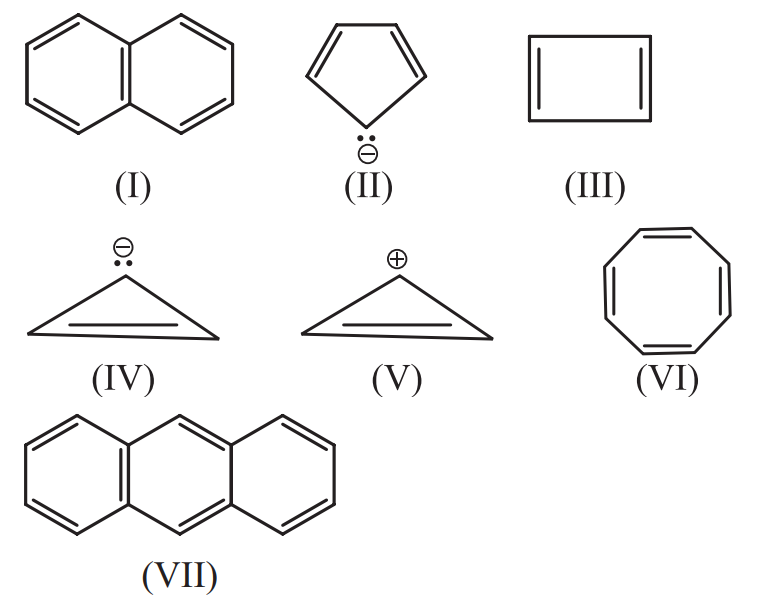 The number of compounds/species which obey Huckel's rule is _______.
Species with $(4n+2)\ \pi$ electrons that are cyclic, planar and conjugated obey Huckel's rule; four qualify.
According to Huckel rule, a compound/molecule is said to be aromatic if it is cyclic, planar, fully conjugated ($sp^2$ hybridised) and has $[4n+2]\ \pi$ electrons. The aromatic species have $10\pi$, $6\pi$, $2\pi$ and $14\pi$ electrons: all these are aromatic species according to Huckel rule.
Reactions of Alkenes – Ozonolysis and Markovnikov Addition of HCl
-
An alkene 'A' on reaction with $O_3$ and Zn-$H_2O$ gives propanone and ethanal in equimolar ratio. Addition of HCl to alkene 'A' gives 'B' as the major product. The structure of product 'B' is:Ozonolysis of A gives propanone and ethanal in equimolar ratio, so A is $(CH_3)_2C=CH-CH_3$ (2-methylbut-2-ene). Addition of HCl follows Markovnikov's rule: $H^+$ adds to the CH carbon to give the more stable 3° carbocation, and $Cl^-$ attaches to it. B: $H_3C-CH_2-C(CH_3)(Cl)-CH_3$ (2-chloro-2-methylbutane)
Stereochemistry of addition to alkenes
-
Given below are two statements: Statement I: trans-But-2-ene upon treatment with $Br_2$ in $CCl_4$ gives the following product.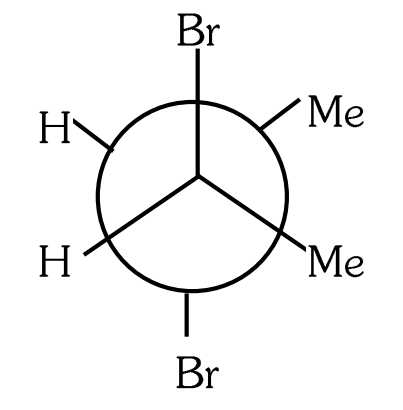 Statement II: cis-But-2-ene upon treatment with alkaline $KMnO_4$ gives the following product.
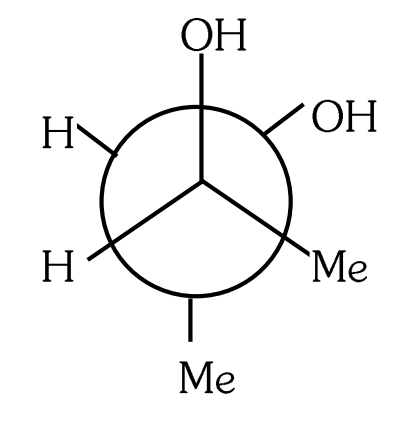 In the light of the above statements, choose the most appropriate answer from the options given below.Anti addition of $Br_2$ to trans-but-2-ene gives the meso compound (2,3-dibromobutane). The product drawn in Statement I, on rotation to its staggered form, is optically active, so it is not the meso product - Statement I is incorrect. Syn dihydroxylation of cis-but-2-ene with alkaline $KMnO_4$ gives the meso diol (butane-2,3-diol); the product drawn in Statement II is the optically inactive meso form - Statement II is correct.
Reduction of alkynes - geometrical isomers
-
Consider the following reaction sequences and choose the correct option.
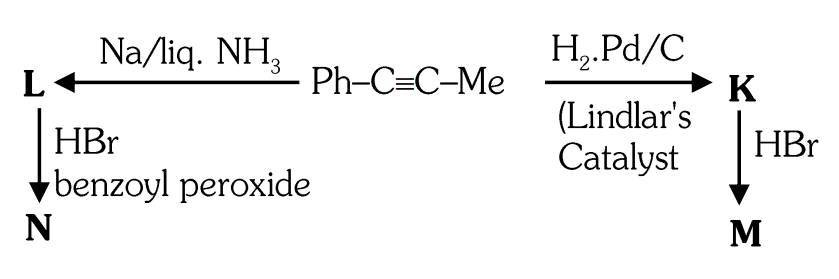
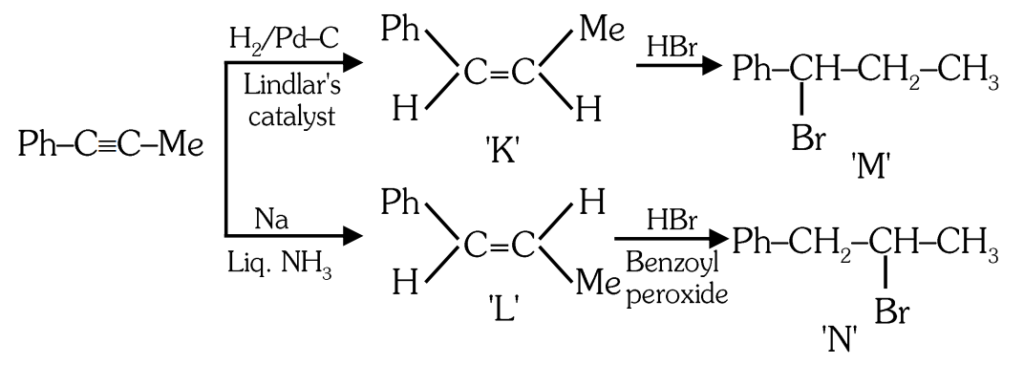 $Ph-C\equiv C-Me\xrightarrow{H_2,\ Pd/C\ (Lindlar's\ catalyst)}$ cis-$PhCH=CHMe$ (K); $\xrightarrow{Na/liq.\ NH_3}$ trans-$PhCH=CHMe$ (L). So K and L are geometrical isomers. K + HBr gives $Ph-CH(Br)-CH_2-CH_3$ (M); L + HBr/benzoyl peroxide gives $Ph-CH_2-CH(Br)-CH_3$ (N), which are position isomers, not stereoisomers.
Electrophilic addition to alkenes
-
In the following reaction:
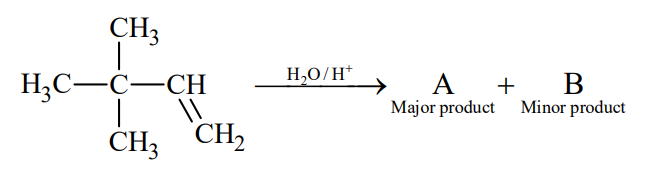
The major product is: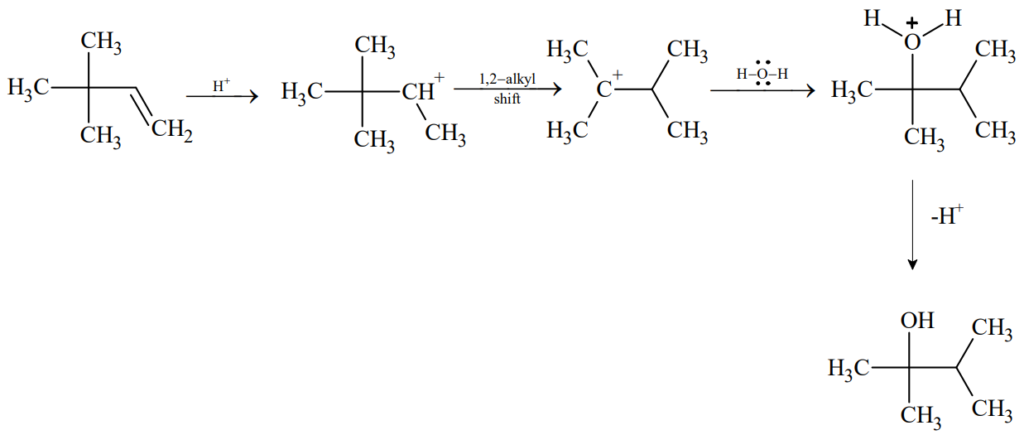
Step 1: $H^+$ adds to the terminal carbon, giving the secondary carbocation $(CH_3)_3C-\overset{+}{C}H-CH_3$.
Step 2: A 1,2-methyl shift converts it into the more stable tertiary carbocation $(CH_3)_2\overset{+}{C}-CH(CH_3)_2$.
Step 3: Water attacks the tertiary carbocation to give the protonated alcohol.
Step 4: Loss of $H^+$ gives $(CH_3)_2C(OH)-CH(CH_3)_2$ (2,3-dimethylbutan-2-ol), the major product.
The unrearranged alcohol $(CH_3)_3C-CH(OH)-CH_3$ is the minor product.
That is every question in Hydrocarbons for this filter.
Want a score?
Answers here are not saved. Practise as a test to be marked and see your progress.
Practise as a test