Looking for classes? Ksquare Career Institute, Bengaluru →

Chemistry
Haloalkanes and Haloarenes
55 questions from 33 papers, each with its answer.
- 55 questions
- 33 papers
- 3.13% of Chemistry
SN1 Reaction Rate and Carbocation Stability
-
The compound that will undergo $S_N1$ reaction with the fastest rate isThe compound forming the most stable carbocation undergoes $S_N1$ reaction at the fastest rate. 1-phenylethyl bromide ($C_6H_5-CH(CH_3)-Br$) ionises to give a benzylic carbocation that is stabilised by resonance with the benzene ring (and by the methyl group). So it undergoes $S_N1$ reaction with the fastest rate.
Nitrile to Amide to Hofmann Bromamide Reaction Sequence
-
Identify the major product C formed in the following reaction sequence: $CH_3-CH_2-CH_2-I \xrightarrow{NaCN} A \xrightarrow[\text{Partial hydrolysis}]{OH^-} B \xrightarrow[Br_2]{NaOH} C \text{(major)}$$CH_3-CH_2-CH_2-I \xrightarrow{NaCN} CH_3-CH_2-CH_2-CN$ (A) (nucleophilic substitution) $CH_3-CH_2-CH_2-CN \xrightarrow[Partial\ hydrolysis]{OH^-} CH_3-CH_2-CH_2-CONH_2$ (B) $CH_3-CH_2-CH_2-CONH_2 \xrightarrow{NaOH/Br_2} CH_3-CH_2-CH_2-NH_2$ (C) (Hofmann bromamide degradation – one carbon less) So the major product C is propylamine.
Substitution (PBr3) followed by Elimination (alc. KOH)
-
Major products A and B formed in the following reaction sequence, are
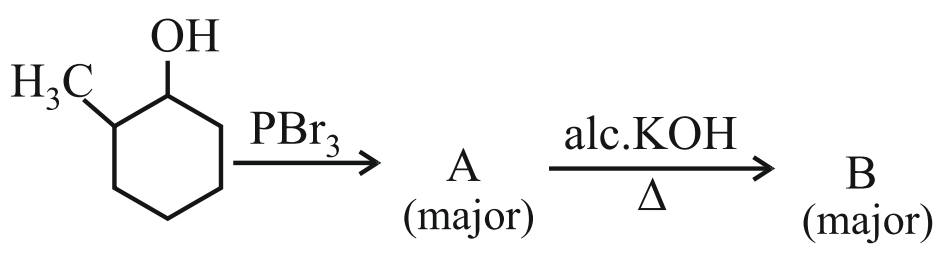
 $PBr_3$ replaces the –OH group by –Br at the same carbon: A = 1-bromo-2-methylcyclohexane.
alc. KOH, $\Delta$ causes dehydrohalogenation; by Saytzeff's rule, the more substituted alkene is the major product, with the double bond towards the carbon bearing $CH_3$: B = 1-methylcyclohexene.
Reactions of Alcohols with HX – Carbocation Rearrangement
-
Consider the following reaction and identify the product (P). $(CH_3)_2CH-CH(OH)-CH_3\xrightarrow{HBr}$ Product (P) (3-Methylbutan-2-ol)
A 2° carbocation rearranges by hydride shift to a 3° carbocation, giving 2-bromo-2-methylbutane.
Initially, after protonation followed by loss of water, a secondary (2°) carbocation is formed; further hydride shift leads to a tertiary (3°) carbocation. $Br^-$ then attacks the 3° carbocation to give 2-Bromo-2-methyl butane.
Preparation of alkyl halides (PCl5), dehydrohalogenation, and peroxide (anti-Markovnikov) addition of HBr
-
In the following reaction sequence, X and Z, respectively are: $CH_3CH_2CH_2-OH + PCl_5 \rightarrow CH_3CH_2CH_2Cl + X + HCl$, then $CH_3CH_2CH_2Cl \xrightarrow[\Delta]{Alc.\ KOH} Y \xrightarrow[(C_6H_5CO)_2O_2]{HBr} Z$$CH_3CH_2CH_2OH \xrightarrow{PCl_5} CH_3CH_2CH_2Cl + POCl_3 + HCl$, so X = $POCl_3$ $CH_3CH_2CH_2Cl \xrightarrow[\Delta]{alc.\ KOH} CH_3-CH=CH_2$ (Y) $CH_3-CH=CH_2 \xrightarrow[(C_6H_5CO)_2O_2]{HBr} CH_3CH_2CH_2Br$ (Z, anti-Markovnikov/peroxide effect) So X = $POCl_3$ and Z = $CH_3CH_2CH_2-Br$.
Nucleophilic substitution in haloarenes – benzyne mechanism
-
Identify A and predict the type of reaction:
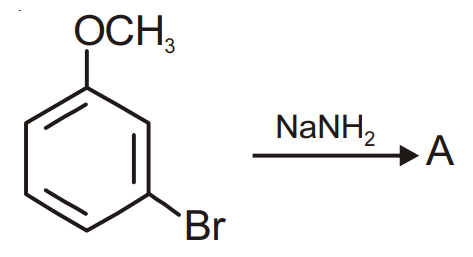
The more stable carbanion (ortho to $OCH_3$) directs $NH_2$ to the original C–Br carbon.
$NH_2^-$ removes the H ortho to Br (between Br and $OCH_3$), and loss of $Br^-$ gives a benzyne intermediate.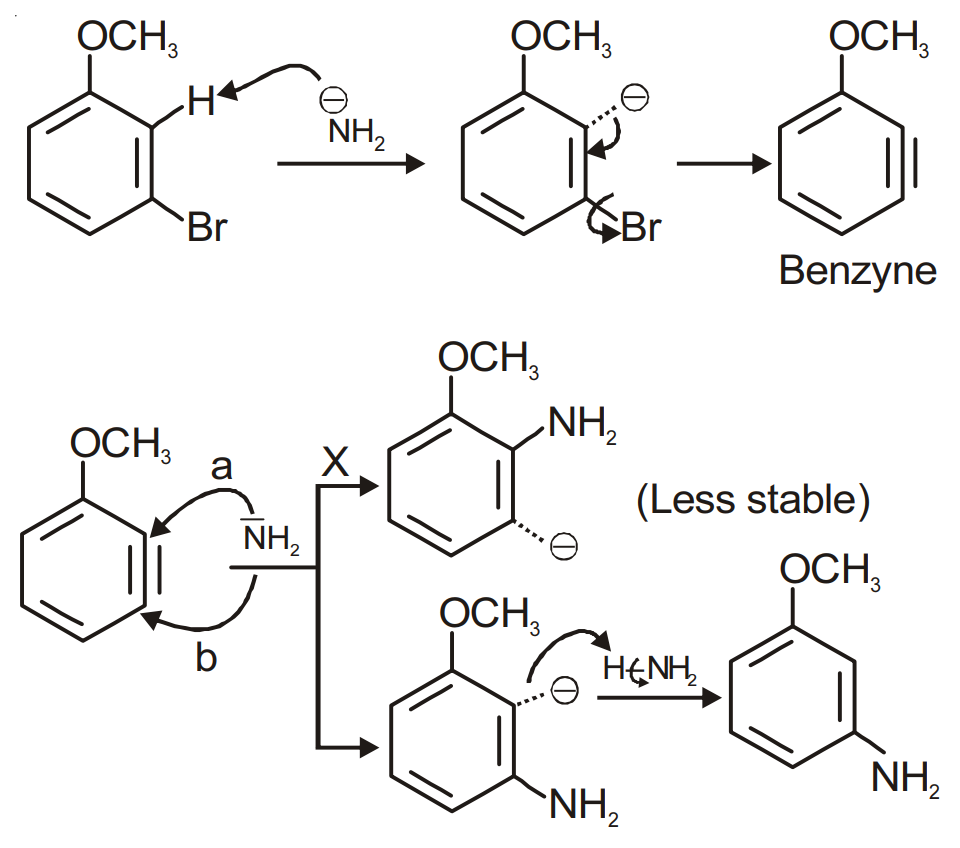
Attack of $NH_2^-$ at position b gives the carbanion ortho to $-OCH_3$, which is more stable as the negative charge is close to the electron-withdrawing group; attack at a gives the less stable carbanion.
Protonation by $NH_3$ gives 3-methoxyaniline.
$\because$ The incoming nucleophile ends on the same carbon on which Br (leaving group) was present, it is NOT cine substitution; it is a substitution reaction.
Mechanism of nucleophilic substitution
-
Consider the reactions:
(i) $(CH_3)_2CH-CH_2Br \xrightarrow{C_2H_5OH} (CH_3)_2CH-CH_2OC_2H_5 + HBr$
(ii) $(CH_3)_2CH-CH_2Br \xrightarrow{C_2H_5O^-} (CH_3)_2CH-CH_2OC_2H_5 + Br^-$
The mechanisms of reactions (i) and (ii) are respectivelyThe substrate, 1-bromo-2-methylpropane, is a primary alkyl halide.
An $S_N1$ reaction would need a primary carbocation, which is very unstable. In an $S_N1$ process this cation would rearrange (hydride shift) to the tertiary cation and give a rearranged product.
In both reactions the product is $(CH_3)_2CH-CH_2OC_2H_5$, in which the carbon skeleton is unchanged; no rearrangement has occurred.
So in both cases the nucleophile attacks the carbon bearing bromine directly, from the back side, in a single step: the $S_N2$ mechanism.
In (ii) the strong nucleophile $C_2H_5O^-$ clearly favours $S_N2$; in (i) the weaker nucleophile $C_2H_5OH$ reacts more slowly but, as the unrearranged product shows, also by $S_N2$.
Hence the mechanisms are $S_N2$ and $S_N2$.
Nucleophilic substitution
-
The correct order of increasing reactivity of C–X bond towards nucleophile in the following compounds is
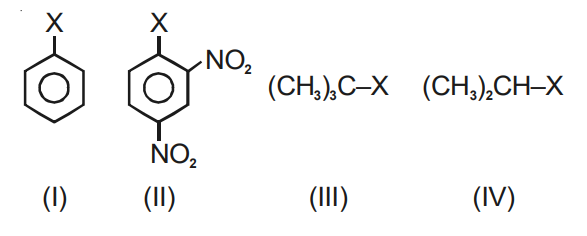 In aryl halides (I and II) the C–X bond has partial double bond character due to resonance and the carbon is $sp^2$ hybridised, so they are much less reactive towards nucleophiles than alkyl halides.
Among the aryl halides, the two electron-withdrawing $-NO_2$ groups at the ortho and para positions in (II) stabilise the intermediate carbanion, so (II) is more reactive than the unsubstituted halobenzene (I): I < II.
The alkyl halides (III and IV) react readily; taking the reaction through the carbocation ($S_N1$) pathway, the tertiary halide (III) forms the more stable tertiary carbocation and is more reactive than the secondary halide (IV): IV < III.
Combining these: I < II < IV < III
R and S Configuration
-
$CH_3-CHCl-CH_2-CH_3$ has a chiral centre. Which one of the following represents its R-configuration?
(Each option is a Fischer projection, described by the groups at the top, left, right and bottom of the central carbon.)Step 1: assign priorities to the four groups on the chiral carbon by atomic number: $Cl$ (1) > $C_2H_5$ (2) > $CH_3$ (3) > $H$ (4).
($C_2H_5$ ranks above $CH_3$ because its first carbon is attached to (C, H, H) while the methyl carbon is attached to (H, H, H).)
Step 2: in a Fischer projection the vertical bonds point away from the viewer. If the lowest priority group (H) is on a vertical bond, the direction 1 to 2 to 3 seen on paper gives the configuration directly; if H is on a horizontal bond, the direction seen must be reversed.
For the projection with $C_2H_5$ on top, $Cl$ on the left, $CH_3$ on the right and $H$ at the bottom: H is on a vertical bond.
Going from $Cl$ (left) to $C_2H_5$ (top) to $CH_3$ (right) is a clockwise path.
Clockwise with H pointing away means the R-configuration.
In the projection with $H_3C$ on the left and $Cl$ on the right (H at the bottom), the path $Cl \rightarrow C_2H_5 \rightarrow CH_3$ is anticlockwise, so it is S.
In the two projections with H on the left (a horizontal bond), the path seen is clockwise, which on reversal gives S.
So the R-configuration is the projection with $C_2H_5$ at the top, $Cl$ on the left, $CH_3$ on the right and $H$ at the bottom.
Optical Isomerism: Enantiomers and Meso Compounds
-
Which of the following pairs of compounds are enantiomers :Enantiomers are non-superimposable mirror images. In Fischer projections, two structures are mirror images if every left and right group is swapped.
A structure of butane-2,3-diol in which both OH groups are on the same side (both right or both left) has a plane of symmetry through the middle. It is the meso form, which is optically inactive and has no enantiomer.
A structure in which the two OH groups are on opposite sides is chiral.
In the first pair, the left structure has OH on the right at C-2 and on the left at C-3 (chiral). The right structure has every group swapped: OH on the left at C-2 and on the right at C-3. They are mirror images.
Neither can be turned into the other by a $180^\circ$ rotation in the plane (which is the only allowed operation for Fischer projections), so they are non-superimposable mirror images, i.e. enantiomers.
In the other pairs, one member is a meso form (both OH on the same side), so those pairs are diastereomers, not enantiomers.
So the pair that are enantiomers is the first pair, with OH groups on opposite sides in both structures and every position swapped between them.
That is every question in Haloalkanes and Haloarenes for this filter.
Want a score?
Answers here are not saved. Practise as a test to be marked and see your progress.
Practise as a test