Looking for classes? Ksquare Career Institute, Bengaluru →

Chemistry
Thermodynamics
82 questions from 36 papers, each with its answer.
- 82 questions
- 36 papers
- 4.66% of Chemistry
Gibbs free energy and spontaneity ($\Delta H$ from $\Delta U$ for gaseous reactions)
-
Consider the following reaction: $2A(g) + B(g) \rightarrow 2D(g)$, $\Delta U^{\ominus} = -10\ kJ\,mol^{-1}$ and $\Delta S^{\ominus} = -44\ J\,K^{-1}$ at 298 K. Identify the CORRECT option with $\Delta G^{\ominus}$ for the reaction and spontaneity of the reaction at 298 K. [Given: $R = 8.31\ J\,mol^{-1}\,K^{-1}$]$\Delta G^\circ = \Delta H^\circ - T\Delta S^\circ$ and $\Delta H^\circ = \Delta U^\circ + \Delta n_g RT$ $\Delta n_g = 2 - 3 = -1$ $\Delta H^\circ = -10 + \left[\frac{(-1)(8.3)(298)}{1000}\right] = -10 - 2.4734 = -12.4734\ kJ\,mol^{-1}$ $\Delta G^\circ = -12.4734 - \frac{(298)(-44)}{1000} = -12.4734 + 13.112$ $= +0.6386\ kJ\,mol^{-1}$, non-spontaneous
Work in isothermal and adiabatic processes - Carnot cycle
-
Consider the reversible processes for 1.0 mol of an ideal gas as shown in the figure.
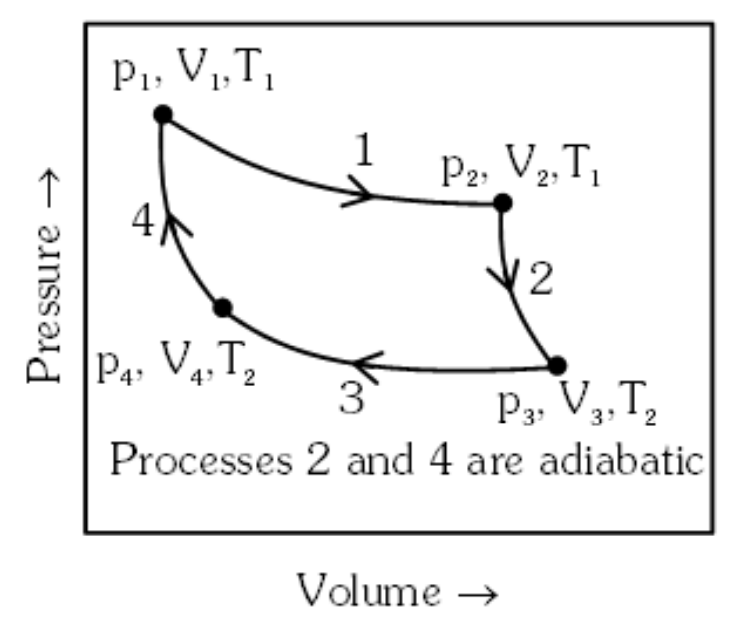 $w_1$, $w_2$, $w_3$ and $w_4$ represent work done (in calories) in the processes 1, 2, 3 and 4, respectively; $\Delta U_2$ and $\Delta U_4$ are changes in the internal energy for the processes 2 and 4, respectively. [use R = 2 cal K$^{-1}$ mol$^{-1}$] The correct option isProcess 1 (isothermal, reversible): $w_1=-nRT_1\ln\frac{V_2}{V_1}=-2T_1\ln\frac{V_2}{V_1}$. Process 3 (isothermal, reversible): $w_3=-2T_2\ln\frac{V_4}{V_3}$. So $w_1+w_3=-2T_1\ln\frac{V_2}{V_1}-2T_2\ln\frac{V_4}{V_3}$. Process 2 (adiabatic expansion): $w_2=\Delta U_2=C_V(T_2-T_1)$. Process 4 (adiabatic compression): $w_4=\Delta U_4=C_V(T_1-T_2)$, so $w_2+w_4=\Delta U_2+\Delta U_4=0$.
Gibbs Energy and Pressure-Volume Work
-
The densities of graphite and diamond at 298 K are 2.25 and 3.31 g cm$^{-3}$, respectively. If the standard free energy difference ($\Delta G^\circ$) is equal to 1895 J mol$^{-1}$, the pressure at which graphite will be transformed into diamond at 298 K is -Graphite changes into diamond when the work done by the applied pressure on the decrease in volume supplies the free energy difference: $\Delta G^\circ = P\,|\Delta V|$.
Molar volume of graphite $= \dfrac{12}{2.25} = 5.33$ cm$^3$ mol$^{-1}$
Molar volume of diamond $= \dfrac{12}{3.31} = 3.63$ cm$^3$ mol$^{-1}$
$|\Delta V| = 5.33 - 3.63 = 1.71$ cm$^3$ mol$^{-1}$ $= 1.71 \times 10^{-6}$ m$^3$ mol$^{-1}$
$P = \dfrac{\Delta G^\circ}{|\Delta V|} = \dfrac{1895}{1.71 \times 10^{-6}} \approx 1.1 \times 10^9$ Pa
This is of the order of $10^9$ Pa, i.e. about $10^4$ atmospheres. Among the options, the value of this order is $9.92 \times 10^8$ Pa; the other options are 10, 100 or 1000 times too small.
So graphite will be transformed into diamond at about $9.92 \times 10^8$ Pa.
That is every question in Thermodynamics for this filter.
Want a score?
Answers here are not saved. Practise as a test to be marked and see your progress.
Practise as a test