Looking for classes? Ksquare Career Institute, Bengaluru →

Chemistry
Alcohols, Phenols and Ethers
65 questions from 33 papers, each with its answer.
- 65 questions
- 33 papers
- 3.69% of Chemistry
Hydroboration-Oxidation and Oxidation of Alcohols
-
Identify the correct reagents that would bring about the following transformation.
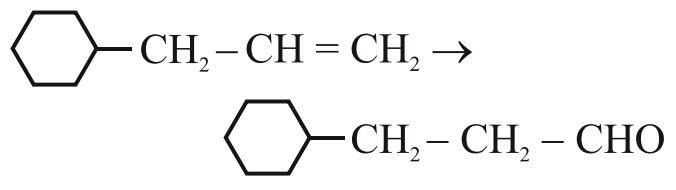 The terminal alkene must be converted to an aldehyde with the carbonyl at the terminal carbon (anti-Markovnikov): (i) $BH_3$ (ii) $H_2O_2/OH^-$: hydroboration-oxidation gives the primary alcohol $-CH_2-CH_2-CH_2-OH$ (anti-Markovnikov addition of water) (iii) PCC: mild oxidation of the primary alcohol stops at the aldehyde $-CH_2-CH_2-CHO$ So the reagents are (i) $BH_3$ (ii) $H_2O_2/OH^-$ (iii) PCC.
Reactions of Ethers – Cleavage by HI
-
Consider the following reaction
 Identify products A and B
The ether cleaves by an SN1 path through a benzylic carbocation.
Reaction follows SN1 pathway involving Benzylic carbocation. [add image]
Dehydration of Alcohols
-
Which amongst the following will be most readily dehydrated under acidic conditions ?
The alcohol whose dehydration gives a conjugated diene is dehydrated most readily.
Formation of conjugated diene in option (c) makes the given reactant most reactive towards dehydration in acidic conditions. [add image] -
Which of the following is not the product of dehydration of
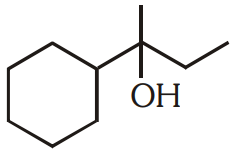 ?Dehydration proceeds through the tertiary carbocation on the side-chain carbon; it is already stable, so no rearrangement occurs.
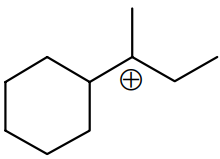
Alkenes can only form by loss of $H^+$ from carbons next to this cation, so the product with the double bond inside the ring away from that carbon is not possible.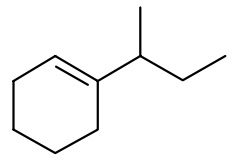
Preparation of Alcohols – Reduction of Carbonyl Compounds
-
The product formed in the following chemical reaction is:
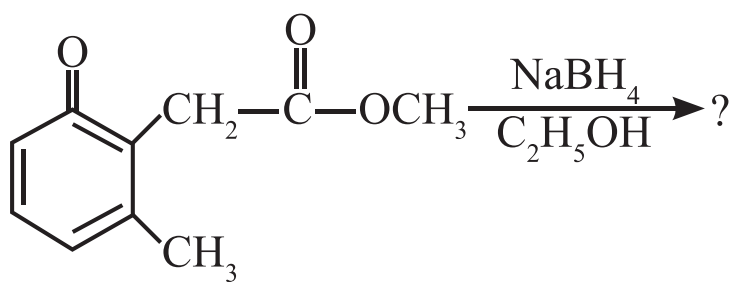 $NaBH_4$ reduces aldehydes and ketones but does not reduce esters. So only the ring C=O is reduced to –OH, and the $-CH_2COOCH_3$ group remains unchanged.
Physical and Chemical Properties of Alcohols, Phenols and Ethers – Basicity
-
The compound that is most difficult to protonate is:In phenol ($Ph-O-H$), the lone pair of electrons on oxygen is involved in resonance with the benzene ring, so oxygen carries a partial positive charge. Hence an incoming proton cannot attack it easily, and phenol is the most difficult to protonate.
Preparation and interconversion reactions of alcohols and phenols
-
Match List I with List II:
Pick the matching item from Column II for each row.
Column I
-
i. -
- ii. $CH_3COOH \rightarrow CH_3CH_2OH$
-
iii. -
-
iv. -
Column II
- a. (i) oleum; (ii) NaOH, ∆ (iii) $H^+$
- b. (i) $O_2$ (ii) $H_2O/H^+$
- c. (i) $CH_3OH, H^+$ (ii) $H_2$, catalyst
- d. (i) conc. $H_2SO_4, \Delta$ (ii) $H^+ / H_2O$
Correct answer: i → b, ii → c, iii → d, iv → a
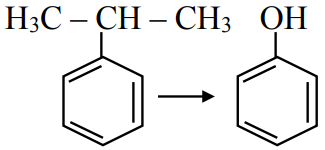
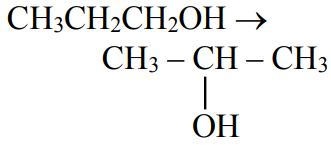
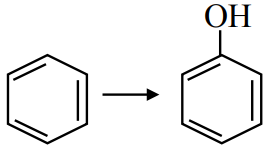
Cumene (isopropylbenzene) $\xrightarrow[(ii)\ H_2O,\ H^+]{(i)\ O_2}$ Phenol, so (i) matches (i) $O_2$; (ii) $H_2O/H^+$. $CH_3COOH \xrightarrow[(ii)\ H_2,\ catalyst]{(i)\ CH_3OH,\ H^+} CH_3CH_2OH$ (esterification followed by hydrogenolysis), so (ii) matches (i) $CH_3OH, H^+$; (ii) $H_2$, catalyst. $CH_3CH_2CH_2OH \xrightarrow[(ii)\ H^+/H_2O]{(i)\ conc.\ H_2SO_4,\ \Delta} CH_3-CH(OH)-CH_3$ (dehydration to propene, then Markovnikov hydration), so (iii) matches (i) conc. $H_2SO_4, \Delta$; (ii) $H^+/H_2O$. Benzene $\xrightarrow[(ii)\ NaOH,\ \Delta;\ (iii)\ H^+]{(i)\ Oleum}$ Phenol (sulphonation, alkali fusion, acidification), so (iv) matches (i) oleum; (ii) NaOH, $\Delta$; (iii) $H^+$. Correct match: i-b, ii-c, iii-d, iv-a. -
i. -
Reactions of polyhydric alcohols
-
When glycerol is treated with excess of HI, it produces
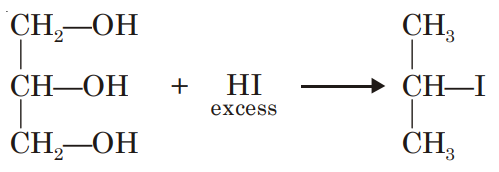
With HI, the three –OH groups of glycerol are first replaced to give 1,2,3-triiodopropane, which is unstable and loses $I_2$ to give allyl iodide: $CH_2OH-CHOH-CH_2OH + 3HI \rightarrow CH_2I-CHI-CH_2I \rightarrow CH_2=CH-CH_2I + I_2$
With a small amount of HI the reaction stops here, at allyl iodide.
With excess HI, allyl iodide adds HI (Markovnikov addition) to give 1,2-diiodopropane, which again loses $I_2$ to give propene: $CH_2=CH-CH_2I + HI \rightarrow CH_3-CHI-CH_2I \rightarrow CH_3-CH=CH_2 + I_2$
Propene then adds another molecule of HI according to Markovnikov's rule: $CH_3-CH=CH_2 + HI \rightarrow CH_3-CHI-CH_3$
Hence with excess HI the final product is 2-iodopropane (isopropyl iodide).
That is every question in Alcohols, Phenols and Ethers for this filter.
Show all 65 questions Next: Aldehydes, Ketones and Carboxylic Acids
Want a score?
Answers here are not saved. Practise as a test to be marked and see your progress.
Practise as a test