Looking for classes? Ksquare Career Institute, Bengaluru →

Chemistry
Organic Chemistry - Some Basic Principles and Techniques
88 questions from 35 papers, each with its answer.
- 88 questions
- 35 papers
- 5% of Chemistry
Isomerism in Cyclic Ethers
-
Total number of possible isomers (both structural as well as stereoisomers) of cyclic ethers of molecular formula $\text{C}_4\text{H}_8\text{O}$ is:
5-membered ring: tetrahydrofuran (1); 4-membered ring: 2-methyloxetane (2: R,S), 3-methyloxetane (1); 3-membered ring: 2-ethyloxirane (2: R,S), 2,3-dimethyloxirane (3: cis-meso, trans-pair), 2,2-dimethyloxirane (1). Total $= 1 + 2 + 1 + 2 + 3 + 1 = 10$.
For cyclic ethers with formula $\text{C}_4\text{H}_8\text{O}$ (Degree of unsaturation = 1): 1. Oxolane (5-membered): Tetrahydrofuran (THF) $\implies 1$ isomer. 2. Oxetanes (4-membered): (a) 2-methyloxetane has one chiral center at C-2 $\implies 2$ enantiomers (R and S); (b) 3-methyloxetane is achiral $\implies 1$ isomer. 3. Oxiranes (3-membered): (a) 2-ethyloxirane has one chiral center $\implies 2$ enantiomers (R and S); (b) 2,3-dimethyloxirane has two chiral centers, giving 1 meso-isomer (cis) and 1 pair of enantiomers (trans-R,R and trans-S,S) $\implies 3$ stereoisomers; (c) 2,2-dimethyloxirane is achiral $\implies 1$ isomer. Summing all structural and stereoisomers: $1 + 2 + 1 + 2 + 3 + 1 = 10$ isomers.
Stereoisomerism – atropisomerism in biphenyls
-
Which of the following biphenyls is optically active?
Bulky ortho groups on both rings restrict rotation, creating axial chirality.
A substituted biphenyl can have a chiral axis when the steric (van der Waals repulsion) interaction between ortho substituents is sufficient to stop rotation of the aromatic rings relative to each other about the bond joining the two rings.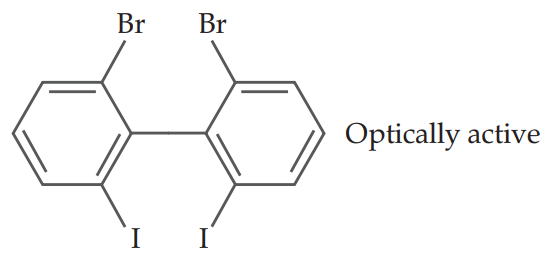
So the biphenyl with Br and I at all four ortho positions is optically active.
Resonance in heterocycles – pyrrole
-
In pyrrole, the electron density is maximum on:
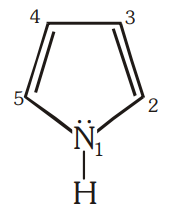
Resonance places negative charge mainly at C2 and C5.
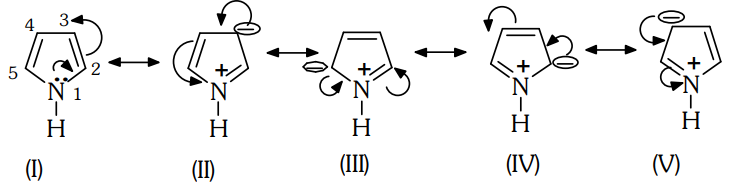
Maximum electron density is at positions 2 and 5, as resonating structures III and IV are more stable than II and V, so they are major contributors.
Tautomerism – keto–enol
-
Which among the given molecules can exhibit tautomerism?
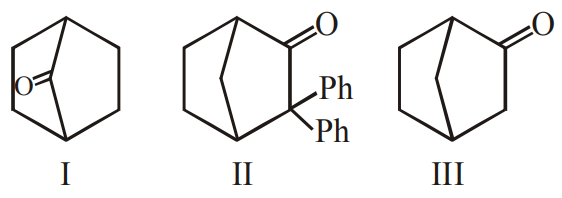
Tautomerism needs an enolisable $\alpha$-H.
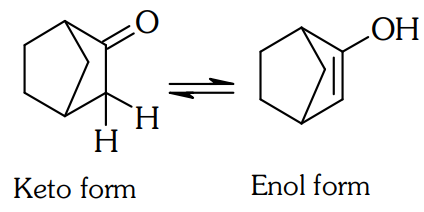
Only III has an $\alpha$-hydrogen that can shift to form a stable enol; in I the $\alpha$-carbons are bridgeheads (enol would violate Bredt's rule) and in II the $\alpha$-carbon has no H.
IUPAC nomenclature
-
Structure of the compound whose IUPAC name is 3-Ethyl-2-hydroxy-4-methylhex-3-en-5-ynoic acid is:Number the chain from the –COOH carbon (C-1): –OH on C-2, ethyl on C-3, C=C between C-3 and C-4, methyl on C-4, C≡C between C-5 and C-6.
$HC\equiv C-C(CH_3)=C(C_2H_5)-CH(OH)-COOH$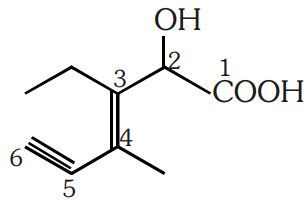
Conformations
-
Which of the following conformers for ethylene glycol is most stable?Ethylene glycol is $HOCH_2-CH_2OH$; its conformations arise by rotation about the C–C bond.
Eclipsed conformations have torsional strain and are less stable than staggered ones.
Normally the anti (staggered) conformation, with the two bulky groups $180^\circ$ apart, would be the most stable.
In ethylene glycol, however, the gauche (staggered) conformation, in which the two –OH groups are $60^\circ$ apart, allows an intramolecular hydrogen bond between the –OH groups.
This hydrogen bond more than compensates for the steric repulsion, so the gauche form is more stable than the anti form.
Hence the most stable conformer is the staggered Newman projection in which the two –OH groups are on adjacent positions (gauche).
That is every question in Organic Chemistry - Some Basic Principles and Techniques for this filter.
Want a score?
Answers here are not saved. Practise as a test to be marked and see your progress.
Practise as a test