Looking for classes? Ksquare Career Institute, Bengaluru →

Chemistry
Aldehydes, Ketones and Carboxylic Acids
91 questions from 38 papers, each with its answer.
- 91 questions
- 38 papers
- 5.17% of Chemistry
Oxidative Cleavage of Alkenes with KMnO4
-
For the given reaction:
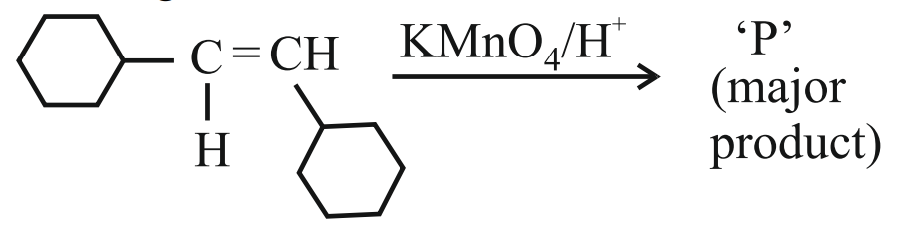 'P' is
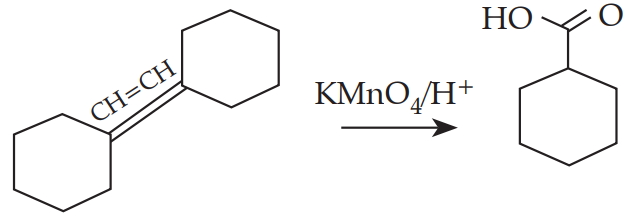
Hot acidic $KMnO_4$ cleaves the C=C double bond. Each =CH– carbon of the alkene is oxidised to a –COOH group. So the major product P is cyclohexanecarboxylic acid, $C_6H_{11}COOH$.
Oxidation, Friedel-Crafts and Ozonolysis Reactions
-
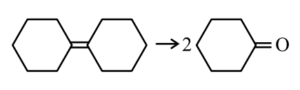
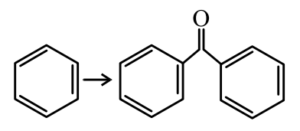
Match List-I (Reaction, shown as structures) with List-II (Reagents/Condition) for the given organic transformations.
Pick the matching item from Column II for each row.
Column I
-
A. -
-
B. -
-
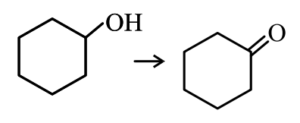
C. -
-
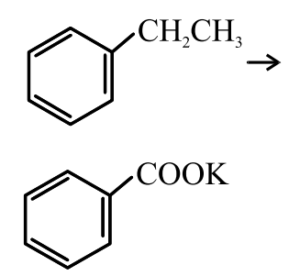
D. -
Column II
- I.
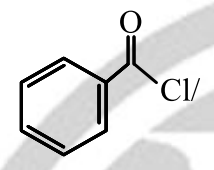 $C_6H_5COCl$ / Anhyd. $AlCl_3$
- II. $CrO_3$
- III. $KMnO_4$/$KOH$, $\Delta$
- IV. (i) $O_3$ (ii) $Zn$-$H_2O$
Correct answer: A → IV, B → I, C → II, D → III
(A) Cleavage of the C=C bond to give two molecules of cyclohexanone: (i) $O_3$ (ii) $Zn-H_2O$ – ozonolysis
(B) Benzene to benzophenone: benzoyl chloride / anhyd. $AlCl_3$ – Friedel-Crafts acylation
(C) Cyclohexanol to cyclohexanone: $CrO_3$ – mild oxidation
(D) Ethylbenzene side chain to $-COOK$: $KMnO_4$/KOH, $\Delta$ – strong oxidation
Correct match: A-IV, B-I, C-II, D-III. -
A. -
Reduction, Dehydration and Wurtz-Fittig Reaction Sequence
-
Identify the final product [D] obtained in the following sequence of reactions,

LiAlH4 reduces the carbonyl to an alcohol, H2SO4 dehydrates it, HBr adds, and Wurtz-Fittig coupling gives D.
$CH_3-CHO\xrightarrow{LiAlH_4}CH_3CH_2OH\xrightarrow{H_2SO_4}CH_2=CH_2\xrightarrow{HBr}CH_3CH_2Br$ (C) Wurtz-Fittig reaction gives (D). [add image] $LiAlH_4$ used for reduction of carbonyl group into alcohol and $H_2SO_4$ used for dehydration of alcohol.
Aldol Condensation
-
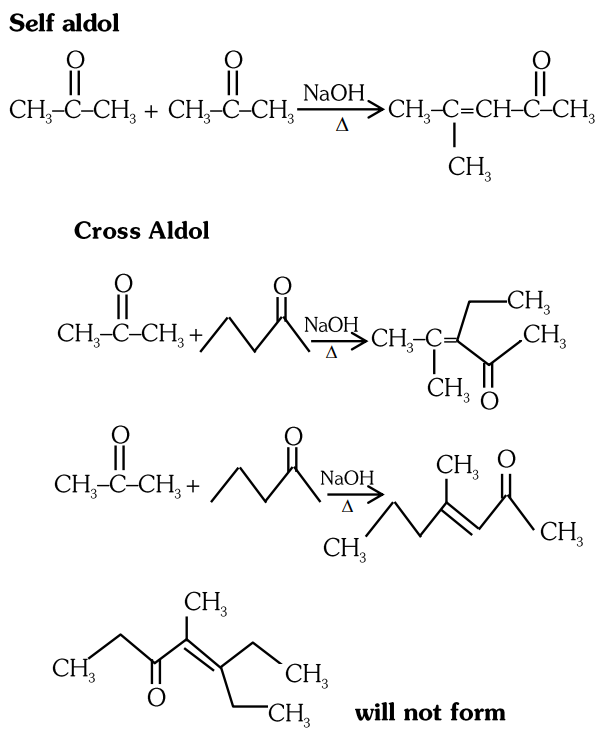
Which one of the following is not formed when acetone reacts with 2-pentanone in the presence of dilute NaOH followed by heating?-
-
Which one of the following compounds will be most readily dehydrated?All four compounds are hydroxy ketones; they differ in the position of the –OH group relative to the C=O group.
A β-hydroxy ketone (–OH on the carbon two positions away from the carbonyl carbon) loses water very easily, as in the dehydration step of the aldol condensation.
Reasons: the hydrogen on the α-carbon, lying between the C=O and the C–OH, is acidic and is easily removed; and the product is an α,β-unsaturated ketone, in which the new C=C is conjugated with C=O and is therefore resonance stabilised.
In an α-hydroxy ketone or a γ-hydroxy ketone, loss of water cannot give such a conjugated system so readily.
The compound $CH_3-CO-CH_2-CH(OH)-CH_2-CH_3$, which has the –OH group at the β-position to the keto group, is therefore the most readily dehydrated, giving $CH_3-CO-CH=CH-CH_2-CH_3$.
Preparation of Aldehydes – Etard Reaction
-
The intermediate compound 'X' in the following chemical reaction is:
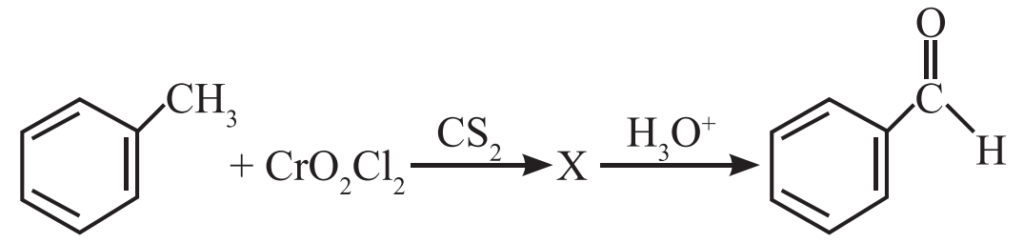 Etard reaction: toluene is oxidised by chromyl chloride in $CS_2$ to form a chromium complex, which on hydrolysis gives benzaldehyde. $C_6H_5CH_3 + CrO_2Cl_2 \xrightarrow{CS_2} C_6H_5CH(OCrOHCl_2)_2 \xrightarrow{H_3O^+} C_6H_5CHO$ So X is $C_6H_5CH(OCrOHCl_2)_2$.
Identification tests (2,4-DNP, Fehling's) and oxidative degradation of methyl ketones
-
Compound $P(C_8H_8O)$ gives a red orange precipitate with 2,4-DNP reagent and it does not reduce Fehling's reagent. On drastic oxidation with chromic acid, P gives an aromatic product Q that produces effervescence on treating with aq. $NaHCO_3$. Compounds P and Q, respectively, are:P ($C_8H_8O$) = acetophenone, $C_6H_5COCH_3$ P gives red-orange ppt with 2,4-DNP (carbonyl group present). P does not reduce Fehling's reagent (ketone, not aldehyde). $C_6H_5COCH_3 \xrightarrow[\Delta]{H_2CrO_4} C_6H_5COOH$ (Q, benzoic acid) $C_6H_5COOH + NaHCO_3 \rightarrow C_6H_5COONa + H_2O + CO_2 \uparrow$ (effervescence) So P = acetophenone and Q = benzoic acid.
Cyanohydrin formation and decarboxylation
-
The below product formed from the following reaction sequence is:
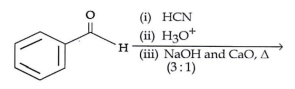 Benzaldehyde + HCN gives the cyanohydrin $C_6H_5CH(OH)CN$; acid hydrolysis gives $C_6H_5CH(OH)COOH$; heating with sodalime (NaOH + CaO, a decarboxylating reagent) removes $CO_2$ to give benzyl alcohol $C_6H_5CH_2OH$.
Grignard carboxylation and amide formation
-
The products A and B in the following reaction sequence are:
 Styrene + HBr (Markovnikov) gives 1-bromo-1-phenylethane; with Mg in dry ether it forms the Grignard reagent, which on reaction with $CO_2$ followed by $H_3O^+$ gives 2-phenylpropanoic acid (A). $SOCl_2$ converts A to the acid chloride, which with $CH_3NH_2$ gives N-methyl-2-phenylpropanamide (B).
Cross aldol condensation
-
The compound that CANNOT be obtained from the aldol condensation reaction shown below, is
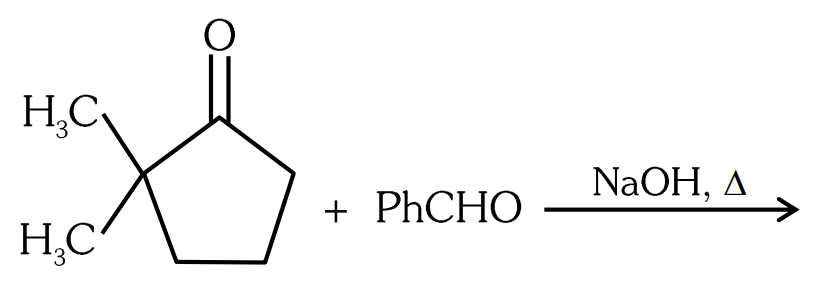 An aldol condensation product must be an $\alpha,\beta$-unsaturated carbonyl compound. In option (1) the ring double bond is at the $\beta,\gamma$ position relative to the C=O, so it cannot be formed by aldol condensation.
That is every question in Aldehydes, Ketones and Carboxylic Acids for this filter.
Want a score?
Answers here are not saved. Practise as a test to be marked and see your progress.
Practise as a test