Looking for classes? Ksquare Career Institute, Bengaluru →

Chemistry
Chemical Kinetics
80 questions from 37 papers, each with its answer.
- 80 questions
- 37 papers
- 4.55% of Chemistry
Activation Energy from Arrhenius Equation (Two-Temperature Form)
-
The rate of a reaction quadruples when temperature changes from $27^\circ C$ to $57^\circ C$. Calculate the energy of activation. Given $R = 8.314$ J $K^{-1} mol^{-1}$, $\log 4 = 0.6021$$\log\frac{k_2}{k_1} = \frac{E_a}{2.303R}\left(\frac{T_2 - T_1}{T_1T_2}\right)$, with $T_1 = 300$ K, $T_2 = 330$ K, $\frac{k_2}{k_1} = 4$ $\log 4 = \frac{E_a}{2.303 \times 8.314} \times \frac{330 - 300}{330 \times 300}$ $E_a = \frac{0.6021 \times 2.303 \times 8.314 \times 330 \times 300}{30}$ $E_a \approx 38040$ J/mol $= 38.04$ kJ/mol
Activation Energy and Arrhenius Equation
-
A reaction can have zero activation energy.Reason: The minimum extra amount of energy absorbed by reactant molecules so that their energy becomes equal to threshold value, is called activation energy.
Radical recombination reactions can have zero activation energy.
A reaction can have zero activation energy, for example, $\dot{C}H_3+\dot{C}H_3\rightarrow CH_3-CH_3$ has zero activation energy.
Arrhenius equation
-
For an elementary chemical reaction, the Arrhenius plot is given below.
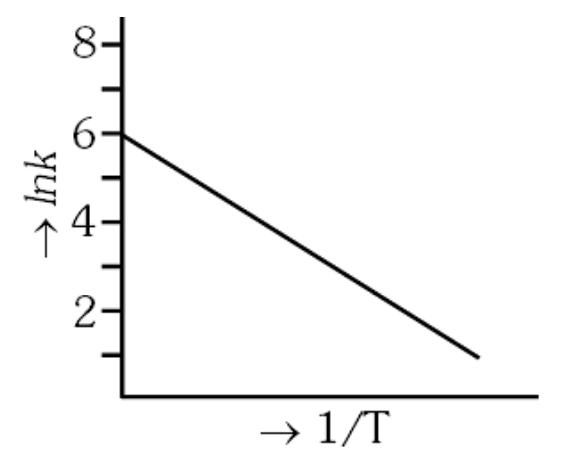 If the energy of activation is 6.64 kJ mol$^{-1}$ and R = 8.3 J K$^{-1}$ mol$^{-1}$, the temperature at which the rate constant becomes $e^2$ min$^{-1}$, is$\ln k=\ln A-\frac{E_a}{RT}$. From the graph, $\ln A=6$ (intercept). For $k=e^2$: $2=6-\frac{6.64\times1000}{8.3\times T} \Rightarrow \frac{6640}{8.3\times T}=4 \Rightarrow T=200$ K.
Reaction mechanism – rate-determining step and order
-
Mechanism of a hypothetical reaction $X_2 + Y_2 \rightarrow 2XY$ is given below:
(i) $X_2 \rightarrow X + X$ (fast)
(ii) $X + Y_2 \rightleftharpoons XY + Y$ (slow)
(iii) $X + Y \rightarrow XY$ (fast). The overall order of the reaction will beSubstitute the pre-equilibrium $[X] \propto [X_2]^{1/2}$ into the slow step rate.
The solution is given by assuming step (i) to be reversible, which is not stated in the question.
Overall rate = rate of slowest step (ii) $= k[X][Y_2]$ ...(1), where k = rate constant of step (ii)
Assuming step (i) to be reversible, its equilibrium constant $k_{eq} = \frac{[X]^2}{[X_2]} \Rightarrow [X] = k_{eq}^{1/2}[X_2]^{1/2}$ ...(2)
Put (2) in (1): Rate $= kk_{eq}^{1/2}[X_2]^{1/2}[Y_2]$
Overall order $= \frac{1}{2} + 1 = \frac{3}{2}$
Note: the source answer assumes step (i) is a fast reversible equilibrium, which the question does not state.
That is every question in Chemical Kinetics for this filter.
Want a score?
Answers here are not saved. Practise as a test to be marked and see your progress.
Practise as a test