Looking for classes? Ksquare Career Institute, Bengaluru →

Chemistry
Organic Chemistry - Some Basic Principles and Techniques
88 questions from 35 papers, each with its answer.
- 88 questions
- 35 papers
- 5% of Chemistry
Hybridization and Bond Dissociation Energy
-
Among the given compounds I-III, the correct order of bond dissociation energy of C–H bond marked with * is:
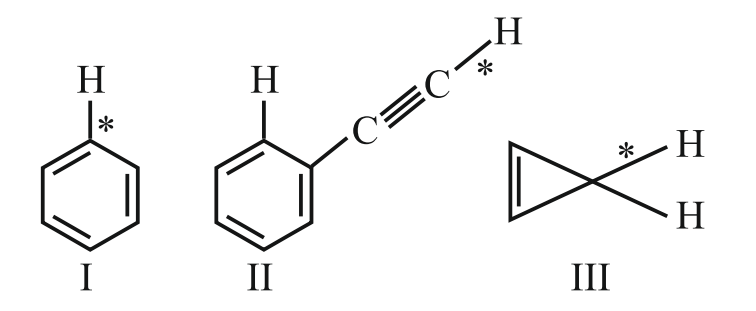
Bond dissociation energy increases with greater s-character: $sp$ ($50\%$ s, alkyne I) > $sp^2$ ($33.3\%$ s, aryl II) > $sp^3$ (cyclopropyl III). Thus $\text{I} > \text{II} > \text{III}$.
The strength and bond dissociation energy (BDE) of a $\text{C}-\text{H}$ bond depends on the hybridization of carbon. Higher s-character brings the bonded electron pair closer to the nucleus, increasing bond strength and BDE: 1. In ethyne (I), carbon is $sp$ hybridized ($50\%$ s-character), giving the highest BDE ($\,\approx 550\text{ kJ/mol}$). 2. In benzene (II), carbon is $sp^2$ hybridized ($33.3\%$ s-character), with intermediate BDE ($\,\approx 464\text{ kJ/mol}$). 3. In cyclopropane (III), the exocyclic C-H bond has predominant $sp^3$ character with lower BDE ($\,\approx 445\text{ kJ/mol}$). Therefore, the correct decreasing order of bond dissociation energy is I > II > III.
Qualitative Analysis – Lassaigne's Test
-
In Lassaigne's extract of an organic compound, both nitrogen and sulphur are present, which gives blood red colour with $Fe^{3+}$ due to the formation of
When N and S are both present, $NaSCN$ forms and gives $[Fe(SCN)]^{2+}$ (blood red) with $Fe^{3+}$.
In case nitrogen and sulphur both are present in an organic compound, sodium thiocyanate is formed. $Na+C+N+S\rightarrow NaSCN$ Which further reacts as: $Fe^{3+}+SCN^-\rightarrow[Fe(SCN)]^{2+}$ (blood red colour)
Covalent Bonding in Organic Molecules – Sigma and Pi Bonds
-
The number of $\sigma$ bonds, $\pi$ bonds and lone pair of electrons in pyridine, respectively are
Pyridine has 11 $\sigma$ bonds, 3 $\pi$ bonds and one lone pair on N.
The structure of pyridine is: [add image] Hence, it has 11 sigma, 3 $\pi$ bonds and one lone pair.
Quantitative Analysis – Estimation of Nitrogen (Kjeldahl's Method)
-
The Kjeldahl's method for the estimation of nitrogen can be used to estimate the amount of nitrogen in which one of the following compounds?Kjeldahl's method is not applicable to compounds containing nitrogen in nitro and azo groups, or nitrogen present in the ring (e.g. pyridine), as the nitrogen of these compounds does not change to ammonium sulphate under these conditions. So it can be used for aniline (nitrogen in an $-NH_2$ group).
Nomenclature of Organic Compounds
-
The correct IUPAC name of the following compound is:
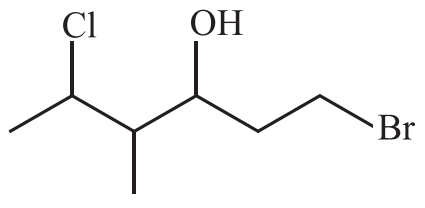
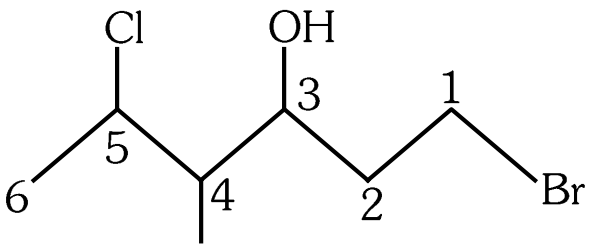
Number the six-carbon chain from the Br end so that the principal group (–OH) gets the lowest locant:
Br on C-1, OH on C-3, $CH_3$ on C-4, Cl on C-5
IUPAC name: 1-bromo-5-chloro-4-methylhexan-3-ol -
The correct structure of 2,6-Dimethyl-dec-4-ene is:
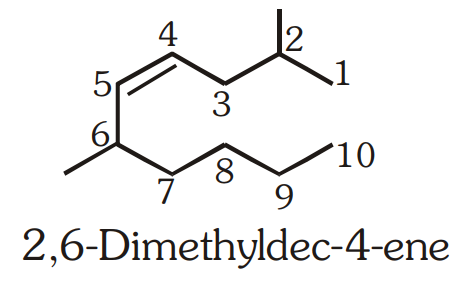
2,6-Dimethyl-dec-4-ene: a 10-carbon chain with a double bond between C-4 and C-5 and methyl groups on C-2 and C-6.
Covalent Bond – Sigma and Pi Bonds in Organic Molecules
-
The number of sigma ($\sigma$) and pi ($\pi$) bonds in pent-2-en-4-yne is:Structure of pent-2-en-4-yne: $CH_3-CH=CH-C\equiv CH$ Counting bonds: C–H σ bonds = 3 + 1 + 1 + 1 = 6; C–C σ bonds = 4 Number of σ bonds = 10 π bonds: 1 in C=C and 2 in C≡C, so number of π bonds = 3
Metamerism
-
The pair of molecules that are metamers among the following is:Metamers have the same molecular formula but different alkyl groups on either side of a polyvalent functional group. $CH_3OCH_2CH_2CH_3$ (methyl propyl ether) and $CH_3CH_2OCH_2CH_3$ (diethyl ether) are metamers.
IUPAC nomenclature of branched alkanes
-
The correct IUPAC name of the following compound is: $CH_3-CH_2-CH(CH_2CH_3)-CH_2-CH(CH_3)-CH_2-CH_3$Longest chain = 7 carbons (heptane), numbered so substituents get lowest locants: $\overset{1}{C}H_3-\overset{2}{C}H_2-\overset{3}{C}H(C_2H_5)-\overset{4}{C}H_2-\overset{5}{C}H(CH_3)-\overset{6}{C}H_2-\overset{7}{C}H_3$ Ethyl at C-3, methyl at C-5 (alphabetical order): 3-ethyl-5-methylheptane
IUPAC Nomenclature and Classification of Carbon
-
A compound with a molecular formula of $C_6H_{14}$ has two tertiary carbons. Its IUPAC name is:Isomers of $C_6H_{14}$ and their number of tertiary carbons: 2,3-dimethylbutane, $(CH_3)_2CH-CH(CH_3)_2$: 2 tertiary C 2,2-dimethylbutane: 0 tertiary C (one quaternary C) n-hexane: 0 tertiary C 2-methylpentane: 1 tertiary C So the compound with two tertiary carbons is 2,3-dimethylbutane.
IUPAC nomenclature of substituted benzenes
-
The correct IUPAC name of the compound
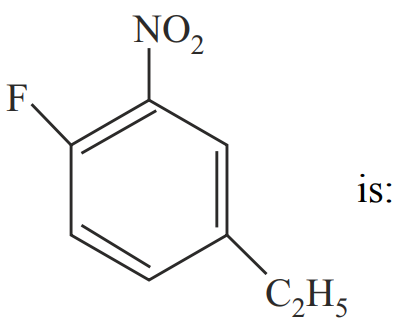 Numbering the ring to give the lowest set of locants to the substituents F, $NO_2$ and $C_2H_5$ (at positions 1, 2 and 4 respectively, with substituents cited alphabetically) gives the name 4-ethyl-1-fluoro-2-nitrobenzene.
Steam distillation
-
A steam volatile organic compound which is immiscible with water has a boiling point of 250°C. During steam distillation, a mixture of this organic compound and water will boil:In steam distillation of an immiscible mixture, the combined vapour pressure of water and the organic compound equals atmospheric pressure at a temperature below the boiling point of either pure component, i.e. close to but below 100°C.
-
A liquid compound (x) can be purified by steam distillation only if it isSteam distillation is used to purify liquid compounds that are steam volatile (has an appreciable vapour pressure at $100^\circ C$) and immiscible with water, so that a mixture of the compound and water can be distilled at a temperature below $100^\circ C$.
Quantitative analysis - estimation of carbon and hydrogen (Liebig's method)
-
On complete combustion, 0.3 g of an organic compound gave 0.2 g of $CO_2$ and 0.1 g of $H_2O$. The percentage composition of carbon and hydrogen in the compound, respectively is:%C $=\dfrac{12\times m_{CO_2}\times100}{44\times m}=\dfrac{12\times0.2\times100}{44\times0.3}=18.18\%$. %H $=\dfrac{2\times m_{H_2O}\times100}{18\times m}=\dfrac{2\times0.1\times100}{18\times0.3}=3.70\%$.
Hyperconjugation and stability of carbocations
-
Methyl group attached to a positively charged carbon atom stabilizes the carbocation due toA methyl group attached to a carbocation can donate electron density through hyperconjugation (delocalisation of C–H sigma bond electrons into the empty p-orbital of the carbocation), which stabilises the positive charge.
Hybridisation and sigma/pi bond counting
-
How many (i) $sp^2$ hybridised carbon atoms and (ii) $\sigma$ bonds are present in the following compound?
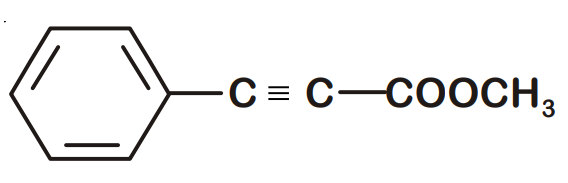 Counting the $sp^2$ hybridised carbons (aromatic ring carbons, the alkene carbons, the ester carbonyl carbon, and the aldehyde carbon) and the total number of $\sigma$ bonds in the substituted cinnamate-aldehyde structure gives 7 $sp^2$ carbons and 6 $\pi$ bonds (as per the figure) for this compound.
Purification techniques for various mixtures/samples
-
Match List-I with List-II
Pick the matching item from Column II for each row.
Column I
- A. Glycerol from spent lye
- B. Chloroform + Aniline
- C. Fractions of crude oil
- D. Aniline + Water
Column II
- I. Steam distillation
- II. Fractional distillation
- III. Distillation under reduced pressure
- IV. Distillation
Correct answer: A → III, B → IV, C → II, D → I
Glycerol from spent lye is purified by distillation under reduced pressure (A-III); Chloroform + Aniline mixture is purified by simple distillation (B-IV); Fractions of crude oil are separated by fractional distillation (C-II); Aniline + Water is separated by steam distillation (D-I).
Inductive and electromeric effects; hyperconjugation
-
Given below are two statements: Statement I: In an organic compound, when inductive and electromeric effects operate in opposite directions, the inductive effect predominates. Statement II: Hyperconjugation is observed in o-xylene. In the light of the above statements, choose the correct answer from the options given below:When inductive and electromeric effects act in opposite directions in an organic compound, the electromeric effect predominates over the inductive effect, not the other way around — so Statement I is false. Hyperconjugation, involving the overlap of a C–H sigma bond with an adjacent pi system, is indeed observed in o-xylene (through its methyl group's C–H bonds interacting with the aromatic ring) — Statement II is true.
Hybridisation of carbon atoms
-
What is the hybridization shown by $C_1$ and $C_2$ carbons, respectively in the given compound? $OHC-CH=CH-CH_2COOCH_3$The ester group has higher priority than the aldehyde, so numbering starts from the ester carbon: $\overset{5}{O}HC-\overset{4}{C}H=\overset{3}{C}H-\overset{2}{C}H_2-\overset{1}{C}OOCH_3$. $C_1$ is the ester carbonyl carbon ($sp^2$) and $C_2$ is the $CH_2$ carbon ($sp^3$).
Stability of carbocations
-
Which of the following is the most stable carbocation?Stability of a carbocation increases with the number of $\alpha$-hydrogens (hyperconjugation) and the number of resonating structures. The carbocation in option (1) is conjugated with two double bonds and is delocalised over several resonance structures, making it the most stable.
Carbocation stability - hyperconjugation
-
The most stable carbocation, among the following is:Stability of these carbocations depends on hyperconjugation (+H effect), i.e. the number of $\alpha$-hydrogens. Option (3) has the maximum number of $\alpha$-H (5).
Carbocation stability - hyperconjugation and resonance
-
The following carbocation is stabilized by the interaction of the empty p orbital with
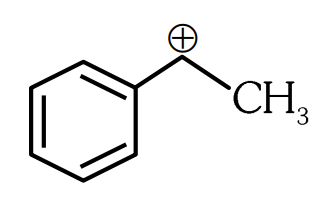 The empty p orbital of the benzylic carbocation $C_6H_5\overset{+}{C}HCH_3$ is stabilised by hyperconjugation with the filled C-H $\sigma$ orbitals of $CH_3$ and by resonance with the filled $\pi$ orbitals of the benzene ring.
Polarity of functional groups
-
Arrange the following compounds in the increasing order of polarity A. $CH_3CH_2OCH_2CH_3$ B. $CH_3CH_2OH$ C. $CH_3COCH_3$ D. $CH_3COOH$Increasing order of polarity: $CH_3CH_2OCH_2CH_3<CH_3COCH_3<CH_3CH_2OH<CH_3COOH$, i.e. A < C < B < D.
Carbocation stability – inductive effect
-
Which of the following carbocations is expected to be most stable?
The carbocation farthest from the electron-withdrawing $-NO_2$ is most stable.
$-NO_2$ group exhibits –I effect and it decreases with increase in distance. In the first structure the positive charge is present on the C-atom at maximum distance from $-NO_2$, so the –I effect reaching it is minimum and stability is maximum.
Inductive effect
-
Which of the following is correct with respect to –I effect of the substituents? (R = alkyl)
–I effect follows electronegativity: N < O < F.
–I effect increases on increasing electronegativity of the atom. So, the correct order of –I effect is $-NH_2 < -OR < -F$. Note: the source key marks $-NH_2 < -OR < -F$ as the most appropriate answer, but states that $-NR_2 < -OR < -F$ may also be correct.
Electrophiles and nucleophiles
-
Which of the following species is not electrophilic in nature?An electrophile is an electron-deficient species that can accept a pair of electrons; it needs a vacant orbital (or an atom able to take up a pair).
$Cl^+$ has only six valence electrons, so it is electron deficient and electrophilic.
$BH_3$ has only six electrons around boron and an empty p orbital; it is electrophilic.
$NO_2^+$ (nitronium ion) has an electron-deficient nitrogen that accepts an electron pair in nitration; it is electrophilic.
$H_3O^+$: although it carries a positive charge, oxygen already has a complete octet (three bond pairs and one lone pair) and has no vacant orbital, so it cannot accept an electron pair.
Hence $H_3O^+$ is not electrophilic.
Methods of purification – steam distillation
-
In steam distillation of toluene, the pressure of toluene in vapour is : -In steam distillation, the mixture of the organic liquid (toluene) and water boils when the sum of their vapour pressures equals the atmospheric (barometric) pressure: $p_{toluene} + p_{water} = P_{atm}$.
So the partial pressure of toluene in the vapour is less than the barometric pressure.
This allows toluene to distil at a temperature below its normal boiling point (and below 100 °C), which avoids decomposition.
So the pressure of toluene in the vapour is less than the pressure of the barometer.
IUPAC nomenclature of polyfunctional compounds
-
The IUPAC name of the compound
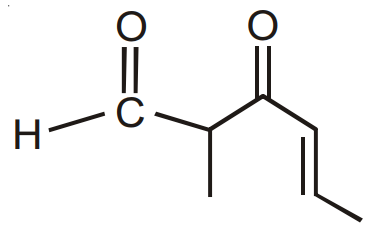 is ________.
CHO gets C1; then the keto group at C3 and C=C at C4.
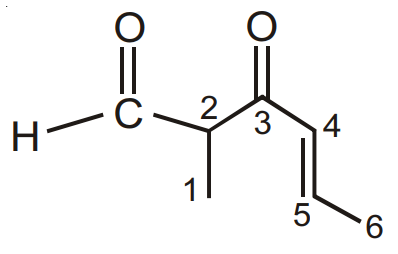
Aldehydes get higher priority over ketones and alkenes in numbering of the principal carbon chain.
$\therefore$ The name is 3-keto-2-methylhex-4-enal (3-oxo-2-methylhex-4-enal).
Hybridisation and planarity
-
In which of the following molecules, all atoms are coplanar?
All-$sp^2$ carbon framework allows coplanarity.
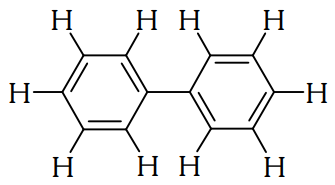
In biphenyl all carbons are $sp^2$ hybridised, so all atoms are coplanar.
Quantitative analysis
-
In Dumas' method for estimation of nitrogen, 0.25 g of an organic compound gave 40 mL of nitrogen collected at 300 K temperature and 725 mm pressure. If the aqueous tension at 300 K is 25 mm, the percentage of nitrogen in the compound is:$V_1 = 40$ mL, $T_1 = 300$ K, $P_1 = 725 - 25 = 700$ mm Hg
Volume at STP: $V_2 = \frac{P_1V_1T_2}{T_1P_2} = \frac{700\times 40\times 273}{300\times 760} = 33.52$ mL
% of N $= \frac{28\times V\times 100}{22400\times \text{mass of compound}}$
% of N $= \frac{28\times 33.52\times 100}{22400\times 0.25} = 16.76$ -
In the Kjeldahl's method for estimation of nitrogen present in a soil sample, ammonia evolved from 0.75 g of sample neutralized 10 mL of 1 M $H_2SO_4$. The percentage of nitrogen in the soil is:10 mmol $H_2SO_4$ neutralises 20 mmol $NH_3$: $H_2SO_4 + 2NH_3 \rightarrow (NH_4)_2SO_4$
$20\times10^{-3}$ mol $NH_3$ contains $14\times20\times10^{-3}$ g nitrogen.
% nitrogen $= \frac{14\times20\times10^{-3}}{0.75}\times100 = 37.33\%$ -
In Dumas' method of estimation of nitrogen 0.35 g of an organic compound gave 55 mL of nitrogen collected at 300 K temperature and 715 mm pressure. The percentage composition of nitrogen in the compound would be (Aqueous tension at 300 K = 15 mm)Pressure of dry nitrogen = 715 − 15 = 700 mm Hg
Convert the volume to STP using $\frac{P_1V_1}{T_1} = \frac{P_2V_2}{T_2}$
$V_2 = \frac{P_1V_1T_2}{T_1P_2} = \frac{700\times55\times273}{300\times760}$
$V_2 = 46.09$ mL
22400 mL of $N_2$ at STP weighs 28 g, so mass of nitrogen = $\frac{28\times46.09}{22400}$ g = 0.0576 g
% of N = $\frac{28\times46.09\times100}{22400\times0.35}$
% of N = 16.45
Hyperconjugation
-
Consider the following compounds
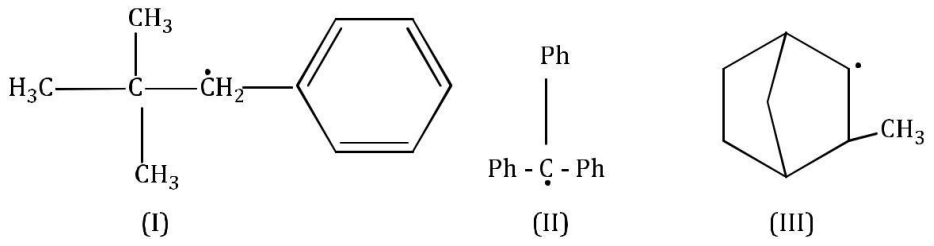 Hyperconjugation occurs in:Hyperconjugation needs $\alpha$-H atoms on a carbon attached to the radical carbon.
In I the radical carbon is attached to a quaternary carbon and a phenyl group (no $\alpha$-H); in II it carries three phenyl groups (no $\alpha$-H).
Only III has $\alpha$-H, so hyperconjugation occurs in III only.
Electronic displacement effects
-
Which of the following is the most correct electron displacement of a nucleophilic reaction to take placeIn $CH_3-CH=CH-CH_2-Cl$, the $CH_3$ group shows +I effect and pushes electrons towards the double bond.
The $\pi$-electrons shift towards the $CH_2Cl$ end, and Cl, showing –I effect, pulls the C–Cl bond electrons towards itself.
The correct representation shows the +I arrow from $CH_3$, the $\pi$-shift towards $CH_2$ and the C–Cl bond pair moving onto Cl, making the carbon open to nucleophilic attack.
Bonding in organic molecules
-
The enolic form of ethyl acetoacetate as below has:
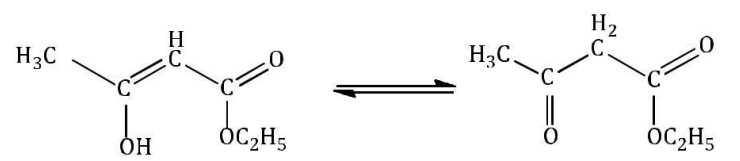 Enol form: $CH_3-C(OH)=CH-COOC_2H_5$ ($C_6H_{10}O_3$, 19 atoms, open chain).
Number of $\sigma$ bonds in an acyclic molecule = atoms − 1 = 18.
$\pi$ bonds: one C=C and one C=O, so 2.
So the enol form has 18 $\sigma$ and 2 $\pi$ bonds.
Tautomerism
-
Given
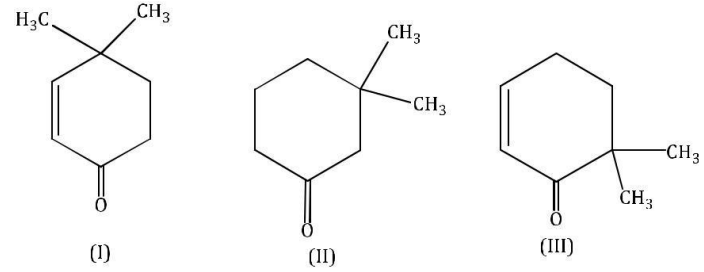
Which of the given compounds can exhibit tautomerism?Keto-enol tautomerism requires at least one $\alpha$-hydrogen next to the C=O group.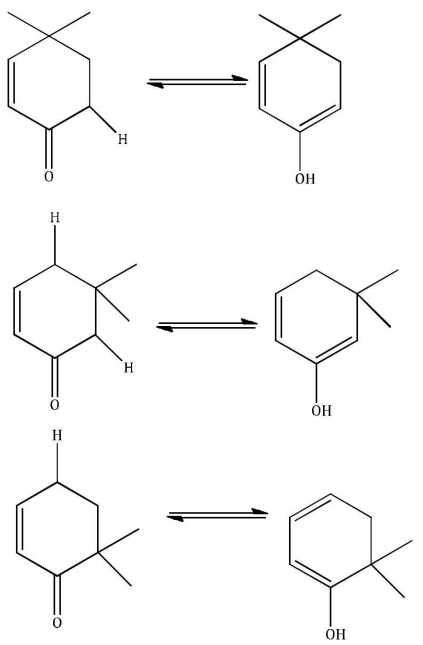
All three ketones have an $\alpha$-H on the other side of the carbonyl group, so I, II and III all exhibit tautomerism. -
The order of stability of the following tautomeric compounds is:
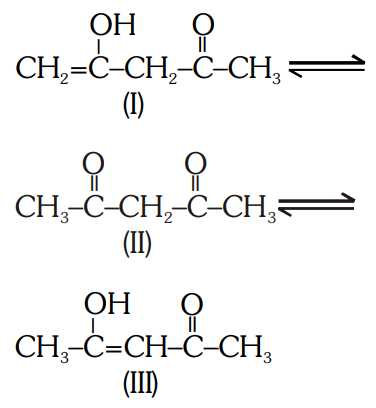 III is the most stable: it has intramolecular H-bonding and a conjugated system, and it forms through the more acidic $-CH_2-$ hydrogen.
II (the diketo form) has no conjugation.
I is the least stable: it forms through the less acidic H and its C=C is not conjugated with C=O.
Stability: III > II > I
Aromaticity
-
The radical
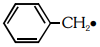 is aromatic because it has:
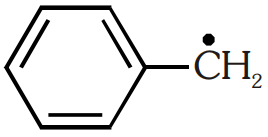 The benzyl free radical is aromatic as per Huckel's rule: it has 6 $\pi$ electrons in the p-orbitals of the six carbon atoms that form the benzene ring.
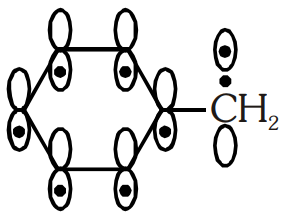 So the ring has 6 p-orbitals and 6 $\pi$ electrons.
IUPAC nomenclature
-
Which nomenclature is not according to IUPAC system?When a double bond and a halogen are both present, the double bond gets the lower number.
$Br-CH_2-CH=CH_2$ is numbered from the double-bond end: $CH_2=CH-CH_2Br$ is 3-bromoprop-1-ene.
So the name 1-bromo-prop-2-ene is not according to the IUPAC system; the other three names are correct. -
The correct IUPAC name of the compound
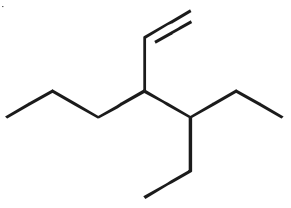 is
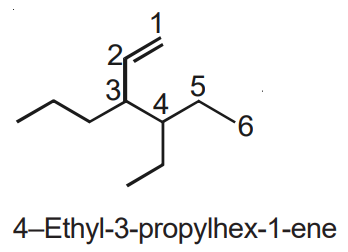
The structure is $CH_2=CH-CH(CH_2CH_2CH_3)-CH(CH_2CH_3)-CH_2-CH_3$.
The parent chain must be the longest chain that contains the double bond; it has six carbons, so the parent is hexene.
Numbering starts from the end nearer to the double bond, so the double bond is at C-1: hex-1-ene.
With this numbering there is a propyl group on C-3 and an ethyl group on C-4.
Substituents are written in alphabetical order (ethyl before propyl).
IUPAC name: 4-Ethyl-3-propylhex-1-ene -
The IUPAC name of the compound $CH_3CH=CHC\equiv CH$ isThe chain has five carbons with one double bond and one triple bond, so the parent name is pentenyne.
The chain is numbered so that the multiple bonds get the lowest set of locants.
Numbering from the triple-bond end gives the locants (1, 3): triple bond at C-1, double bond at C-3.
Numbering from the methyl end gives the locants (2, 4): double bond at C-2, triple bond at C-4.
(1, 3) is lower than (2, 4), so numbering starts from the triple-bond end. In the name, 'ene' is written before 'yne'.
IUPAC name: Pent-3-en-1-yne -
The IUPAC name of the compound having the formula $CH\equiv C-CH=CH_2$ isThe chain has four carbons with one double bond and one triple bond: butenyne.
The multiple bonds get the lowest set of locants. Numbering from either end gives the same set (1, 3).
When there is such a choice, the double bond is given the lower number.
So numbering starts from the $CH_2=$ end: $\overset{4}{C}H\equiv\overset{3}{C}-\overset{2}{C}H=\overset{1}{C}H_2$; the double bond is at C-1 and the triple bond at C-3.
In the name, 'ene' is written before 'yne'.
IUPAC name: 1-butene-3-yne (but-1-en-3-yne) -
IUPAC names of some compounds are given. Which one is incorrect -In IUPAC nomenclature, when two or more different substituents are present, their prefixes are written in alphabetical order, irrespective of their locants.
For $CH_3CH_2CH_2-CH(C_2H_5)-CH(CH_3)-CH_2CH_3$, the longest chain has seven carbons (heptane), with a methyl group on C-3 and an ethyl group on C-4.
Ethyl comes before methyl in alphabetical order, so the correct name is 4-ethyl-3-methylheptane, not 3-methyl-4-ethylheptane.
3-Methyl-2-butanol (3-methylbutan-2-ol) is correct: the OH group gets the lowest locant.
2-Ethyl-3-methylbut-1-ene is correct: the main chain must contain the double bond, and ethyl is cited before methyl.
4-Methyl-2-pentyne (4-methylpent-2-yne) is correct: the triple bond gets the lowest locant.
So the incorrect name is 3-methyl-4-ethylheptane. -
The incorrect IUPAC name is : -$CH_3COCH(CH_3)CH_3$: the principal functional group (C=O) must get the lowest possible number. Numbering from the left end gives C=O at C-2 and the methyl at C-3. So the correct name is 3-methyl-2-butanone (3-methylbutan-2-one), and '2-methyl-3-butanone' is incorrect.
$CH_3CH(CH_3)CH(C_2H_5)CH_3$: the longest chain has five carbons (through the ethyl group), with methyls at C-2 and C-3: 2,3-dimethylpentane; correct.
$CH_3C\equiv CCH(CH_3)_2$: five-carbon chain, triple bond at C-2, methyl at C-4: 4-methyl-2-pentyne; correct.
$CH_3CHClCHBrCH_3$: halogens at 2 and 3 either way; alphabetical order gives bromo the lower number: 2-bromo-3-chlorobutane; correct.
So the incorrect IUPAC name is 2-methyl-3-butanone.
Optical isomerism
-
A compound of molecular formula $C_7H_{16}$ shows optical isomerism, compound will beA compound shows optical isomerism if it has a chiral carbon (a carbon bonded to four different groups).
2,3-Dimethylpentane, $CH_3-CH(CH_3)-CH(CH_3)-CH_2-CH_3$ ($C_7H_{16}$): C-3 is bonded to H, $CH_3$, $CH(CH_3)_2$ and $C_2H_5$, four different groups. So it is chiral and shows optical isomerism.
2-Methylhexane has no carbon with four different groups (C-2 has two methyls).
2,2-Dimethylbutane is $C_6H_{14}$ and is not chiral.
So the compound is 2,3-dimethylpentane.
IUPAC nomenclature and geometrical isomerism
-
The IUPAC name of the following compound is
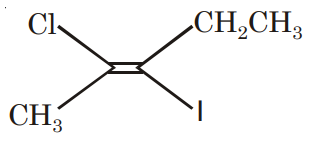 The longest chain containing the double bond is $CH_3-C(Cl)=C(I)-CH_2-CH_3$, which has five carbons: pentene.
Numbering from the methyl end gives the double bond position 2 (pent-2-ene); numbering from the other end would give 3, so the first numbering is chosen.
With this numbering, chlorine is on C-2 and iodine is on C-3.
Substituents are written in alphabetical order: chloro before iodo, giving 2-chloro-3-iodo-2-pentene.
Geometry: on C-2 the higher-priority group is Cl (over $CH_3$) and on C-3 it is I (over $CH_2CH_3$). In the structure Cl and I lie on opposite sides of the double bond, so the isomer is trans.
IUPAC name: trans-2-chloro-3-iodo-2-pentene
Distinguishing tests of functional groups
-
Match the compounds given in List-I with their characteristic reactions given in List-II. Select the correct option.
Pick the matching item from Column II for each row.
Column I
- a. $CH_3CH_2CH_2CH_2NH_2$
- b. $CH_3C\equiv CH$
- c. $CH_3CH_2COOCH_3$
- d. $CH_3CH(OH)CH_3$
Column II
- i. Alkaline hydrolysis
- ii. With KOH (alcohol) and $CHCl_3$ produces bad smell
- iii. Gives white ppt. with ammoniacal $AgNO_3$
- iv. With Lucas reagent cloudiness appears after 5 minutes
Correct answer: a → ii, b → iii, c → i, d → iv
a. $CH_3CH_2CH_2CH_2NH_2$ is a primary amine; warmed with $CHCl_3$ and alcoholic KOH it gives an isocyanide with a very offensive smell (carbylamine reaction): a-ii.
b. $CH_3C\equiv CH$ is a terminal alkyne with an acidic hydrogen; with ammoniacal $AgNO_3$ (Tollens' reagent) it gives a white precipitate of silver propynide: b-iii.
c. $CH_3CH_2COOCH_3$ is an ester; it undergoes alkaline hydrolysis (saponification) to give the sodium salt of the acid and methanol: c-i.
d. $CH_3CH(OH)CH_3$ is a secondary alcohol; with Lucas reagent (conc. HCl + anhydrous $ZnCl_2$) cloudiness appears after about 5 minutes: d-iv.
Correct match: a-ii, b-iii, c-i, d-iv.
Stability of Carbanions
-
The stability of carbanions in the following :
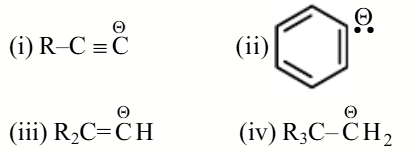
is in the order of :More the electronegativity of the hybrid atom carrying the negative charge, more is its tendency to retain the (-)ve charge, and more stable is the carbanion.
The electronegativity of hybrid orbitals depends on their s-character. It follows the order: $sp \gt sp^2 \gt sp^3$
(i) $R-C\equiv C^{\ominus}$: the negative charge is on an $sp$ carbon (50 percent s-character), so it is the most stable.
(ii) Phenyl carbanion: the negative charge is on an $sp^2$ carbon of the ring.
(iii) $R_2C=\overset{\ominus}{C}H$: the negative charge is on an $sp^2$ carbon, but the two electron releasing alkyl groups ($+I$ effect) on the adjacent carbon intensify the charge, so it is less stable than (ii).
(iv) $R_3C-\overset{\ominus}{C}H_2$: the negative charge is on an $sp^3$ carbon (25 percent s-character) and is further destabilised by the $+I$ effect of the alkyl groups, so it is the least stable.
Order of stability: (i) > (ii) > (iii) > (iv)
Methods of Purification
-
The best method for the separation of naphthalene and benzoic acid from their mixture is -Sublimation is used to separate a substance that changes directly from the solid to the vapour state on heating from non-sublimable impurities.
Naphthalene sublimes readily on gentle warming (it is volatile even at room temperature, which is why moth balls slowly disappear).
According to the answer key of this paper, the mixture is separated by sublimation: on gentle heating the naphthalene sublimes first and is collected on a cool surface, leaving the benzoic acid behind.
Note: benzoic acid also sublimes at higher temperature, so in the laboratory the two are better separated chemically, by shaking the mixture with aqueous $NaHCO_3$; benzoic acid dissolves as sodium benzoate while naphthalene remains undissolved.
Distillation is suited to liquids, and chromatography is used mainly for small amounts or many components.
So the answer given by the key is sublimation.
Structural Isomerism
-
The molecular formula of diphenyl methane,
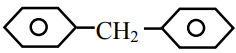 , is $C_{13}H_{12}$. How many structural isomers are possible when one of the hydrogens is replaced by a chlorine atom :-Diphenylmethane is symmetrical: the two phenyl rings are equivalent, and each ring is symmetrical about the axis through the $CH_2$ carbon and the para carbon.
So the distinct types of hydrogen are:
1. The two H atoms of the $CH_2$ group: replacing one gives $C_6H_5-CHCl-C_6H_5$.
2. Ortho H of a ring (2 per ring, all equivalent): gives o-chlorodiphenylmethane.
3. Meta H of a ring: gives m-chlorodiphenylmethane.
4. Para H of a ring: gives p-chlorodiphenylmethane.
(Substituting in the second ring gives the same compounds, because both rings are equivalent.)
So 4 structural isomers are possible.
IUPAC Nomenclature of Alkanes
-
IUPAC name of the compound given below is :
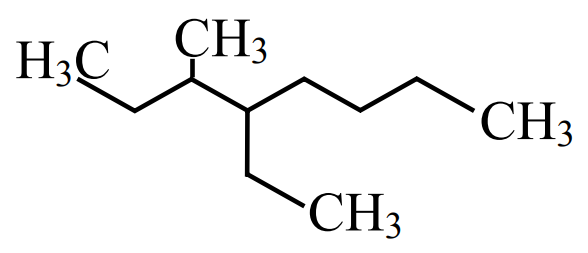 Step 1: Find the longest carbon chain. The longest chain has eight carbons, so the parent alkane is octane.
Step 2: Number the chain from the end that gives the lowest locants to the substituents. Numbering from the end nearer the branches gives a methyl group at C-3 and an ethyl group at C-4 (locant set 3, 4). Numbering from the other end would give 5, 6, which is higher.
Step 3: Write the substituents in alphabetical order (ethyl before methyl), irrespective of their locant numbers.
So the name is 4-Ethyl-3-methyloctane.
'3-Methyl-4-ethyloctane' has the correct numbers but wrong alphabetical order; '5-ethyl-6-methyloctane' uses higher locants; 'diethylheptane' does not use the longest chain.
IUPAC Nomenclature: Compounds with Double and Triple Bonds
-
IUPAC name of the following is $CH_2=CH-CH_2-CH_2-C\equiv CH$The chain has six carbons with one C=C and one C$\equiv$C bond, so it is a hexenyne.
When a double and a triple bond are at equivalent distances from the two ends, the double bond gets the lower number. Numbering from the C=C end: double bond at C-1, triple bond at C-5.
The ending '-ene' is written before '-yne'.
So the name is 1-hexene-5-yne (modern form: hex-1-en-5-yne).
Resonance
-
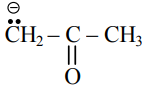 and
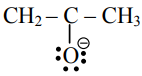 areThe two structures are of the enolate ion of acetone. In the first, the negative charge is on the carbon next to the C=O group. In the second, the electrons have moved to form a C=C bond and the negative charge is on oxygen.
Only the electrons (the $\pi$ electrons and the lone pair) are differently arranged; the positions of all the atoms, including hydrogen atoms, are exactly the same.
Structures that differ only in the arrangement of electrons are resonating structures (canonical forms) of the same species.
Tautomers differ in the position of an atom (usually H), e.g. keto and enol forms of acetone.
So these are resonating structures.
Electronic Effects: Resonance
-
Polarization in acrolein is :Acrolein, $CH_2=CH-CHO$, is an $\alpha,\beta$-unsaturated aldehyde. The C=C double bond is in conjugation with the C=O group.
The electronegative oxygen withdraws the $\pi$ electrons through the conjugated system (–R effect):
$CH_2=CH-CH=O \leftrightarrow \overset{+}{C}H_2-CH=CH-O^-$
So the terminal $CH_2$ (the $\beta$-carbon) gets a partial positive charge and the oxygen gets a partial negative charge.
So the polarisation is $\overset{+\delta}{C}H_2=CH-CH\overset{-\delta}{O}$. (This is why nucleophiles can attack the $\beta$-carbon in conjugate addition.)
That is every question in Organic Chemistry - Some Basic Principles and Techniques for this filter.
Want a score?
Answers here are not saved. Practise as a test to be marked and see your progress.
Practise as a test