Looking for classes? Ksquare Career Institute, Bengaluru →

Chemistry
Redox Reactions
30 questions from 25 papers, each with its answer.
- 30 questions
- 25 papers
- 1.7% of Chemistry
Calculation of Oxidation Number
-
The oxidation number of the underlined atom in the following species: (1) $H\underline{Au}Cl_4$ is +3 (2) $\underline{Cu}_2O$ is $-1$ (3) $\underline{Cl}O_3^-$ is +5 (4) $K_2\underline{Cr}_2O_7$ is +6. Identify the incorrect option.In $Cu_2O$, oxygen is $-2$; for charge balance, $2x+(-2)=0\Rightarrow x=+1$. So copper in $Cu_2O$ is $+1$, not $-1$ — the statement in option (2) is incorrect. (Options 1, 3, 4 are correctly assigned oxidation states.)
Balancing Redox Reactions – Ion-Electron Method
-
On balancing the given redox reaction, $aCr_2O_7^{2-}+bSO_3^{2-}(aq)+cH^+(aq)\rightarrow2aCr^{3+}(aq)+bSO_4^{2-}(aq)+\frac{c}{2}H_2O(l)$ the coefficients a, b and c are found to be, respectively:
Combining half-reactions gives $Cr_2O_7^{2-}+3SO_3^{2-}+8H^+\rightarrow2Cr^{3+}+3SO_4^{2-}+4H_2O$.
Reduction half reaction: $Cr_2O_7^{2-}+14H^++6e^-\rightarrow2Cr^{3+}+7H_2O$ ... (i) Oxidation half reaction: $[SO_3^{2-}+H_2O\rightarrow SO_4^{2-}+2H^++2e^-]\times3$ ... (ii) Oxygen is balanced by adding water and hydrogen is balanced by adding $H^+$ and the charge is balanced by electrons. Add (eq. (i)) + (3 × eq. (ii)): $Cr_2O_7^{2-}+3SO_3^{2-}+8H^+\rightarrow2Cr^{3+}+3SO_4^{2-}+4H_2O$ a = 1, b = 3, c = 8
Electrochemical Series and Feasibility of Reactions
-
At 298 K, the standard electrode potentials of $Cu^{2+}/Cu$, $Zn^{2+}/Zn$, $Fe^{2+}/Fe$ and $Ag^+/Ag$ are 0.34 V, $-0.76$ V, $-0.44$ V and 0.80 V, respectively. On the basis of standard electrode potential, predict which of the following reaction can not occur?Standard reduction potentials: $E^\circ_{Zn^{2+}/Zn} < E^\circ_{Fe^{2+}/Fe} < E^\circ_{Cu^{2+}/Cu} Fe > Cu > Ag A more reactive metal (lower SRP) can displace a less reactive metal from its salt solution. $2CuSO_4(aq) + 2Ag(s) \rightarrow 2Cu(s) + Ag_2SO_4(aq)$ is not possible, as Ag is less reactive than Cu.
Oxidation Number
-
In acidic medium, $H_2O_2$ changes $Cr_2O_7^{2-}$ to $CrO_5$ which has two (–O–O–) bonds. Oxidation state of Cr in $CrO_5$ is:$CrO_5$ has two peroxy linkages: four O atoms are in the −1 state and one is in the −2 state.
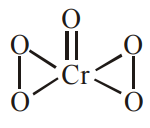
$x + 4(-1) + (-2) = 0 \Rightarrow x = +6$ -
A mixture of potassium chlorate, oxalic acid and sulphuric acid is heated. During the reaction which element undergoes maximum change in the oxidation number?$KClO_3 + H_2C_2O_4 + H_2SO_4 \rightarrow K_2SO_4 + KCl + CO_2 + H_2O$
Cl: +5 in $ClO_3^-$ → −1 in $Cl^-$, a change of 6 units.
C: +3 in oxalic acid → +4 in $CO_2$, a change of 1 unit.
S (+6) and H (+1) do not change.
So chlorine undergoes the maximum change.
Types of Redox Reactions – Disproportionation
-
Which of the following reactions are disproportionation reaction? (a) $2Cu^+\rightarrow Cu^{2+}+Cu^0$ (b) $3MnO_4^{2-}+4H^+\rightarrow2MnO_4^-+MnO_2+2H_2O$ (c) $2KMnO_4\xrightarrow{\Delta}K_2MnO_4+MnO_2+O_2$ (d) $2MnO_4^-+3Mn^{2+}+2H_2O\rightarrow5MnO_2+4H^+$ Select the correct option from the following:(a) $2Cu^+\rightarrow Cu^{2+}+Cu^0$: Cu goes from +1 to +2 and 0 → disproportionation (b) $3MnO_4^{2-}+4H^+\rightarrow2MnO_4^-+MnO_2+2H_2O$: Mn goes from +6 to +7 and +4 → disproportionation (c) $2KMnO_4\rightarrow K_2MnO_4+MnO_2+O_2$: Mn is reduced (+7 → +6, +4) while O is oxidised → not disproportionation (d) $2MnO_4^-+3Mn^{2+}+2H_2O\rightarrow5MnO_2+4H^+$: Mn from +7 and +2 goes to +4 → comproportionation, not disproportionation So only (a) and (b) are disproportionation reactions.
Disproportionation and oxidation states of manganese
-
The oxidation states not shown by Mn in given reaction is: $3MnO_4^{2-}+4H^+\rightarrow2MnO_4^-+MnO_2+2H_2O$ A. +6 B. +2 C. +4 D. +7 E. +3. Choose the most appropriate answer from the options given below:In this disproportionation reaction, $MnO_4^{2-}$ (Mn is +6) disproportionates into $MnO_4^-$ (Mn is +7) and $MnO_2$ (Mn is +4). So the oxidation states shown are +6, +7 and +4; +2 and +3 are not shown.
Definition of a redox couple
-
The correct option for a redox couple is:A redox couple consists of the oxidised and reduced forms of the same element/species (e.g. $Zn^{2+}/Zn$ or $Fe^{3+}/Fe^{2+}$).
Types of redox reactions
-
Which of the following reactions is a decomposition redox reaction?Lead nitrate decomposes to PbO, $NO_2$ and $O_2$. The oxidation state of N changes from +5 to +4 and that of O from -2 to 0, so it is a decomposition redox reaction. (1) and (4) are disproportionation reactions; (3) is a combination reaction.
Redox titration - stoichiometry
-
In an acidic medium, 10 mL of 0.25 M oxalic acid is titrated with $KMnO_4$ solution. If the volume of $KMnO_4$ solution required to reach end point is 10 mL, the strength of the $KMnO_4$ solution isEquivalents of oxalic acid = equivalents of $KMnO_4$: $M_1\times n_1\times V_1=M_2\times n_2\times V_2 \Rightarrow 0.25\times2\times10=M_2\times5\times10 \Rightarrow M_2=0.10$ M.
Balancing redox reactions
-
The number of moles of $KMnO_4$ that will be needed to react with one mole of sulphite ion in acidic solution isIn acidic solution: $MnO_4^- + 8H^+ + 5e^- \rightarrow Mn^{2+} + 4H_2O$ (Mn changes from +7 to +2, gain of 5 electrons)
$SO_3^{2-} + H_2O \rightarrow SO_4^{2-} + 2H^+ + 2e^-$ (S changes from +4 to +6, loss of 2 electrons)
To balance the electrons, multiply the first by 2 and the second by 5 and add.
The balanced chemical equation is: $2MnO_4^- + 6H^+ + 5SO_3^{2-} \rightarrow 2Mn^{2+} + 5SO_4^{2-} + 3H_2O$
From the equation, the moles of $MnO_4^-$ required to oxidise 5 moles of $SO_3^{2-}$ are 2.
Moles of $MnO_4^-$ required to oxidise 1 mole of $SO_3^{2-}$ are $\dfrac{2}{5}$. -
The number of moles of $KMnO_4$ reduced by one mole of KI in alkaline medium is :-In alkaline (or neutral) medium, $KMnO_4$ is reduced to $MnO_2$: $MnO_4^- + 2H_2O + 3e^- \rightarrow MnO_2 + 4OH^-$ (Mn changes from +7 to +4, a gain of 3 electrons).
In alkaline medium, iodide is oxidised to iodate: $I^- + 6OH^- \rightarrow IO_3^- + 3H_2O + 6e^-$ (I changes from $-1$ to +5, a loss of 6 electrons).
Equating the electrons: 6 electrons lost by one $I^-$ are taken up by $\dfrac{6}{3} = 2$ moles of $MnO_4^-$.
Balanced equation: $2KMnO_4 + KI + H_2O \rightarrow 2MnO_2 + KIO_3 + 2KOH$
So one mole of KI reduces two moles of $KMnO_4$.
Redox titrations
-
Assuming complete ionization, same moles of which of the following compounds will require the least amount of acidified $KMnO_4$ for complete oxidation?The amount of $KMnO_4$ needed is proportional to the electrons lost per formula unit (n-factor).
$FeC_2O_4$: $Fe^{2+}\rightarrow Fe^{3+}$ (1) + $C_2O_4^{2-}\rightarrow 2CO_2$ (2) = 3
$Fe(NO_2)_2$: 1 + $2\times(NO_2^-\rightarrow NO_3^-)$ (2×2) = 5
$FeSO_3$: 1 + $SO_3^{2-}\rightarrow SO_4^{2-}$ (2) = 3
$FeSO_4$: only $Fe^{2+}\rightarrow Fe^{3+}$ = 1
So $FeSO_4$ requires the least $KMnO_4$.
Oxidising and reducing agents
-
The pair of compounds that can exist together is:$FeCl_2$ and $SnCl_2$ are both reducing agents, so they do not react with each other and can exist together.
Standard Electrode Potentials
-
On the basis of the following $E^\circ$ values, the strongest oxidizing agent is :
$[Fe(CN)_6]^{4-} \rightarrow [Fe(CN)_6]^{3-} + e^-$; $E^\circ = -0.35$ V
$Fe^{2+} \rightarrow Fe^{3+} + e^-$; $E^\circ = -0.77$ VThe given values are oxidation potentials. Reverse the reactions to get the standard reduction potentials:
$[Fe(CN)_6]^{3-} + e^- \rightarrow [Fe(CN)_6]^{4-}$; $E^\circ = +0.35$ V
$Fe^{3+} + e^- \rightarrow Fe^{2+}$; $E^\circ = +0.77$ V
An oxidizing agent oxidises other species and gets itself reduced easily.
Higher the positive reduction potential, stronger is the oxidizing agent.
$Fe^{3+}$ has the higher reduction potential (+0.77 V) compared with $[Fe(CN)_6]^{3-}$ (+0.35 V).
$Fe^{2+}$ and $[Fe(CN)_6]^{4-}$ are the reduced forms; they act as reducing agents, not oxidizing agents.
So the strongest oxidizing agent is $Fe^{3+}$.
That is every question in Redox Reactions for this filter.
Show all 30 questions Next: Organic Chemistry - Some Basic Principles and Techniques
Want a score?
Answers here are not saved. Practise as a test to be marked and see your progress.
Practise as a test