Looking for classes? Ksquare Career Institute, Bengaluru →

Chemistry
Hydrocarbons
75 questions from 35 papers, each with its answer.
- 75 questions
- 35 papers
- 4.26% of Chemistry
Reactions of Alkynes – Partial Reduction (Lindlar Catalyst)
-
The most suitable reagent for the following conversion is: $H_3C-C\equiv C-CH_3\rightarrow$ cis-2-butene
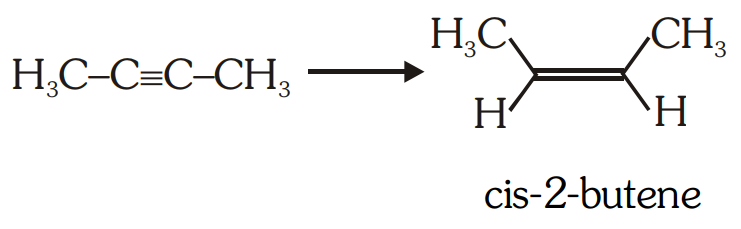 Partial hydrogenation of an alkyne with Lindlar-type catalyst ($H_2$, Pd/C, quinoline) gives a cis-alkene by syn addition. $H_3C-C\equiv C-CH_3\xrightarrow{H_2,\ Pd/C,\ quinoline}$ cis-2-butene (Na/liquid $NH_3$ would give trans-2-butene.)
Reactions of Alkenes – Ozonolysis and Markovnikov Addition of HCl
-
An alkene 'A' on reaction with $O_3$ and Zn-$H_2O$ gives propanone and ethanal in equimolar ratio. Addition of HCl to alkene 'A' gives 'B' as the major product. The structure of product 'B' is:Ozonolysis of A gives propanone and ethanal in equimolar ratio, so A is $(CH_3)_2C=CH-CH_3$ (2-methylbut-2-ene). Addition of HCl follows Markovnikov's rule: $H^+$ adds to the CH carbon to give the more stable 3° carbocation, and $Cl^-$ attaches to it. B: $H_3C-CH_2-C(CH_3)(Cl)-CH_3$ (2-chloro-2-methylbutane)
Aromatic Hydrocarbons – Electrophilic Substitution
-
Among the following, the reaction that proceeds through an electrophilic substitution is:Chlorination of benzene with $Cl_2$ in presence of anhydrous $AlCl_3$ proceeds through electrophilic substitution: $C_6H_6+Cl_2\xrightarrow{AlCl_3}C_6H_5Cl+HCl$ Generation of electrophile: $Cl-Cl+AlCl_3\rightarrow Cl^++AlCl_4^-$ $Cl^+$ attacks the benzene ring to form the arenium ion (σ-complex), which loses $H^+$ to give chlorobenzene. (The Sandmeyer reaction is not an electrophilic substitution, $Cl_2$/UV light gives an addition product, and $C_6H_5CH_2OH$ + HCl is nucleophilic substitution.)
That is every question in Hydrocarbons for this filter.
Want a score?
Answers here are not saved. Practise as a test to be marked and see your progress.
Practise as a test