Looking for classes? Ksquare Career Institute, Bengaluru →

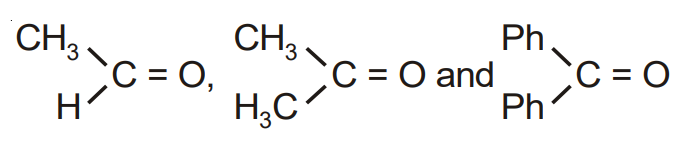
The order of reactivity of phenyl magnesium bromide (PhMgBr) with the following compounds:
A
I > III > II
B
I > II > III
C
III > II > I
D
II > I > III
Detailed Solution
PhMgBr adds to the carbonyl group as a nucleophile (nucleophilic addition); reactivity depends on the electrophilicity of the carbonyl carbon and on steric hindrance around it.
(I) Acetaldehyde has only one alkyl group: least +I effect and least steric crowding, so it is the most reactive.
(II) Acetone has two methyl groups: their +I effect lowers the positive charge on the carbonyl carbon and they add steric hindrance, so it is less reactive than acetaldehyde.
(III) Benzophenone has two bulky phenyl groups: resonance of the rings with C=O (+R effect) reduces the electrophilicity of the carbonyl carbon greatly, and the steric hindrance is maximum, so it is the least reactive.
Order of reactivity: I > II > III
(I) Acetaldehyde has only one alkyl group: least +I effect and least steric crowding, so it is the most reactive.
(II) Acetone has two methyl groups: their +I effect lowers the positive charge on the carbonyl carbon and they add steric hindrance, so it is less reactive than acetaldehyde.
(III) Benzophenone has two bulky phenyl groups: resonance of the rings with C=O (+R effect) reduces the electrophilicity of the carbonyl carbon greatly, and the steric hindrance is maximum, so it is the least reactive.
Order of reactivity: I > II > III