Looking for classes? Ksquare Career Institute, Bengaluru →

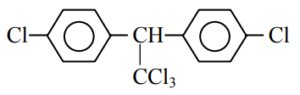
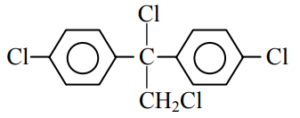
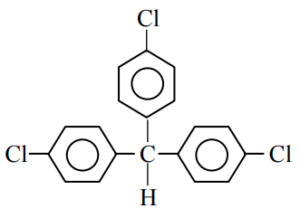
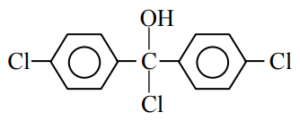
Trichloroacetaldehyde, $CCl_3CHO$, reacts with chlorobenzene in presence of sulphuric acid and produces
A
- 
B
- 
C
- 
D
- 
Detailed Solution
Chloral ($CCl_3CHO$) condenses with two molecules of chlorobenzene in the presence of concentrated sulphuric acid.
The acid protonates the carbonyl oxygen, and the resulting electrophile attacks the para position of chlorobenzene (Cl is ortho/para directing; para is preferred).
A second molecule of chlorobenzene reacts in the same way, and one molecule of water is eliminated.
$2C_6H_5Cl + OHC-CCl_3 \xrightarrow{H_2SO_4} (p\text{-}ClC_6H_4)_2CH-CCl_3 + H_2O$
The product is p,p′-dichlorodiphenyltrichloroethane (DDT), the well-known insecticide.
Hence the product is $(p\text{-}ClC_6H_4)_2CH-CCl_3$.
The acid protonates the carbonyl oxygen, and the resulting electrophile attacks the para position of chlorobenzene (Cl is ortho/para directing; para is preferred).
A second molecule of chlorobenzene reacts in the same way, and one molecule of water is eliminated.
$2C_6H_5Cl + OHC-CCl_3 \xrightarrow{H_2SO_4} (p\text{-}ClC_6H_4)_2CH-CCl_3 + H_2O$
The product is p,p′-dichlorodiphenyltrichloroethane (DDT), the well-known insecticide.
Hence the product is $(p\text{-}ClC_6H_4)_2CH-CCl_3$.