Looking for classes? Ksquare Career Institute, Bengaluru →

Chemistry
Showing 1–25 of 335 questions
-
The ratio of the wavelengths of the light absorbed by a Hydrogen atom when it undergoes $n = 2 \rightarrow n = 3$ and $n = 4 \rightarrow n = 6$ transitions, respectively, is:A $\frac{1}{36}$B $\frac{1}{16}$C $\frac{1}{9}$D $\frac{1}{4}$
Energy absorbed is $\Delta E_1 = R_H \left(\frac{1}{4} - \frac{1}{9}\right) = \frac{5}{36} R_H$ and $\Delta E_2 = R_H \left(\frac{1}{16} - \frac{1}{36}\right) = \frac{5}{144} R_H$. Since $\lambda \propto 1/\Delta E$, $\lambda_1 / \lambda_2 = \Delta E_2 / \Delta E_1 = \frac{5/144}{5/36} = \frac{36}{144} = \frac{1}{4}$.
For hydrogen-like transitions, the energy difference between energy levels $n_1$ and $n_2$ is $\Delta E = R_H \left(\frac{1}{n_1^2} - \frac{1}{n_2^2}\right)$. For $n = 2 \rightarrow 3$: $\Delta E_1 = R_H \left(\frac{1}{4} - \frac{1}{9}\right) = \frac{5}{36} R_H$. For $n = 4 \rightarrow 6$: $\Delta E_2 = R_H \left(\frac{1}{16} - \frac{1}{36}\right) = \frac{5}{144} R_H$. Since wavelength $\lambda = \frac{hc}{\Delta E}$, the ratio of wavelengths is $\frac{\lambda_1}{\lambda_2} = \frac{\Delta E_2}{\Delta E_1} = \frac{5/144}{5/36} = \frac{36}{144} = \frac{1}{4}$. -
Which of the following statements are true?
A. Unlike $\text{Ga}$ that has a very high melting point, $\text{Cs}$ has a very low melting point.
B. On Pauling scale, the electronegativity values of $\text{N}$ and $\text{Cl}$ are not the same.
C. $\text{Ar}$, $\text{K}^+$, $\text{Cl}^-$, $\text{Ca}^{2+}$ and $\text{S}^{2-}$ are all isoelectronic species.
D. The correct order of the first ionization enthalpies of $\text{Na}$, $\text{Mg}$, $\text{Al}$, and $\text{Si}$ is $\text{Si} > \text{Al} > \text{Mg} > \text{Na}$.
E. The atomic radius of $\text{Cs}$ is greater than that of $\text{Li}$ and $\text{Rb}$.
Choose the correct answer from the options given below:A A, B and E onlyB C and E onlyC C and D onlyD A, C and E onlyC and E are true. Ga also has a very low melting point ($29.8^\circ\text{C}$); N and Cl both have electronegativity $3.0$ on Pauling scale; IE1 order is $\text{Si} > \text{Mg} > \text{Al} > \text{Na}$.
Statement A is false because both Ga ($29.8^\circ\text{C}$) and Cs ($28.5^\circ\text{C}$) have very low melting points. Statement B is false because both N and Cl have identical electronegativity of 3.0 on Pauling's scale. Statement C is true as all contain 18 electrons. Statement D is false because the actual order is $\text{Si} > \text{Mg} > \text{Al} > \text{Na}$ (due to stable filled $3s^2$ in Mg). Statement E is true as atomic radius increases down Group 1: $\text{Cs} > \text{Rb} > \text{Li}$. Hence only C and E are true. -
Match List-I with List-II.
Column I
- A. $\text{Co}^{2+}$
- B. $\text{Mg}^{2+}$
- C. $\text{Pb}^{2+}$
- D. $\text{Al}^{3+}$
Column II
- I. Group-I
- II. Group-III
- III. Group-IV
- IV. Group-VI
Correct answer: A → III, B → IV, C → I, D → II
In qualitative salt analysis: $\text{Pb}^{2+}$ is in Group-I, $\text{Al}^{3+}$ is in Group-III, $\text{Co}^{2+}$ is in Group-IV, and $\text{Mg}^{2+}$ is in Group-VI.
According to the systematic qualitative cation analysis scheme: Group-I includes $\text{Pb}^{2+}$ (precipitated as chloride with dil. $\text{HCl}$); Group-III includes $\text{Al}^{3+}, \text{Fe}^{3+}$ (precipitated as hydroxides with $\text{NH}_4\text{OH}$ in presence of $\text{NH}_4\text{Cl}$); Group-IV includes $\text{Co}^{2+}, \text{Ni}^{2+}, \text{Mn}^{2+}, \text{Zn}^{2+}$ (precipitated as sulphides with $\text{H}_2\text{S}$ in basic medium); Group-VI includes $\text{Mg}^{2+}$. Thus, A-III, B-IV, C-I, D-II. -
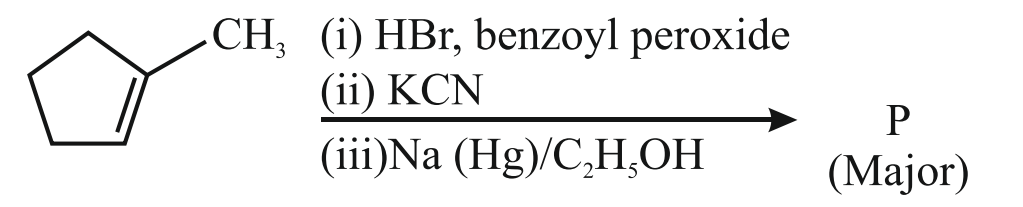
Predict the major product 'P' in the following sequence of reactions:
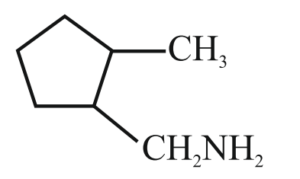
 A (2-methylcyclopentyl)methanamine
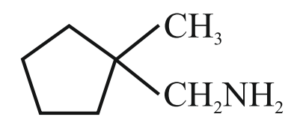
 B (1-methylcyclopentyl)methanamine
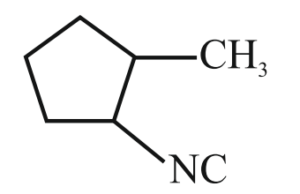
 C 1-cyano-2-methylcyclopentane
 D 1-cyano-1-methylcyclopentane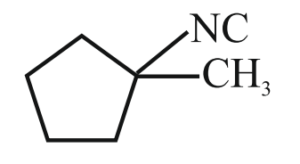
Peroxide effect adds Br at C-2 (anti-Markovnikov). Nucleophilic substitution with KCN yields 2-methylcyclopentanecarbonitrile. Reduction by Na(Hg)/EtOH (Mendius reduction) yields (2-methylcyclopentyl)methanamine.
Reaction step 1: Free radical anti-Markovnikov addition of HBr in the presence of benzoyl peroxide to 1-methylcyclopentene gives 1-bromo-2-methylcyclopentane (Br attaches to the less substituted carbon). Reaction step 2: Cyanide substitution ($S_N2$) with KCN replaces Br by CN, yielding 2-methylcyclopentanecarbonitrile. Reaction step 3: Reduction of nitrile group with $\text{Na(Hg)}/\text{C}_2\text{H}_5\text{OH}$ (Mendius reaction) reduces $-\text{CN}$ to $-\text{CH}_2\text{NH}_2$, producing (2-methylcyclopentyl)methanamine. -
Energy and radius of first Bohr orbit of $\text{He}^+$ and $\text{Li}^{2+}$ are [Given: $R_H = 2.18 \times 10^{-18}\text{ J}$, $a_0 = 52.9\text{ pm}$]:A $E_n(\text{Li}^{2+}) = -19.62 \times 10^{-18}\text{ J}; r_n(\text{Li}^{2+}) = 17.6\text{ pm}; E_n(\text{He}^+) = -8.72 \times 10^{-18}\text{ J}; r_n(\text{He}^+) = 26.4\text{ pm}$B $E_n(\text{Li}^{2+}) = -8.72 \times 10^{-18}\text{ J}; r_n(\text{Li}^{2+}) = 26.4\text{ pm}; E_n(\text{He}^+) = -19.62 \times 10^{-18}\text{ J}; r_n(\text{He}^+) = 17.6\text{ pm}$C $E_n(\text{Li}^{2+}) = -19.62 \times 10^{-16}\text{ J}; r_n(\text{Li}^{2+}) = 17.6\text{ pm}; E_n(\text{He}^+) = -8.72 \times 10^{-16}\text{ J}; r_n(\text{He}^+) = 26.4\text{ pm}$D $E_n(\text{Li}^{2+}) = -8.72 \times 10^{-16}\text{ J}; r_n(\text{Li}^{2+}) = 17.6\text{ pm}; E_n(\text{He}^+) = -19.62 \times 10^{-16}\text{ J}; r_n(\text{He}^+) = 17.6\text{ pm}$
$E_n = -R_H \frac{Z^2}{n^2}$ and $r_n = a_0 \frac{n^2}{Z}$. For $\text{He}^+$ ($Z=2$): $E_1 = -8.72 \times 10^{-18}\text{ J}$, $r_1 = 26.45\text{ pm}$. For $\text{Li}^{2+}$ ($Z=3$): $E_1 = -19.62 \times 10^{-18}\text{ J}$, $r_1 = 17.63\text{ pm}$.
For hydrogenic species: Energy is $E_n = -R_H \frac{Z^2}{n^2}$ and radius is $r_n = a_0 \frac{n^2}{Z}$. For $\text{He}^+$ ($Z = 2, n = 1$): $E_1 = -2.18 \times 10^{-18} \times (2^2) = -8.72 \times 10^{-18}\text{ J}$, $r_1 = \frac{52.9}{2} = 26.45\text{ pm} \approx 26.4\text{ pm}$. For $\text{Li}^{2+}$ ($Z = 3, n = 1$): $E_1 = -2.18 \times 10^{-18} \times (3^2) = -19.62 \times 10^{-18}\text{ J}$, $r_1 = \frac{52.9}{3} = 17.63\text{ pm} \approx 17.6\text{ pm}$. -
Which of the following are paramagnetic?
A. $[\text{NiCl}_4]^{2-}$
B. $\text{Ni(CO)}_4$
C. $[\text{Ni(CN)}_4]^{2-}$
D. $[\text{Ni(H}_2\text{O)}_6]^{2+}$
E. $\text{Ni(PPh}_3)_4$
Choose the correct answer from the options given below:A A and C onlyB B and E onlyC A and D onlyD A, D and E only$[\text{NiCl}_4]^{2-}$ (tetrahedral, $sp^3$) and $[\text{Ni(H}_2\text{O)}_6]^{2+}$ (octahedral, $sp^3d^2$) both have two unpaired electrons ($d^8$ high-spin) and are paramagnetic.
$\text{Ni}^{2+}$ has $3d^8$ electronic configuration. With weak field ligands: $[\text{NiCl}_4]^{2-}$ is tetrahedral ($sp^3$) with 2 unpaired electrons (paramagnetic); $[\text{Ni(H}_2\text{O)}_6]^{2+}$ is octahedral ($sp^3d^2$) with 2 unpaired electrons (paramagnetic). With strong field ligand: $[\text{Ni(CN)}_4]^{2-}$ undergoes pairing to form square planar ($dsp^2$) low-spin with 0 unpaired electrons (diamagnetic). For $\text{Ni}(0)$ complexes $\text{Ni(CO)}_4$ and $\text{Ni(PPh}_3)_4$, configuration is $3d^{10}$ (all paired, diamagnetic). Thus only A and D are paramagnetic. -
Given below are two statements:
Statement I: Like nitrogen that can form ammonia, arsenic can form arsine.
Statement II: Antimony cannot form antimony pentoxide.
In the light of the above statements, choose the most appropriate answer from the options given below:A Both Statement I and Statement II are correct.B Both Statement I and Statement II are incorrect.C Statement I is correct but Statement II is incorrect.D Statement I is incorrect but Statement II is correct.Statement I is correct (arsenic forms arsine $\text{AsH}_3$). Statement II is incorrect because antimony forms antimony pentoxide $\text{Sb}_2\text{O}_5$.
Group 15 elements form hydrides of formula $\text{EH}_3$ ($\text{NH}_3, \text{PH}_3, \text{AsH}_3$ / arsine, $\text{SbH}_3, \text{BiH}_3$). Therefore, Statement I is correct. All elements of Group 15 form two types of oxides: trioxides ($\text{E}_2\text{O}_3$) and pentoxides ($\text{E}_2\text{O}_5$). Antimony forms antimony pentoxide ($\text{Sb}_2\text{O}_5$), which makes Statement II incorrect. -
Which among the following electronic configurations belong to main group elements?
A. $[\text{Ne}]3s^1$
B. $[\text{Ar}]3d^3 4s^2$
C. $[\text{Kr}]4d^{10}5s^2 5p^5$
D. $[\text{Ar}]3d^{10}4s^1$
E. $[\text{Rn}]5f^0 6d^2 7s^2$
Choose the correct answer from the options given below:A B and E onlyB A and C onlyC D and E onlyD A, C and D onlyMain group elements belong to s- and p-blocks. A ($\text{Na}$, s-block) and C ($\text{I}$, p-block) are main group elements.
Main group (representative) elements are elements of the s-block and p-block (Groups 1, 2, and 13 to 18). Configuration A ($[\text{Ne}]3s^1$) is Sodium (Group 1, s-block). Configuration C ($[\text{Kr}]4d^{10}5s^2 5p^5$) is Iodine (Group 17, p-block). Configurations B (Vanadium) and D (Copper) are transition d-block elements, while E (Thorium) is an actinoid (f-block). Thus, only A and C belong to main group elements. -
Dalton's Atomic theory could not explain which of the following?A Law of conservation of massB Law of constant proportionC Law of multiple proportionD Law of gaseous volume
Dalton's atomic theory explained the laws of chemical combination by mass, but failed to explain Gay-Lussac's law of gaseous volumes.
Dalton's atomic theory provided a logical explanation for the law of conservation of mass, law of definite/constant proportions, and law of multiple proportions, but it could not explain Gay-Lussac's law of combining gaseous volumes (which was later explained by Avogadro's hypothesis). -
Consider the following compounds: $\underline{\text{K}}\text{O}_2$, $\text{H}_2\underline{\text{O}}_2$ and $\text{H}_2\underline{\text{S}}\text{O}_4$. The oxidation states of the underlined elements in them are, respectively:A +1, -1, and +6B +2, -2, and +6C +1, -2, and +4D +4, -4, and +6
In $\text{KO}_2$, $\text{K} = +1$ (superoxide). In $\text{H}_2\text{O}_2$, $\text{O} = -1$ (peroxide). In $\text{H}_2\text{SO}_4$, $\text{S} = +6$.
1. In potassium superoxide ($\text{KO}_2$), potassium is an alkali metal and always has an oxidation state of $+1$ (the superoxide ion is $\text{O}_2^-$ where each oxygen is $-1/2$). 2. In hydrogen peroxide ($\text{H}_2\text{O}_2$), the peroxide linkage gives oxygen an oxidation state of $-1$. 3. In sulfuric acid ($\text{H}_2\text{SO}_4$), $2(+1) + x + 4(-2) = 0 \implies x = +6$. Hence, the oxidation states are $+1, -1$, and $+6$. -
If the half-life ($t_{1/2}$) for a first order reaction is $1\text{ minute}$, then the time required for 99.9% completion of the reaction is closest to:A 2 minutesB 4 minutesC 5 minutesD 10 minutes
For a first order reaction, $t_{99.9\%} \approx 10 \times t_{1/2} = 10 \times 1\text{ min} = 10\text{ minutes}$.
For a first order reaction: $k = \frac{0.693}{t_{1/2}} = \frac{0.693}{1\text{ min}} = 0.693\text{ min}^{-1}$. Time for 99.9% completion: $t = \frac{2.303}{k} \log\left(\frac{100}{100 - 99.9}\right) = \frac{2.303}{0.693} \log\left(\frac{100}{0.1}\right) = \frac{2.303}{0.693} \log(10^3) = \frac{2.303 \times 3}{0.693} = \frac{6.909}{0.693} \approx 10\text{ minutes}$. -
The correct order of the wavelength of light absorbed by the following complexes is:
A. $[\text{Co(NH}_3)_6]^{3+}$
B. $[\text{Co(CN)}_6]^{3-}$
C. $[\text{Cu(H}_2\text{O)}_4]^{2+}$
D. $[\text{Ti(H}_2\text{O)}_6]^{3+}$
Choose the correct answer from the options given below:A B < D < A < CB B < A < D < CC C < D < A < BD C < A < D < BCrystal field splitting follows $\Delta_o \propto \text{charge on metal} \times \text{ligand strength}$: $\text{CN}^- > \text{NH}_3 > \text{H}_2\text{O}$. Since $\lambda_{\text{abs}} \propto 1/\Delta_o$, the absorbed wavelength order is $\text{B} < \text{A} < \text{D} < \text{C}$.
According to spectrochemical series, ligand field strength is $\text{CN}^- > \text{NH}_3 > \text{H}_2\text{O}$. Higher oxidation state on metal and stronger ligand increase crystal field splitting: $\Delta_o([\text{Co(CN)}_6]^{3-}) > \Delta_o([\text{Co(NH}_3)_6]^{3-}) > \Delta_o([\text{Ti(H}_2\text{O)}_6]^{3+}) > \Delta_o([\text{Cu(H}_2\text{O)}_4]^{2+})$. Since absorbed photon wavelength is inversely related to splitting ($\lambda = \frac{hc}{\Delta}$), the order of absorbed wavelength is $B < A < D < C$. -
Which one of the following compounds can exist as cis-trans isomers?A Pent-1-eneB 2-Methylhex-2-eneC 1,1-DimethylcyclopropaneD 1,2-Dimethylcyclohexane
1,2-Dimethylcyclohexane possesses two stereocenters with restricted rotation, existing as cis- and trans-geometric isomers.
For geometrical isomerism, there must be restricted rotation and each carbon of the stereogenic unit must be attached to two different groups. In Pent-1-ene, terminal carbon has two identical H atoms; in 2-methylhex-2-ene, C-2 has two methyl groups; in 1,1-dimethylcyclopropane, C-1 has two methyl groups. In 1,2-dimethylcyclohexane, the ring provides restricted rotation and C-1 and C-2 both hold $-\text{H}$ and $-\text{CH}_3$, allowing cis- and trans-isomers. -
Phosphoric acid ionizes in three steps with their ionization constant values $K_{a_1}, K_{a_2}$ and $K_{a_3}$ respectively, while $K$ is the overall ionization constant. Which of the following statements are true?
A. $\log K = \log K_{a_1} + \log K_{a_2} + \log K_{a_3}$
B. $\text{H}_3\text{PO}_4$ is stronger acid than $\text{H}_2\text{PO}_4^-$ and $\text{HPO}_4^{2-}$
C. $K_{a_1} > K_{a_2} > K_{a_3}$
D. $K = \frac{K_{a_1} + K_{a_2} + K_{a_3}}{2}$
Choose the correct answer from the options given below:A A and B onlyB A and C onlyC B, C and D onlyD A, B and C onlyOverall constant is $K = K_{a_1} \cdot K_{a_2} \cdot K_{a_3}$, so $\log K = \log K_{a_1} + \log K_{a_2} + \log K_{a_3}$. Removing successive protons from negatively charged species becomes increasingly difficult, so $K_{a_1} > K_{a_2} > K_{a_3}$ and $\text{H}_3\text{PO}_4$ is the strongest acid. Thus A, B, and C are true.
For polyprotic acid $\text{H}_3\text{PO}_4$: 1. Stepwise ionizations add to give overall reaction $\text{H}_3\text{PO}_4 \rightleftharpoons 3\text{H}^+ + \text{PO}_4^{3-}$, so overall $K = K_{a_1} \times K_{a_2} \times K_{a_3} \implies \log K = \log K_{a_1} + \log K_{a_2} + \log K_{a_3}$ (Statement A is true). 2. Due to electrostatic attraction, losing a proton from a neutral molecule is much easier than from negatively charged ions $\text{H}_2\text{PO}_4^-$ and $\text{HPO}_4^{2-}$, so $K_{a_1} > K_{a_2} > K_{a_3}$ and $\text{H}_3\text{PO}_4$ is the strongest acid among them (Statements B and C are true). Statement D is mathematically incorrect. Thus, A, B, and C are true. -
Which one of the following reactions does NOT give benzene as the product?A Reaction (1)
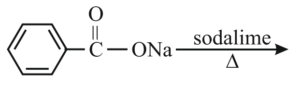 B Reaction (2)
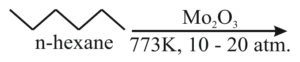 C Reaction (3)
 D Reaction (4)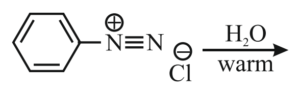
Hydrolysis of benzenediazonium chloride with warm water yields phenol ($\text{C}_6\text{H}_5\text{OH}$), not benzene.
Reaction (1) is decarboxylation of sodium benzoate giving benzene. Reaction (2) is aromatization of n-hexane over $\text{Mo}_2\text{O}_3$ catalyst giving benzene. Reaction (3) is cyclic polymerization of ethyne forming benzene. Reaction (4) is warming benzenediazonium chloride with water, which undergoes nucleophilic substitution to yield phenol: $\text{C}_6\text{H}_5\text{N}_2^+\text{Cl}^- + \text{H}_2\text{O} \xrightarrow{\Delta} \text{C}_6\text{H}_5\text{OH} + \text{N}_2 + \text{HCl}$. Thus, reaction (4) does not yield benzene. -
If the molar conductivity ($\Lambda_m$) of a $0.050\text{ mol L}^{-1}$ solution of a monobasic weak acid is $90\text{ S cm}^2\text{mol}^{-1}$, its extent (degree) of dissociation will be [Assume $\lambda_+^\circ = 349.6\text{ S cm}^2\text{mol}^{-1}$ and $\lambda_-^\circ = 50.4\text{ S cm}^2\text{mol}^{-1}$]:A 0.115B 0.125C 0.225D 0.215
$\Lambda_m^\circ = 349.6 + 50.4 = 400.0\text{ S cm}^2\text{mol}^{-1}$. Degree of dissociation $\alpha = \Lambda_m / \Lambda_m^\circ = 90 / 400 = 0.225$.
According to Kohlrausch's law of independent migration of ions, limiting molar conductivity is $\Lambda_m^\circ = \lambda_+^\circ + \lambda_-^\circ = 349.6 + 50.4 = 400.0\text{ S cm}^2\text{mol}^{-1}$. The degree of dissociation $\alpha$ is given by $\alpha = \frac{\Lambda_m}{\Lambda_m^\circ} = \frac{90\text{ S cm}^2\text{mol}^{-1}}{400.0\text{ S cm}^2\text{mol}^{-1}} = 0.225$. -
Given below are two statements:
Statement I: A hypothetical diatomic molecule with bond order zero is quite stable.
Statement II: As bond order increases, the bond length increases.
In the light of the above statements, choose the most appropriate answer from the options given below:A Both Statement I and Statement II are trueB Both Statement I and Statement II are falseC Statement I is true but Statement II is falseD Statement I is false but Statement II is trueBoth statements are false: bond order zero implies no chemical bond (molecule does not exist), and bond length is inversely proportional to bond order.
In Molecular Orbital Theory, a bond order of zero indicates that bonding electrons equal antibonding electrons, meaning no net attractive bonding exists and the molecule is completely unstable/does not exist (Statement I is false). As bond order increases, atoms are pulled closer by stronger shared electron density, so bond length decreases (Statement II is false). Hence, both statements are false. -
Out of the following complex compounds, which of the compound will be having the minimum conductance in solution?A $[\text{Co(NH}_3)_3\text{Cl}_3]$B $[\text{Co(NH}_3)_4\text{Cl}_2]\text{Cl}$C $[\text{Co(NH}_3)_6]\text{Cl}_3$D $[\text{Co(NH}_3)_5\text{Cl}]\text{Cl}_2$
$[\text{Co(NH}_3)_3\text{Cl}_3]$ is a neutral coordination complex that does not ionize in water, giving minimum electrical conductance.
Electrical conductance in aqueous solution is directly proportional to the number of free ions produced per formula unit. $[\text{Co(NH}_3)_6]\text{Cl}_3$ produces 4 ions; $[\text{Co(NH}_3)_5\text{Cl}]\text{Cl}_2$ produces 3 ions; $[\text{Co(NH}_3)_4\text{Cl}_2]\text{Cl}$ produces 2 ions. $[\text{Co(NH}_3)_3\text{Cl}_3]$ is a neutral non-electrolyte complex that does not dissociate into ions in water, exhibiting minimum (near zero) electrical conductance. -
Match List-I with List-II.
Column I
- A. $\text{XeO}_3$
- B. $\text{XeF}_2$
- C. $\text{XeOF}_4$
- D. $\text{XeF}_6$
Column II
- I. $sp^3d$, linear
- II. $sp^3$, pyramidal
- III. $sp^3d^3$, distorted octahedral
- IV. $sp^3d^2$, square pyramidal
Correct answer: A → II, B → I, C → IV, D → III
$\text{XeO}_3$: $sp^3$ pyramidal; $\text{XeF}_2$: $sp^3d$ linear; $\text{XeOF}_4$: $sp^3d^2$ square pyramidal; $\text{XeF}_6$: $sp^3d^3$ distorted octahedral.
Hybridization and shapes of xenon compounds: 1. $\text{XeO}_3$: 3 $\sigma$ bonds + 1 lone pair = 4 steric number $\implies sp^3$, trigonal pyramidal (II). 2. $\text{XeF}_2$: 2 $\sigma$ bonds + 3 lone pairs = 5 steric number $\implies sp^3d$, linear (I). 3. $\text{XeOF}_4$: 5 $\sigma$ bonds + 1 lone pair = 6 steric number $\implies sp^3d^2$, square pyramidal (IV). 4. $\text{XeF}_6$: 6 $\sigma$ bonds + 1 lone pair = 7 steric number $\implies sp^3d^3$, distorted octahedral (III). Hence, A-II, B-I, C-IV, D-III. -
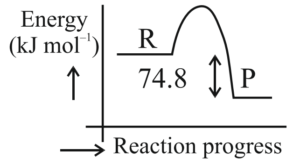
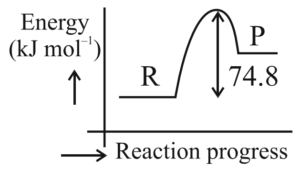
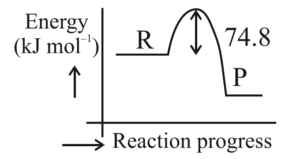
$\text{C}(s) + 2\text{H}_2(g) \rightarrow \text{CH}_4(g); \Delta H = -74.8\text{ kJ mol}^{-1}$. Which of the following diagrams gives an accurate representation of the above reaction? [R $\rightarrow$ reactants; P $\rightarrow$ products]A Energy profile where Products (P) lie $74.8\text{ kJ mol}^{-1}$ below Reactants (R) with downward enthalpy arrow.
 B Energy profile where Products (P) lie above Reactants (R).
 C Energy profile showing an endothermic plateau.
 D Energy profile with no activation energy barrier.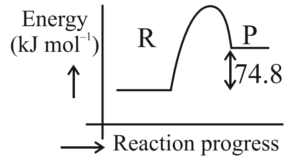
Since $\Delta H = -74.8\text{ kJ mol}^{-1}$ is exothermic, products have lower potential energy than reactants by $74.8\text{ kJ mol}^{-1}$.
The formation of methane from carbon and hydrogen is exothermic ($\Delta H = -74.8\text{ kJ mol}^{-1}$). For an exothermic reaction, the enthalpy of products is lower than the enthalpy of reactants: $H_P < H_R$, with $\Delta H = H_P - H_R = -74.8\text{ kJ mol}^{-1}$. Thus, the potential energy profile shows an initial activation barrier followed by a product level lying $74.8\text{ kJ mol}^{-1}$ below the reactant level, represented accurately by diagram (1). -
Match List-I with List-II.
Column I
- A. Humidity
- B. Alloys
- C. Amalgams
- D. Smoke
Column II
- I. Solid in solid
- II. Liquid in gas
- III. Solid in gas
- IV. Liquid in solid
Correct answer: A → II, B → I, C → IV, D → III
Humidity: Liquid in gas; Alloys: Solid in solid; Amalgams: Liquid in solid; Smoke: Solid in gas.
Classification of solution types: 1. Humidity represents water vapour dispersed in air (liquid in gas, II). 2. Alloys are homogeneous solid solutions of metals (solid in solid, I). 3. Amalgams are liquid mercury dissolved in a solid metal (liquid in solid, IV). 4. Smoke consists of solid carbon/dust particles dispersed in air (solid in gas, III). Therefore, the correct matching is A-II, B-I, C-IV, D-III. -
The correct order of decreasing basic strength of the given amines is:A N-methylaniline > benzenamine > ethanamine > N-ethylethanamineB N-ethylethanamine > ethanamine > benzenamine > N-methylanilineC N-ethylethanamine > ethanamine > N-methylaniline > benzenamineD benzenamine > ethanamine > N-methylaniline > N-ethylethanamine
Aliphatic amines are stronger bases than aromatic amines. Secondary aliphatic amine > primary aliphatic amine > secondary aromatic amine > aniline.
Aliphatic amines have localized electron pairs on nitrogen and are far stronger bases than aryl amines where the nitrogen lone pair is delocalized into the benzene ring (+R effect). Among aliphatic amines in aqueous medium, diethylamine (N-ethylethanamine, $2^\circ$) is more basic than ethylamine (ethanamine, $1^\circ$) due to combined $+I$ and steric/solvation effects. Among aromatic amines, N-methylaniline has a $+I$ methyl group that enhances electron density on N relative to benzenamine (aniline). Thus: N-ethylethanamine > ethanamine > N-methylaniline > benzenamine. -
Among the following, choose the ones with equal number of atoms:
A. $212\text{ g of } \text{Na}_2\text{CO}_3(s)$ [molar mass = $106\text{ g}$]
B. $248\text{ g of } \text{Na}_2\text{O}(s)$ [molar mass = $62\text{ g}$]
C. $240\text{ g of } \text{NaOH}(s)$ [molar mass = $40\text{ g}$]
D. $12\text{ g of } \text{H}_2(g)$ [molar mass = $2\text{ g}$]
E. $220\text{ g of } \text{CO}_2(g)$ [molar mass = $44\text{ g}$]
Choose the correct answer from the options given below:A A, B, and C onlyB A, B, and D onlyC B, C, and D onlyD B, D, and E onlyTotal atoms $= n \times \text{atomicity} \times N_A$. A: $2 \times 6 = 12 N_A$; B: $4 \times 3 = 12 N_A$; D: $6 \times 2 = 12 N_A$. Thus A, B, and D contain equal numbers of atoms.
Calculating total moles of atoms: A. $\text{Na}_2\text{CO}_3$: Moles $= 212/106 = 2\text{ mol}$. Each unit contains 6 atoms, so total atoms $= 2 \times 6 N_A = 12 N_A$. B. $\text{Na}_2\text{O}$: Moles $= 248/62 = 4\text{ mol}$. Each unit contains 3 atoms, so total atoms $= 4 \times 3 N_A = 12 N_A$. C. $\text{NaOH}$: Moles $= 240/40 = 6\text{ mol}$. Each unit contains 3 atoms, so total atoms $= 6 \times 3 N_A = 18 N_A$. D. $\text{H}_2$: Moles $= 12/2 = 6\text{ mol}$. Each molecule has 2 atoms, so total atoms $= 6 \times 2 N_A = 12 N_A$. E. $\text{CO}_2$: Moles $= 220/44 = 5\text{ mol}$. Each molecule has 3 atoms, so total atoms $= 5 \times 3 N_A = 15 N_A$. Thus, A, B, and D each contain $12 N_A$ atoms. -
Match List-I with List-II.
Column I
- A. Vitamin $\text{B}_{12}$
- B. Vitamin D
- C. Vitamin $\text{B}_2$
- D. Vitamin $\text{B}_6$
Column II
- I. Cheilosis
- II. Convulsions
- III. Rickets
- IV. Pernicious anaemia
Correct answer: A → IV, B → III, C → I, D → II
Vitamin $\text{B}_{12}$: Pernicious anaemia; Vitamin D: Rickets; Vitamin $\text{B}_2$: Cheilosis; Vitamin $\text{B}_6$: Convulsions.
Vitamins and deficiency disorders: 1. Vitamin $\text{B}_{12}$ (Cobalamin) deficiency causes Pernicious anaemia (IV). 2. Vitamin D (Calciferol) deficiency causes Rickets (III). 3. Vitamin $\text{B}_2$ (Riboflavin) deficiency causes Cheilosis (fissuring at corners of mouth) (I). 4. Vitamin $\text{B}_6$ (Pyridoxine) deficiency leads to Convulsions (II). Hence, A-IV, B-III, C-I, D-II. -
The correct order of decreasing acidity of the following aliphatic acids is:A $(\text{CH}_3)_3\text{CCOOH} > (\text{CH}_3)_2\text{CHCOOH} > \text{CH}_3\text{COOH} > \text{HCOOH}$B $\text{CH}_3\text{COOH} > (\text{CH}_3)_2\text{CHCOOH} > (\text{CH}_3)_3\text{CCOOH} > \text{HCOOH}$C $\text{HCOOH} > \text{CH}_3\text{COOH} > (\text{CH}_3)_2\text{CHCOOH} > (\text{CH}_3)_3\text{CCOOH}$D $\text{HCOOH} > (\text{CH}_3)_3\text{CCOOH} > (\text{CH}_3)_2\text{CHCOOH} > \text{CH}_3\text{COOH}$
Alkyl groups are electron-donating ($+I$) which destabilize the carboxylate anion, decreasing acid strength: $\text{HCOOH} > \text{CH}_3\text{COOH} > (\text{CH}_3)_2\text{CHCOOH} > (\text{CH}_3)_3\text{CCOOH}$.
Acidity of carboxylic acids depends on the stability of the conjugate carboxylate anion ($\text{RCOO}^-$). Electron-donating inductive groups ($+I$) intensify the negative charge on the carboxylate group and destabilize it, thereby reducing acid strength. Formic acid (HCOOH) has no alkyl group and is the strongest acid. Acetic acid has one $+I$ methyl group, isobutyric acid has an isopropyl group (two methyls), and pivalic acid has a tert-butyl group (three methyls), making it the weakest acid. The decreasing order of acidity is $\text{HCOOH} > \text{CH}_3\text{COOH} > (\text{CH}_3)_2\text{CHCOOH} > (\text{CH}_3)_3\text{CCOOH}$.