Looking for classes? Ksquare Career Institute, Bengaluru →

Chemistry
Thermodynamics
82 questions from 36 papers, each with its answer.
- 82 questions
- 36 papers
- 4.66% of Chemistry
Gibbs energy and spontaneity
-
The values of $\Delta H$ and $\Delta S$ for the reaction, $C(graphite) + CO_2(g) \rightarrow 2CO(g)$ are 170 kJ and 170 J $K^{-1}$ respectively. This reaction will be spontaneous atA reaction is spontaneous when $\Delta G = \Delta H - T\Delta S < 0$
With $\Delta H$ and $\Delta S$ both positive, this needs $T\Delta S > \Delta H$, i.e., $T > \frac{\Delta H}{\Delta S}$
$\frac{\Delta H}{\Delta S} = \frac{170\times10^3\ J}{170\ J\,K^{-1}} = 1000$ K
So the reaction is spontaneous only above 1000 K.
Among the given temperatures, only 1110 K is above 1000 K.
Bond enthalpy
-
From the following bond energies:
H–H bond energy: 431.37 kJ $mol^{-1}$
C=C bond energy: 606.10 kJ $mol^{-1}$
C–C bond energy: 336.49 kJ $mol^{-1}$
C–H bond energy: 410.50 kJ $mol^{-1}$
Enthalpy for the reaction,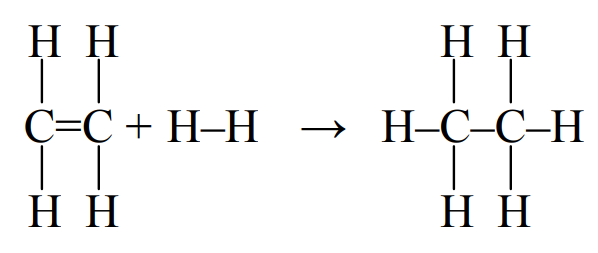 will be$\Delta H$ = (sum of bond energies of bonds broken) − (sum of bond energies of bonds formed)
Bonds broken (reactants): 1 C=C + 4 C–H + 1 H–H = $606.10 + 4(410.50) + 431.37 = 2679.47$ kJ
Bonds formed (product, ethane): 1 C–C + 6 C–H = $336.49 + 6(410.50) = 2799.49$ kJ
$\Delta H = 2679.47 - 2799.49$
$\Delta H = -120.02 \approx -120.0$ kJ $mol^{-1}$
That is every question in Thermodynamics for this filter.
Want a score?
Answers here are not saved. Practise as a test to be marked and see your progress.
Practise as a test