Looking for classes? Ksquare Career Institute, Bengaluru →

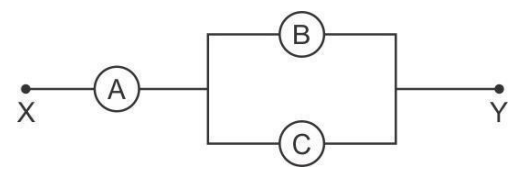
A, B and C are voltmeters of resistance R, 1.5R and 3R, respectively, as shown in the figure. When some potential difference is applied between X and Y, the voltmeter readings are $V_A$, $V_B$ and $V_C$, respectively, then
A
$V_A = V_B = V_C$
B
$V_A \ne V_B = V_C$
C
$V_A = V_B \ne V_C$
D
$V_A \ne V_B \ne V_C$
Detailed Solution
B and C are in parallel, so $V_B = V_C$.
Equivalent resistance of B and C: $\frac{1.5R\times 3R}{1.5R + 3R} = R$
This combination is in series with A (resistance R). In series $V \propto R$, so the voltage across A equals that across the combination.
$V_A = V_B = V_C$
Equivalent resistance of B and C: $\frac{1.5R\times 3R}{1.5R + 3R} = R$
This combination is in series with A (resistance R). In series $V \propto R$, so the voltage across A equals that across the combination.
$V_A = V_B = V_C$