Looking for classes? Ksquare Career Institute, Bengaluru →

Current Electricity
Combination of Resistors
9 questions from 9 papers, each with its answer.
- questions
- 9
- papers
- 9
- years asked, 2017–2026
- 2 of 10
- of Current Electricity
- 6.92%
Appears in
Concepts tested
- Parallel arcs of a ring
- Potential difference in a resistor network
- Power and current division
- Resistance of a ring between diametric points
- Resistor Network Equivalent Resistance
- Resistors in parallel
- Series and parallel combination of equal resistors
- series vs parallel of identical wires
- Series-parallel voltage division
All Questions
2025 1 question
-
A wire of resistance $R$ is cut into 8 equal pieces. From these pieces two equivalent resistances are made by adding four of these together in parallel. Then these two sets are added in series. The net effective resistance of the combination is:
Each piece has resistance $R/8$. Four in parallel give $R_p = (R/8)/4 = R/32$. Two such sets in series give $R_{net} = R/32 + R/32 = R/16$.
Resistance of each piece: $r = R/8$. When 4 pieces are connected in parallel, the equivalent resistance of one set is $R_p = \frac{r}{4} = \frac{R/8}{4} = \frac{R}{32}$. When two such identical parallel sets are connected in series, the net resistance is $R_{net} = R_p + R_p = \frac{R}{32} + \frac{R}{32} = \frac{2R}{32} = \frac{R}{16}$.
2021 1 question
-
The effective resistance of a parallel connection that consists of four wires of equal length, equal area of cross-section and same material is $0.25\ \Omega$. What will be the effective resistance if they are connected in series?In parallel: $R_{eq} = \frac{R}{4} = 0.25\ \Omega \Rightarrow R = 1\ \Omega$ (each wire) In series: $R_{series} = 4R = 4 \times 1 = 4\ \Omega$
2015 AIPMT-I 1 question
-
A, B and C are voltmeters of resistance R, 1.5R and 3R, respectively, as shown in the figure. When some potential difference is applied between X and Y, the voltmeter readings are $V_A$, $V_B$ and $V_C$, respectively, then
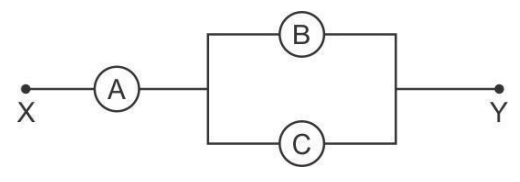 B and C are in parallel, so $V_B = V_C$.
Equivalent resistance of B and C: $\frac{1.5R\times 3R}{1.5R + 3R} = R$
This combination is in series with A (resistance R). In series $V \propto R$, so the voltage across A equals that across the combination.
$V_A = V_B = V_C$
2012 AIPMT-PRE 1 question
-
A ring is made of a wire having a resistance $R_0 = 12\ \Omega$. Find the points A and B, as shown in the figure, at which a current carrying conductor should be connected so that the resistance R of the sub circuit between these points is equal to $\frac{8}{3}\ \Omega$.
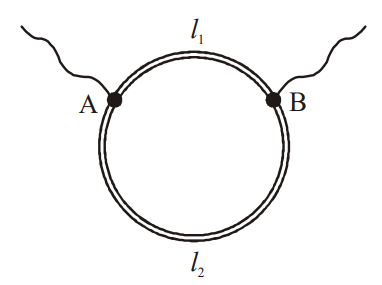 The two arcs have resistances $R_1$ and $R_2$ (proportional to $l_1$ and $l_2$) and are in parallel between A and B.
$R_1 + R_2 = 12$ ...(i)
$\frac{R_1R_2}{R_1 + R_2} = \frac{8}{3} \Rightarrow R_1R_2 = 32$ ...(ii)
Solving: $R_1 = 4\ \Omega$ and $R_2 = 8\ \Omega$
$\frac{l_1}{l_2} = \frac{R_1}{R_2} = \frac{1}{2}$
2011 AIPMT-PRE 1 question
-
If power dissipated in the 9 $\Omega$ resistor in the circuit shown is 36 watt, the potential difference across the 2 $\Omega$ resistor is
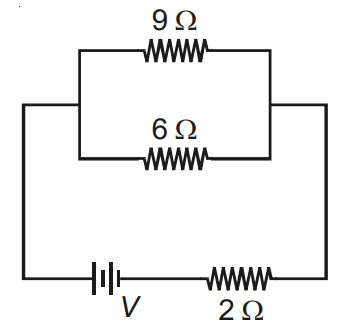 In the circuit the 9 $\Omega$ and 6 $\Omega$ resistors are in parallel, and this combination is in series with the 2 $\Omega$ resistor.
Power in the 9 $\Omega$ resistor: $P = I_1^2R$, so $36 = I_1^2\times9$, giving $I_1 = 2$ A
Potential difference across the 9 $\Omega$ resistor = $I_1R = 2\times9 = 18$ V
The same 18 V is across the 6 $\Omega$ resistor, so $I_2 = \frac{18}{6} = 3$ A
Total current through the 2 $\Omega$ resistor = $I_1 + I_2 = 2 + 3 = 5$ A
Potential difference across the 2 $\Omega$ resistor = $5\times2 = 10$ V
2009 AIPMT 1 question
-
A wire of resistance 12 ohms per metre is bent to form a complete circle of radius 10 cm. The resistance between its two diametrically opposite points, A and B as shown in the figure, is
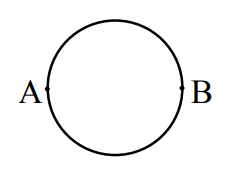 Length of the wire = circumference = $2\pi r = 2\pi\times0.1 = 0.2\pi$ m
Total resistance of the wire = $12\times0.2\pi = 2.4\pi\ \Omega$
Diametrically opposite points divide the circle into two equal semicircles, each of resistance $\frac{2.4\pi}{2} = 1.2\pi\ \Omega$
Between A and B these two halves are in parallel: $R_{AB} = \frac{1.2\pi\times1.2\pi}{1.2\pi + 1.2\pi} = \frac{1.2\pi}{2}$
$R_{AB} = 0.6\pi\ \Omega$
2008 AIPMT 1 question
-
In the circuit shown, the current through the $4\,\Omega$ resistor is 1 amp when the points P and M are connected to a D.C. voltage source. The potential difference between the points M and N is -
(Between P and M there are two parallel branches. Upper branch: $4\,\Omega$ and $3\,\Omega$ in parallel. Lower branch: $0.5\,\Omega$ and $0.5\,\Omega$ in parallel, joined at N in series with $1\,\Omega$.)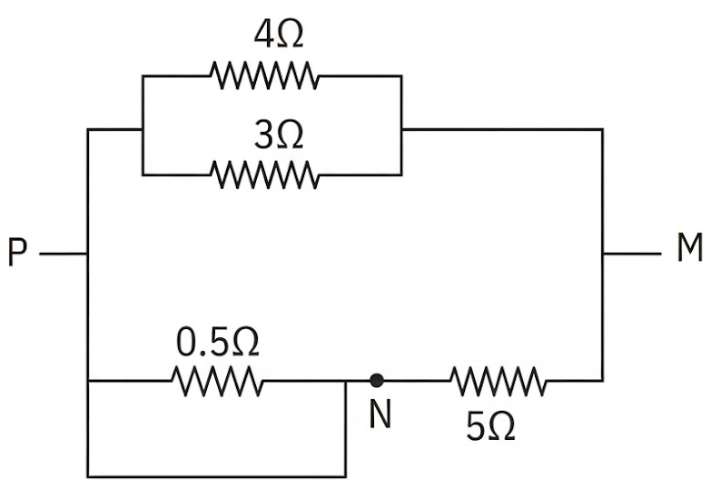 Current through the $4\,\Omega$ resistor: $i_1 = 1$ A.
Potential difference across the $4\,\Omega$ resistor: $V_{PM} = 1 \times 4 = 4$ V. This is the potential difference between P and M.
The $3\,\Omega$ resistor is in parallel with $4\,\Omega$, so the current through it is $i_2 = \dfrac{4}{3}$ A.
Lower branch: the two $0.5\,\Omega$ resistors in parallel give $\dfrac{0.5 \times 0.5}{0.5 + 0.5} = 0.25\,\Omega = \dfrac{1}{4}\,\Omega$ between P and N.
This is in series with $1\,\Omega$ between N and M, so the resistance of the lower branch $= \dfrac{1}{4} + 1 = \dfrac{5}{4}\,\Omega$.
The lower branch is also connected between P and M, so the current through it is $i_4 = \dfrac{V_{PM}}{5/4} = \dfrac{4 \times 4}{5} = \dfrac{16}{5} = 3.2$ A.
Potential difference across N and M: $V_{NM} = i_4 \times 1\,\Omega = 3.2 \times 1 = 3.2$ volt
Second approach: $V_{PN} + V_{NM} = 4$ V and $\dfrac{V_{PN}}{V_{NM}} = \dfrac{1/4}{1} = \dfrac{1}{4}$, so $\dfrac{1}{4}V_{NM} + V_{NM} = 4 \Rightarrow V_{NM} = \dfrac{16}{5} = 3.2$ V.
2005 AIPMT 1 question
-
When a wire of uniform cross-section $a$, length $l$ and resistance R is bent into a complete circle, resistance between any two diametrically opposite points will be -When the wire is bent into a circle, two diametrically opposite points A and B divide it into two equal semicircles.
Each semicircle has half the length of the wire, so its resistance is $\dfrac{R}{2}$.
Between A and B the two semicircles are in parallel.
$R_{AB} = \dfrac{(R/2)(R/2)}{(R/2) + (R/2)}$
$R_{AB} = \dfrac{R^2/4}{R} = \dfrac{R}{4}$
2004 AIPMT 1 question
-
Resistances n, each of r ohm, when connected in parallel give an equivalent resistance of R ohm. If these resistances were connected in series, the combination would have a resistance in ohms, equal toFor n equal resistances r in parallel: $\dfrac{1}{R} = \dfrac{1}{r} + \dfrac{1}{r} + \dots$ (n times) $= \dfrac{n}{r}$
So according to the question $R = \dfrac{r}{n} \Rightarrow r = nR$
For the same n resistances in series: $R_{series} = r + r + \dots$ (n times) $= nr$
Substituting $r = nR$: $R_{series} = n \times nR = n^2R$
So the series combination has a resistance of $n^2R$ ohm.