Looking for classes? Ksquare Career Institute, Bengaluru →

Current Electricity
Combination of Resistors and Symmetry
1 question from 1 paper, each with its answer.
- question
- 1
- paper
- 1
- of Current Electricity
- 0.77%
Concepts tested
- Balanced network with no current in a branch
All Questions
2004 AIPMT 1 question
-
Five equal resistances each of resistance R are connected as shown in the Figure. A battery of V volts is connected between A and B. The current flowing in AFCEB will be
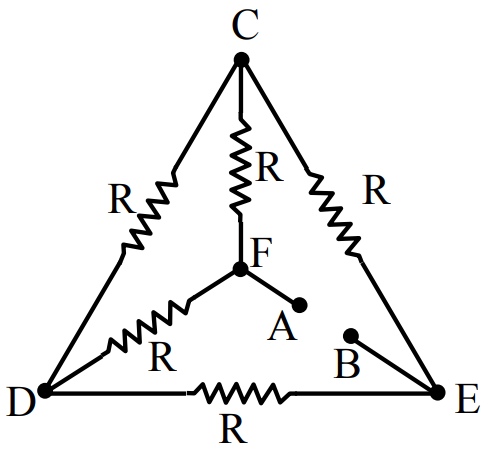 The battery is effectively connected between points F (joined to A) and E (joined to B).
From F there are two routes to E: F–C–E (resistors FC and CE) and F–D–E (resistors FD and DE). The fifth resistor DC joins C and D.
Each of C and D is connected to F by one resistor R and to E by one resistor R, so by symmetry C and D are at the same potential. Hence no current flows through the resistor DC, and it can be removed.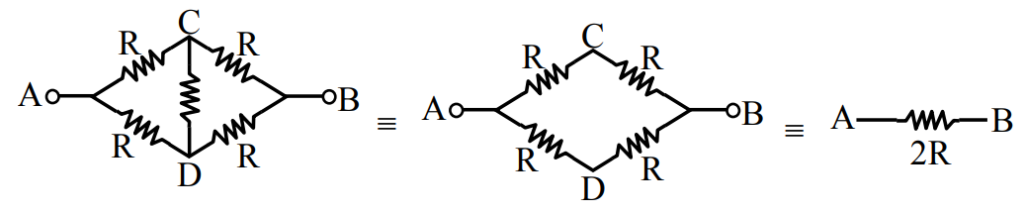
Now the circuit is two branches, each of $R + R = 2R$, in parallel. Equivalent resistance $= \dfrac{2R \times 2R}{4R} = R$.
Total current from the battery $= \dfrac{V}{R}$, which divides equally between the two identical branches.
Current in the branch AFCEB $= \dfrac{V}{2R}$