Looking for classes? Ksquare Career Institute, Bengaluru →

Current Electricity
Heating Effect of Current
3 questions from 3 papers, each with its answer.
- questions
- 3
- papers
- 3
- years asked, 2017–2026
- 1 of 10
- of Current Electricity
- 2.31%
Appears in
Concepts tested
- Electrical energy and heat
- heat in parallel resistors
- Heating time with coils in parallel
All Questions
2022 1 question
-
Two resistors of resistance, $100\ \Omega$ and $200\ \Omega$ are connected in parallel in an electrical circuit. The ratio of the thermal energy developed in $100\ \Omega$ to that in $200\ \Omega$ in a given time is :In parallel, the potential drop V across both resistors is the same. $P = \frac{V^2}{R} \Rightarrow P \propto \frac{1}{R}$ $\frac{P_1}{P_2} = \frac{R_2}{R_1} = \frac{200}{100} = \frac{2}{1}$ So the ratio of thermal energies is 2 : 1.
2008 AIPMT 1 question
-
An electric kettle takes 4 A current at 220 V. How much time will it take to boil 1 kg of water from temperature $20^\circ C$ ? The temperature of boiling water is $100^\circ C$.Heat required to boil the water: $Q = mc\,\Delta T$
$Q = 1 \times 1 \times (100 - 20) = 80$ kcal
In joules, taking $c = 4200$ J kg$^{-1}$ K$^{-1}$: $Q = 1 \times 4200 \times 80 = 336000$ J
Heat given by the supply in time $t$: $H = V\,i\,t = 220 \times 4 \times t = 880\,t$ J
Setting $H = Q$:
$880\,t = 336000$
$t = \dfrac{336000}{880} = 381.8$ s
$t = \dfrac{381.8}{60} \approx 6.3$ min
So the kettle takes about 6.3 min to boil the water.
2003 AIPMT 1 question
-
An electric kettle has two heating coils. When one of the coils is connected to an a.c. source, the water in the kettle boils in 10 minutes. When the other coil is used the water boils in 40 minutes. If both the coils are connected in parallel, the time taken by the same quantity of water to boil will be :The same quantity of heat Q is needed to boil the water each time, and the supply voltage V is the same.
$Q = \dfrac{V^2}{R_1}t_1 = \dfrac{V^2}{R_2}t_2 = \dfrac{V^2}{R}t$, where R is the resistance of the parallel combination.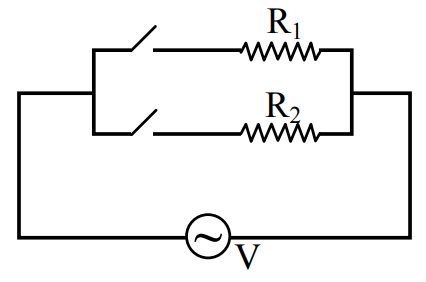
For parallel coils: $\dfrac{1}{R} = \dfrac{1}{R_1} + \dfrac{1}{R_2}$
From the heat equation, $\dfrac{1}{R} = \dfrac{Q}{V^2 t}$, so $\dfrac{Q}{V^2t} = \dfrac{Q}{V^2t_1} + \dfrac{Q}{V^2t_2}$
$\Rightarrow \dfrac{1}{t} = \dfrac{1}{t_1} + \dfrac{1}{t_2} \Rightarrow t = \dfrac{t_1t_2}{t_1 + t_2}$
$t = \dfrac{10 \times 40}{10 + 40} = 8$ min