Looking for classes? Ksquare Career Institute, Bengaluru →

Current Electricity
Potentiometer
8 questions from 8 papers, each with its answer.
- questions
- 8
- papers
- 8
- years asked, 2017–2026
- 1 of 10
- of Current Electricity
- 6.15%
Appears in
Concepts tested
- Potential gradient 3
- balance length vs EMF
- Comparison of potential differences
- Internal resistance of a cell
- Internal resistance using a potentiometer
- Null method draws no current
All Questions
2021 1 question
-
In a potentiometer circuit a cell of EMF 1.5 V gives balance point at 36 cm length of wire. If another cell of EMF 2.5 V replaces the first cell, then at what length of the wire, the balance point occurs?For a potentiometer, $E \propto \ell$: $\frac{E_1}{E_2} = \frac{\ell_1}{\ell_2}$ $\frac{1.5}{2.5} = \frac{36}{\ell_2} \Rightarrow \ell_2 = 36 \times \frac{5}{3} = 60$ cm
2015 AIPMT-I 1 question
-
A potentiometer wire has length 4 m and resistance 8 $\Omega$. The resistance that must be connected in series with the wire and an accumulator of emf 2 V, so as to get a potential gradient 1 mV per cm on the wire isPotential gradient $x = 1$ mV/cm $= \frac{10^{-3}}{10^{-2}}$ V/m $= 0.1$ V/m
$x = \frac{E}{R + R'}\times\frac{R}{L}$
$0.1 = \frac{2}{8 + R'}\times\frac{8}{4}$
$8 + R' = 40 \Rightarrow R' = 32\ \Omega$
2015 AIPMT-II 1 question
-
A potentiometer wire of length L and a resistance r are connected in series with a battery of e.m.f. $E_0$ and a resistance $r_1$. An unknown e.m.f. E is balanced at a length l of the potentiometer wire. The e.m.f. E will be given by:Current in the wire: $i = \frac{E_0}{r + r_1}$
Potential gradient: $x = \frac{ir}{L} = \frac{E_0r}{(r + r_1)L}$
$E = xl = \frac{E_0r}{(r + r_1)}\cdot\frac{l}{L}$
2014 AIPMT 1 question
-
A potentiometer circuit has been set up for finding the internal resistance of a given cell. The main battery, used across the potentiometer wire, has an emf of 2.0 V and a negligible internal resistance. The potentiometer wire itself is 4 m long. When the resistance R, connected across the given cell, has values of (i) infinity (ii) 9.5 $\Omega$, the balancing lengths on the potentiometer wire are found to be 3 m and 2.85 m, respectively. The value of internal resistance of the cell isInternal resistance $r = \left(\frac{E - V}{V}\right)R = \left(\frac{l_1 - l_2}{l_2}\right)R$
$r = \left(\frac{3 - 2.85}{2.85}\right)(9.5) = 0.5\ \Omega$
2010 AIPMT-PRE 1 question
-
A potentiometer circuit is set up as shown. The potential gradient across the potentiometer wire is k volt/cm and the ammeter, present in the circuit, reads 1.0 A when two way key is switched off. The balance points, when the key between the terminals (i) 1 and 2 (ii) 1 and 3, is plugged in, are found to be at lengths $l_1$ cm and $l_2$ cm respectively. The magnitudes of the resistors R and X, in ohms, are then equal, respectively, to
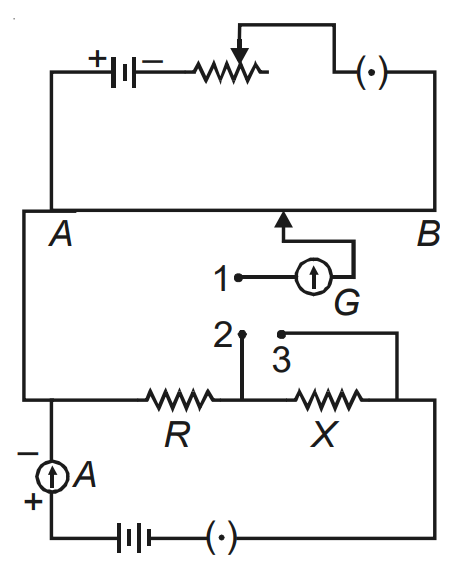 The current through R and X in the secondary circuit is I = 1.0 A.
With the key between 1 and 2, the potential difference across R alone is balanced: $V_R = IR = kl_1$
Since I = 1 A, $R = kl_1$ ohm
With the key between 1 and 3, the potential difference across R and X in series is balanced: $I(R + X) = kl_2$
$R + X = kl_2$, so $X = kl_2 - kl_1$
$X = k(l_2 - l_1)$ ohm
So R and X are $kl_1$ and $k(l_2 - l_1)$ respectively.
2008 AIPMT 1 question
-
A cell can be balanced against 110 cm and 100 cm of potentiometer wire, respectively with and without being short circuited through a resistance of $10\,\Omega$. Its internal resistance is -In a potentiometer the potential difference is proportional to the balancing length.
On open circuit the cell balances at the longer length, so emf $E \propto l_1$ with $l_1 = 110$ cm.
When the cell is shunted by $R = 10\,\Omega$, its terminal voltage $V = \dfrac{E}{R + r}\cdot R \propto l_2$ with $l_2 = 100$ cm.
$\dfrac{E}{V} = \dfrac{R + r}{R} = \dfrac{l_1}{l_2}$
$\Rightarrow r = \left(\dfrac{l_1}{l_2} - 1\right)R = \left(\dfrac{l_1 - l_2}{l_2}\right)R$
$r = \dfrac{110 - 100}{100} \times 10$
$r = 1\,\Omega$
(The larger balancing length always belongs to the open-circuit emf, since $E \gt V$.)
2001 AIPMT 1 question
-
If specific resistance of a potentiometer wire is $10^{-7}\ \Omega$ m and current flowing through it is 0.1 A, cross-sectional area of wire is $10^{-6}$ m$^2$ then potential gradient will be : -Potential gradient $x = \dfrac{V}{l} = \dfrac{IR}{l} = \dfrac{I\rho l}{Al} = \dfrac{I\rho}{A}$
$x = \dfrac{0.1 \times 10^{-7}}{10^{-6}} = 10^{-2}$ V/m
2000 AIPMT 1 question
-
The potentiometer is best for measuring voltage, as :A potentiometer measures voltage by a null (balance) method. At the balance point, no current flows through the galvanometer, i.e. no current is drawn from the cell being measured.
So it measures the potential difference as in an open circuit, i.e. the true emf of a cell, without the drop due to internal resistance.
A voltmeter draws some current, so it measures a slightly lower terminal voltage.
So the potentiometer is best because it measures p.d. as in an open circuit.