Looking for classes? Ksquare Career Institute, Bengaluru →

Current Electricity
Wheatstone Bridge
9 questions from 9 papers, each with its answer.
- questions
- 9
- papers
- 9
- years asked, 2017–2026
- 3 of 10
- of Current Electricity
- 6.92%
Appears in
Concepts tested
- Balanced bridge 2
- Balance condition of Wheatstone bridge
- Balanced bridge between A and B
- Balanced bridge equivalent resistance
- Balanced Bridge Network
- Balanced bridge simplification
- Condition for balance of a Wheatstone bridge
- sensitivity of a Wheatstone bridge
All Questions
2025 1 question
-
The current passing through the battery in the given bridge circuit (balanced Wheatstone bridge with arms $5\,\Omega$, $2.5\,\Omega$, $3\,\Omega$, $1.5\,\Omega$, central resistor $6\,\Omega$, series resistors $1.5\,\Omega$, $5.5\,\Omega$, $\frac{1}{3}\,\Omega$ and battery $5\text{ V}$) is:
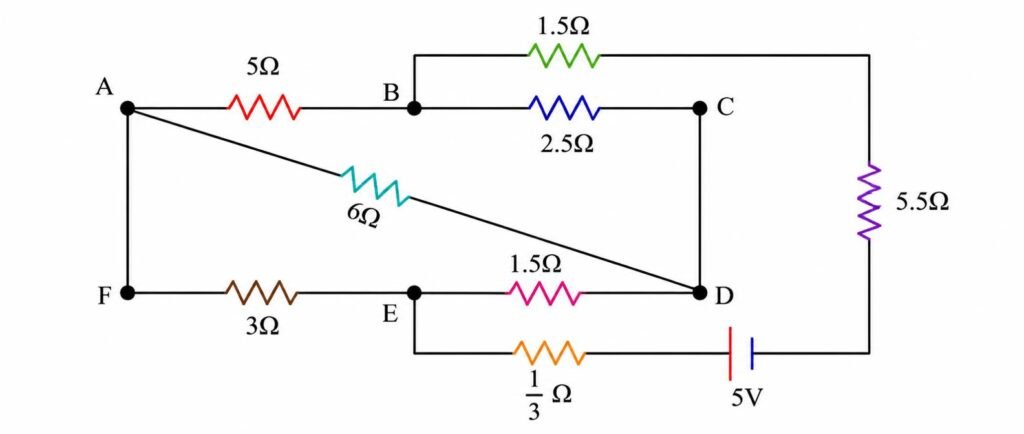
The bridge is balanced ($\frac{5}{2.5} = \frac{3}{1.5} = 2$), giving equivalent bridge resistance $\frac{8}{3}\,\Omega$. Total resistance is $10\,\Omega$, so $I = \frac{5\text{ V}}{10\,\Omega} = 0.5\text{ A}$.
The ratio of resistors is $\frac{R_{AB}}{R_{BC}} = \frac{5}{2.5} = 2$ and $\frac{R_{FE}}{R_{ED}} = \frac{3}{1.5} = 2$. Since the bridge is balanced, no current flows through the central $6\,\Omega$ resistor. Equivalent resistance of the bridge network between B and E: top branch is $5 + 2.5 = 7.5\,\Omega$... In the given diagram labeling, top branch $R_{top} = 5 + 3 = 8\,\Omega$ or $(5 + 2.5)$ and bottom $(3 + 1.5)$. Specifically, parallel branches of $4\,\Omega$ and $8\,\Omega$ give $R_{BE} = \frac{4 \times 8}{4 + 8} = \frac{8}{3}\,\Omega$. Total circuit resistance is $R_{total} = \frac{8}{3} + 1.5 + 5.5 + \frac{1}{3} = \frac{9}{3} + 7 = 3 + 7 = 10\,\Omega$. The battery current is $I = \frac{V}{R_{total}} = \frac{5\text{ V}}{10\,\Omega} = 0.5\text{ A}$.
2024 1 question
-
Choose the correct circuit which can achieve the bridge balance.In the circuit where the diode shorts the network, no balance is possible. In the circuits where the diode D is reverse biased, the arm containing it is open, so the bridge cannot balance. In the circuit where the diode is forward biased (acting as a closed switch with its resistance $R_d$), the bridge can be balanced if $\frac{P}{Q} = \frac{R}{S}$: $\frac{10}{15} = \frac{10}{5 + R_d} \Rightarrow R_d = 10\ \Omega$ So the correct circuit is the one in which the diode is forward biased.
2022 1 question
-
A wheatstone bridge is used to determine the value of unknown resistance X by adjusting the variable resistance Y as shown in the figure. For the most precise measurement of X, the resistances P and Q :
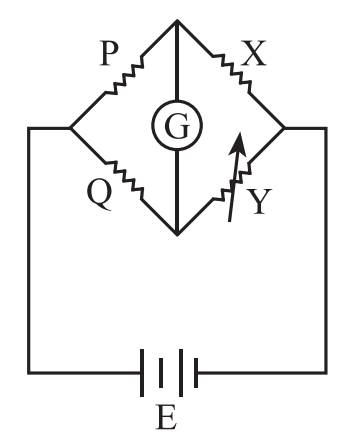 A Wheatstone bridge is most sensitive when all four resistances are of the same order. So for the most precise measurement of X, P and Q should be approximately equal (and small), which reduces the error in the experiment.
2013 NEET 1 question
-
The resistances of the four arms P, Q, R and S in a Wheatstone's bridge are 10 ohm, 30 ohm, 30 ohm and 90 ohm, respectively. The e.m.f. and internal resistance of the cell are 7 volt and 5 ohm respectively. If the galvanometer resistance is 50 ohm, the current drawn from the cell will be:$\frac{P}{Q} = \frac{R}{S} = \frac{1}{3}$, so the bridge is balanced and no current flows through the galvanometer.
Resistance of the bridge $= \frac{(40)(120)}{40 + 120} = 30\ \Omega$
Current through the cell $= \frac{7}{5 + 30} = \frac{1}{5}$ A = 0.2 A
2007 AIPMT-PRE 1 question
-
Three resistances P, Q, R each of $2\,\Omega$ and an unknown resistance S form the four arms of a Wheatstone bridge circuit. When a resistance of $6\,\Omega$ is connected in parallel to S the bridge gets balanced. What is the value of S?A balanced Wheatstone bridge requires $\dfrac{P}{Q} = \dfrac{R}{S'}$, where $S'$ is the resistance of the fourth arm.
$\dfrac{2}{2} = \dfrac{2}{S'}$
Therefore the effective resistance of the fourth arm should be $S' = 2\,\Omega$.
This effective resistance is the parallel combination of S and the $6\,\Omega$ resistance.
In a parallel combination: $\dfrac{1}{S'} = \dfrac{1}{6} + \dfrac{1}{S}$
$\dfrac{1}{2} = \dfrac{1}{6} + \dfrac{1}{S}$
$\dfrac{1}{S} = \dfrac{1}{2} - \dfrac{1}{6} = \dfrac{3 - 1}{6} = \dfrac{1}{3}$
$\Rightarrow S = 3\,\Omega$
2005 AIPMT 1 question
-
For the network shown in the figure the value of the current $i$ is -
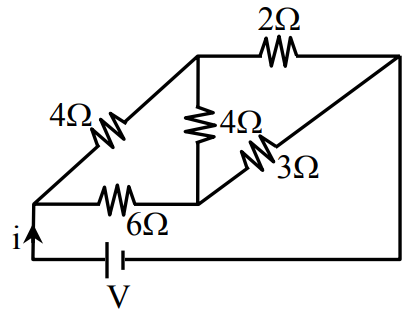 The resistances $4\,\Omega$, $6\,\Omega$, $2\,\Omega$ and $3\,\Omega$ form the four arms of a Wheatstone bridge, with the middle $4\,\Omega$ resistor as the galvanometer arm.
Check the balance: $\dfrac{4}{6} = \dfrac{2}{3}$, so the bridge is balanced and no current flows through the middle $4\,\Omega$ resistor; it can be removed.
The circuit then reduces to two parallel branches: $(4 + 2) = 6\,\Omega$ and $(6 + 3) = 9\,\Omega$.
Equivalent resistance $= \dfrac{6 \times 9}{6 + 9} = \dfrac{54}{15} = \dfrac{18}{5}\,\Omega$
Current drawn from the source: $i = \dfrac{V}{18/5}$
$\Rightarrow i = \dfrac{5V}{18}$
2003 AIPMT 1 question
-
In a Wheatstone's bridge all the four arms have equal resistance R. If the resistance of the galvanometer arm is also R, the equivalent resistance of the combination as seen by the battery is :
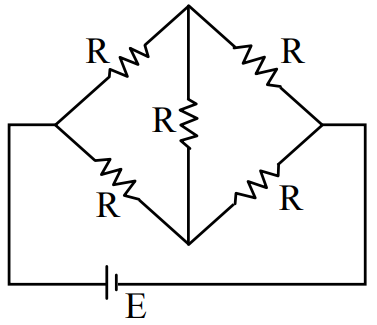
All four arms are equal, so $\dfrac{P}{Q} = \dfrac{R}{S}$ and the bridge is balanced. No current flows through the galvanometer arm, so it can be removed.
The circuit then has two branches in parallel, each of $R + R = 2R$.
Equivalent resistance $= \dfrac{2R \times 2R}{2R + 2R} = R$
So the resistance seen by the battery, i.e. the equivalent resistance between A and B, is R.
2001 AIPMT 1 question
-
The resistance of each arm of the Wheatstone bridge is 10 ohm. A resistance of 10 ohm is connected in series with galvanometer then the equivalent resistance across the battery will be :All four arms are equal (10 $\Omega$ each), so the bridge is balanced: $\dfrac{P}{Q} = \dfrac{R}{S}$.
No current flows through the galvanometer branch, whatever its resistance (10 $\Omega$ added in series makes no difference). So that branch can be removed.
Then there are two branches of $10 + 10 = 20\ \Omega$ in parallel.
$R_{eq} = \dfrac{20 \times 20}{20 + 20} = 10\ \Omega$
2000 AIPMT 1 question
-
Calculate the net resistance of the circuit between A and B :
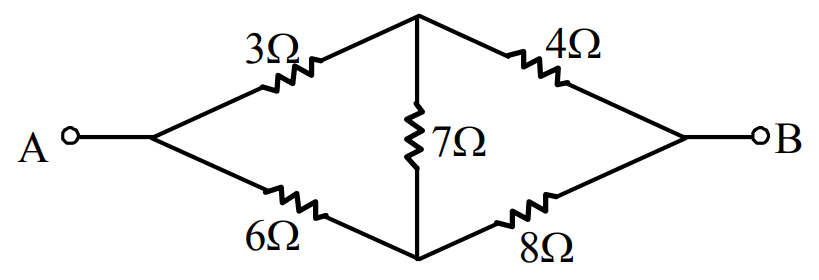 The arrangement is a Wheatstone bridge with arms 3, 4 (top) and 6, 8 (bottom), and 7 $\Omega$ in the middle branch.
Check balance: $\dfrac{3}{4} = \dfrac{6}{8}$, so the bridge is balanced and no current flows through the 7 $\Omega$ resistor. It can be removed.
Top branch: $3 + 4 = 7\ \Omega$; bottom branch: $6 + 8 = 14\ \Omega$. These are in parallel.
$R = \dfrac{R_1R_2}{R_1 + R_2} = \dfrac{14 \times 7}{21} = \dfrac{14}{3}\ \Omega$