Looking for classes? Ksquare Career Institute, Bengaluru →

Kirchhoff's rules
Appears in
Concepts tested here
- Conservation laws
- Null deflection condition
- Potential at a point
All Questions
2012 AIPMT-PRE 1 question
-
In the circuit shown the cells A and B have negligible resistances. For $V_A$ = 12 V, $R_1$ = 500 $\Omega$ and R = 100 $\Omega$ the galvanometer (G) shows no deflection. The value of $V_B$ is
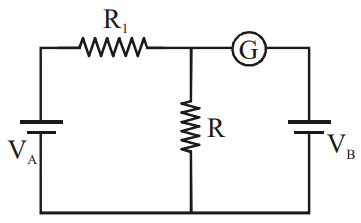 With no current through the galvanometer, cell A drives a current through $R_1$ and R in series.
$i = \frac{12}{500 + 100} = \frac{12}{600} = \frac{1}{50}$ A
Potential difference across R $= 100\times\frac{1}{50} = 2$ V
For null deflection $V_B$ equals this potential difference: $V_B = 2$ V
2011 AIPMT-MAINS 1 question
-
In the circuit shown in the figure, if the potential at point A is taken to be zero, the potential at point B is
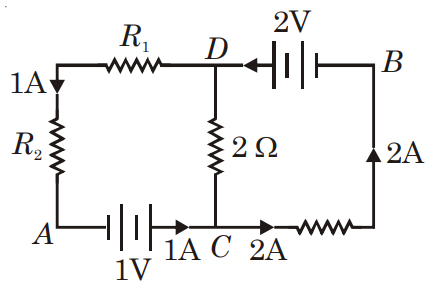 Start from A, where $V_A = 0$, and move along the lower branch A → C → B, adding the potential changes.
Across the 1 V cell from A to C the potential rises by 1 V: $V_C = 0 + 1 = 1$ V
At C the two currents join; the current in the 2 $\Omega$ resistor between D and C is 1 A flowing from D to C, so D is higher than C by $1\times2 = 2$ V: $V_D = 1 + 2 = 3$ V
Going from D to B through the 2 V cell the potential falls by 2 V: $V_B = 3 - 2 = 1$ V
In one line: $0 + 1 + 2 - 2 = V_B$
$V_B = +1$ V
2010 AIPMT-PRE 1 question
-
Consider the following two statements
(A) Kirchhoff's junction law follows from the conservation of charge.
(B) Kirchhoff's loop law follows from the conservation of energy.
Which of the following is correct?Junction law: the sum of currents entering a junction equals the sum of currents leaving it. Charge cannot accumulate at a junction, so the charge arriving per second equals the charge leaving per second. This is conservation of charge, so (A) is correct.
Loop law: the algebraic sum of the changes in potential around any closed loop is zero. A charge taken round a closed loop returns to the same potential, so the energy it gains from the sources equals the energy it loses in the resistors. This is conservation of energy, so (B) is correct.
Hence both (A) and (B) are correct.