Looking for classes? Ksquare Career Institute, Bengaluru →

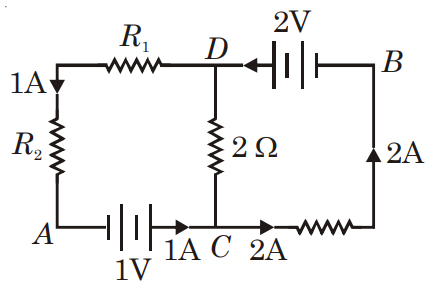
In the circuit shown in the figure, if the potential at point A is taken to be zero, the potential at point B is
A
−2 V
B
+1 V
C
−1 V
D
+2 V
Detailed Solution
Start from A, where $V_A = 0$, and move along the lower branch A → C → B, adding the potential changes.
Across the 1 V cell from A to C the potential rises by 1 V: $V_C = 0 + 1 = 1$ V
At C the two currents join; the current in the 2 $\Omega$ resistor between D and C is 1 A flowing from D to C, so D is higher than C by $1\times2 = 2$ V: $V_D = 1 + 2 = 3$ V
Going from D to B through the 2 V cell the potential falls by 2 V: $V_B = 3 - 2 = 1$ V
In one line: $0 + 1 + 2 - 2 = V_B$
$V_B = +1$ V
Across the 1 V cell from A to C the potential rises by 1 V: $V_C = 0 + 1 = 1$ V
At C the two currents join; the current in the 2 $\Omega$ resistor between D and C is 1 A flowing from D to C, so D is higher than C by $1\times2 = 2$ V: $V_D = 1 + 2 = 3$ V
Going from D to B through the 2 V cell the potential falls by 2 V: $V_B = 3 - 2 = 1$ V
In one line: $0 + 1 + 2 - 2 = V_B$
$V_B = +1$ V