Looking for classes? Ksquare Career Institute, Bengaluru →

A wire of resistance 12 ohms per metre is bent to form a complete circle of radius 10 cm. The resistance between its two diametrically opposite points, A and B as shown in the figure, is
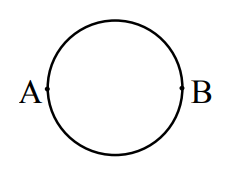
A
6 $\Omega$
B
$0.6\pi\ \Omega$
C
3 $\Omega$
D
$6\pi\ \Omega$
Detailed Solution
Length of the wire = circumference = $2\pi r = 2\pi\times0.1 = 0.2\pi$ m
Total resistance of the wire = $12\times0.2\pi = 2.4\pi\ \Omega$
Diametrically opposite points divide the circle into two equal semicircles, each of resistance $\frac{2.4\pi}{2} = 1.2\pi\ \Omega$
Between A and B these two halves are in parallel: $R_{AB} = \frac{1.2\pi\times1.2\pi}{1.2\pi + 1.2\pi} = \frac{1.2\pi}{2}$
$R_{AB} = 0.6\pi\ \Omega$
Total resistance of the wire = $12\times0.2\pi = 2.4\pi\ \Omega$
Diametrically opposite points divide the circle into two equal semicircles, each of resistance $\frac{2.4\pi}{2} = 1.2\pi\ \Omega$
Between A and B these two halves are in parallel: $R_{AB} = \frac{1.2\pi\times1.2\pi}{1.2\pi + 1.2\pi} = \frac{1.2\pi}{2}$
$R_{AB} = 0.6\pi\ \Omega$