Looking for classes? Ksquare Career Institute, Bengaluru →

In the circuit shown, the current through the $4\,\Omega$ resistor is 1 amp when the points P and M are connected to a D.C. voltage source. The potential difference between the points M and N is -
(Between P and M there are two parallel branches. Upper branch: $4\,\Omega$ and $3\,\Omega$ in parallel. Lower branch: $0.5\,\Omega$ and $0.5\,\Omega$ in parallel, joined at N in series with $1\,\Omega$.)
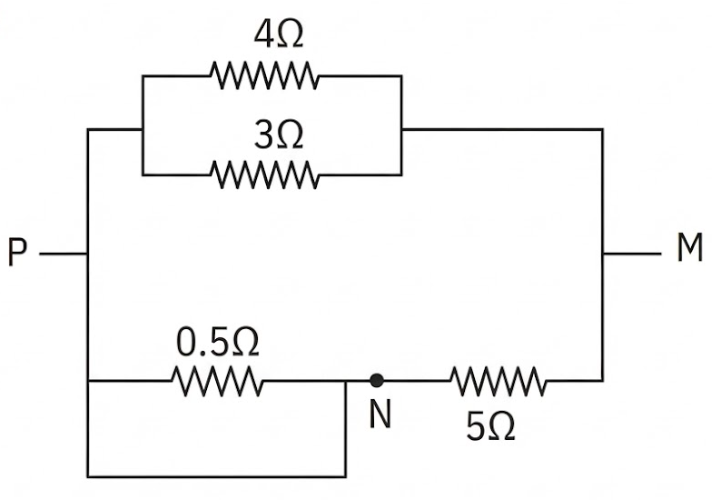
(Between P and M there are two parallel branches. Upper branch: $4\,\Omega$ and $3\,\Omega$ in parallel. Lower branch: $0.5\,\Omega$ and $0.5\,\Omega$ in parallel, joined at N in series with $1\,\Omega$.)
A
0.5 volt
B
3.2 volt
C
1.5 volt
D
1.0 volt
Detailed Solution
Current through the $4\,\Omega$ resistor: $i_1 = 1$ A.
Potential difference across the $4\,\Omega$ resistor: $V_{PM} = 1 \times 4 = 4$ V. This is the potential difference between P and M.
The $3\,\Omega$ resistor is in parallel with $4\,\Omega$, so the current through it is $i_2 = \dfrac{4}{3}$ A.
Lower branch: the two $0.5\,\Omega$ resistors in parallel give $\dfrac{0.5 \times 0.5}{0.5 + 0.5} = 0.25\,\Omega = \dfrac{1}{4}\,\Omega$ between P and N.
This is in series with $1\,\Omega$ between N and M, so the resistance of the lower branch $= \dfrac{1}{4} + 1 = \dfrac{5}{4}\,\Omega$.
The lower branch is also connected between P and M, so the current through it is $i_4 = \dfrac{V_{PM}}{5/4} = \dfrac{4 \times 4}{5} = \dfrac{16}{5} = 3.2$ A.
Potential difference across N and M: $V_{NM} = i_4 \times 1\,\Omega = 3.2 \times 1 = 3.2$ volt
Second approach: $V_{PN} + V_{NM} = 4$ V and $\dfrac{V_{PN}}{V_{NM}} = \dfrac{1/4}{1} = \dfrac{1}{4}$, so $\dfrac{1}{4}V_{NM} + V_{NM} = 4 \Rightarrow V_{NM} = \dfrac{16}{5} = 3.2$ V.
Potential difference across the $4\,\Omega$ resistor: $V_{PM} = 1 \times 4 = 4$ V. This is the potential difference between P and M.
The $3\,\Omega$ resistor is in parallel with $4\,\Omega$, so the current through it is $i_2 = \dfrac{4}{3}$ A.
Lower branch: the two $0.5\,\Omega$ resistors in parallel give $\dfrac{0.5 \times 0.5}{0.5 + 0.5} = 0.25\,\Omega = \dfrac{1}{4}\,\Omega$ between P and N.
This is in series with $1\,\Omega$ between N and M, so the resistance of the lower branch $= \dfrac{1}{4} + 1 = \dfrac{5}{4}\,\Omega$.
The lower branch is also connected between P and M, so the current through it is $i_4 = \dfrac{V_{PM}}{5/4} = \dfrac{4 \times 4}{5} = \dfrac{16}{5} = 3.2$ A.
Potential difference across N and M: $V_{NM} = i_4 \times 1\,\Omega = 3.2 \times 1 = 3.2$ volt
Second approach: $V_{PN} + V_{NM} = 4$ V and $\dfrac{V_{PN}}{V_{NM}} = \dfrac{1/4}{1} = \dfrac{1}{4}$, so $\dfrac{1}{4}V_{NM} + V_{NM} = 4 \Rightarrow V_{NM} = \dfrac{16}{5} = 3.2$ V.