Looking for classes? Ksquare Career Institute, Bengaluru →

A hollow cylinder has a charge $q$ coulomb within it. If $\phi$ is the electric flux in units of volt-metre associated with the curved surface B, the flux linked with the plane surface A in units of volt-metre will be
(A and C are the two plane end faces of the cylinder and B is its curved surface.)
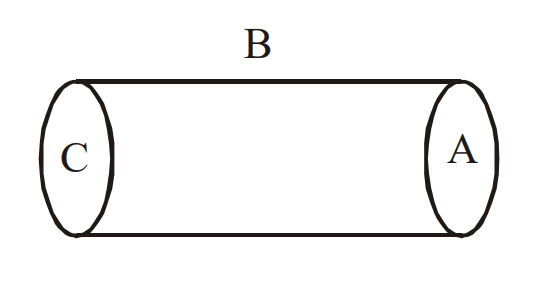
(A and C are the two plane end faces of the cylinder and B is its curved surface.)
A
$\dfrac{q}{2\varepsilon_0}$
B
$\dfrac{\phi}{3}$
C
$\dfrac{q}{\varepsilon_0} - \phi$
D
$\dfrac{1}{2}\left(\dfrac{q}{\varepsilon_0} - \phi\right)$
Detailed Solution
By Gauss's law, the total flux through the closed cylindrical surface is $\phi_{total} = \phi_A + \phi_B + \phi_C = \dfrac{q}{\varepsilon_0}$
Here $q$ is the total charge enclosed.
As given, the flux associated with the curved surface B is $\phi_B = \phi$.
The charge is placed symmetrically, so the flux linked with the two plane surfaces A and C is equal. Let $\phi_A = \phi_C = \phi'$.
Therefore $\dfrac{q}{\varepsilon_0} = 2\phi' + \phi_B = 2\phi' + \phi$
$2\phi' = \dfrac{q}{\varepsilon_0} - \phi$
$\Rightarrow \phi' = \dfrac{1}{2}\left(\dfrac{q}{\varepsilon_0} - \phi\right)$
Here $q$ is the total charge enclosed.
As given, the flux associated with the curved surface B is $\phi_B = \phi$.
The charge is placed symmetrically, so the flux linked with the two plane surfaces A and C is equal. Let $\phi_A = \phi_C = \phi'$.
Therefore $\dfrac{q}{\varepsilon_0} = 2\phi' + \phi_B = 2\phi' + \phi$
$2\phi' = \dfrac{q}{\varepsilon_0} - \phi$
$\Rightarrow \phi' = \dfrac{1}{2}\left(\dfrac{q}{\varepsilon_0} - \phi\right)$