Looking for classes? Ksquare Career Institute, Bengaluru →

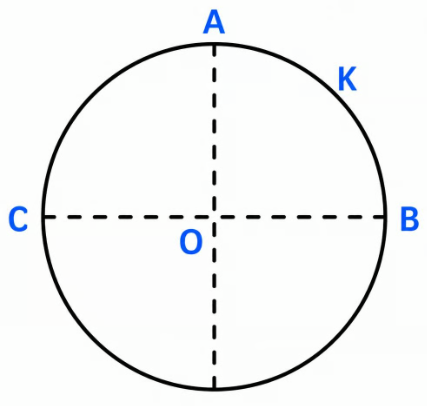
A thin conducting ring of radius $R$ is given a charge $+Q$. The electric field at the centre O of the ring due to the charge on the part AKB of the ring is $E$. The electric field at the centre due to the charge on the part ACDB of the ring is -
A
$E$ along KO
B
$3E$ along OK
C
$3E$ along KO
D
$E$ along OK
Detailed Solution
The charge $+Q$ is distributed uniformly on the ring, so the net electric field at the centre O of the complete ring is zero.
By the principle of superposition: $\vec{E}_{AKB} + \vec{E}_{ACDB} = 0$
$\Rightarrow \vec{E}_{ACDB} = -\vec{E}_{AKB}$
So the field due to the part ACDB is equal in magnitude and opposite in direction to the field due to the part AKB.
The part AKB carries positive charge and K is its mid-point, so its field at O points away from the arc, i.e. along KO, with magnitude $E$.
Therefore the field at O due to the part ACDB has magnitude $E$ and is directed along OK.
By the principle of superposition: $\vec{E}_{AKB} + \vec{E}_{ACDB} = 0$
$\Rightarrow \vec{E}_{ACDB} = -\vec{E}_{AKB}$
So the field due to the part ACDB is equal in magnitude and opposite in direction to the field due to the part AKB.
The part AKB carries positive charge and K is its mid-point, so its field at O points away from the arc, i.e. along KO, with magnitude $E$.
Therefore the field at O due to the part ACDB has magnitude $E$ and is directed along OK.