Looking for classes? Ksquare Career Institute, Bengaluru →

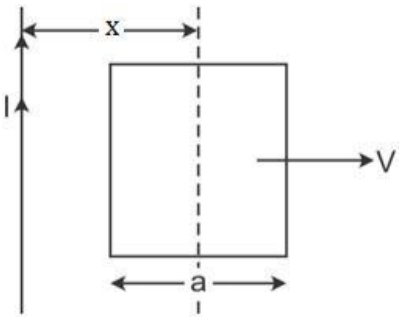
A conducting square frame of side 'a' and a long straight wire carrying current I are located in the same plane as shown in the figure. The frame moves to the right with a constant velocity 'V'. The emf induced in the frame will be proportional to
A
$\frac{1}{x^2}$
B
$\frac{1}{(2x-a)^2}$
C
$\frac{1}{(2x+a)^2}$
D
$\frac{1}{(2x-a)(2x+a)}$
Detailed Solution
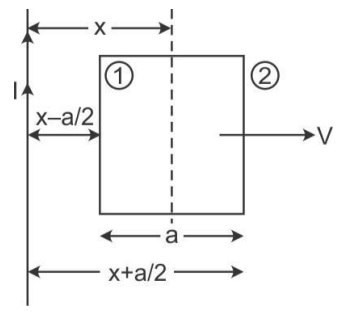
emf in the near side (1): $\varepsilon_1 = B_1Vl$; emf in the far side (2): $\varepsilon_2 = B_2Vl$
Net emf: $\varepsilon = \varepsilon_1 - \varepsilon_2 = Vl(B_1 - B_2) \propto (B_1 - B_2)$
Since $B \propto \frac{1}{r}$: $\varepsilon \propto \frac{1}{x - \frac{a}{2}} - \frac{1}{x + \frac{a}{2}}$
$\varepsilon \propto \frac{1}{(2x-a)(2x+a)}$