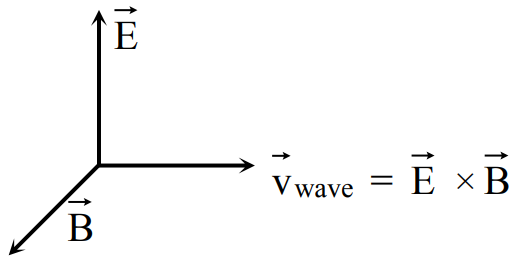
The velocity of electromagnetic wave is parallel to : -
A
$\vec{B} \times \vec{E}$
B
$\vec{E} \times \vec{B}$
C
$\vec{E}$
D
$\vec{B}$
The answer is B.
Solution
In an electromagnetic wave, $\vec{E}$ and $\vec{B}$ are perpendicular to each other and to the direction of propagation. The direction of propagation (and of energy flow, the Poynting vector) is along $\vec{E} \times \vec{B}$. Example: if $\vec{E}$ is along $\hat{i}$ and $\vec{B}$ along $\hat{j}$, the wave travels along $\hat{i} \times \hat{j} = \hat{k}$. So the velocity of an electromagnetic wave is parallel to $\vec{E} \times \vec{B}$.
ConceptDirection of propagation
Nature of electromagnetic waves in past papers
3 questions from this chapter have appeared across 3 exam years.