Looking for classes? Ksquare Career Institute, Bengaluru →

Electromagnetic Waves
Nature of electromagnetic waves
3 questions from 3 papers, each with its answer.
- questions
- 3
- papers
- 3
- of Electromagnetic Waves
- 6.12%
Appears in
Concepts tested
- Direction of propagation 2
- Phase and direction of E and B
All Questions
2011 AIPMT-PRE 1 question
-
The electric and the magnetic field, associated with an e.m. wave, propagating along the +z-axis, can be represented byIn an electromagnetic wave, $\vec{E}$, $\vec{B}$ and the direction of propagation are mutually perpendicular, and the wave travels along $\vec{E}\times\vec{B}$.
For propagation along +z we need $\vec{E}\times\vec{B}$ along $\hat{k}$.
$\hat{i}\times\hat{j} = \hat{k}$, so $\vec{E} = E_0\hat{i}$, $\vec{B} = B_0\hat{j}$ gives propagation along +z.
Checking the others: $\hat{j}\times\hat{k} = \hat{i}$ (along +x), $\hat{k}\times\hat{i} = \hat{j}$ (along +y), $\hat{j}\times\hat{i} = -\hat{k}$ (along −z).
Hence $\vec{E} = E_0\hat{i}$, $\vec{B} = B_0\hat{j}$.
2007 AIPMT-PRE 1 question
-
The electric and magnetic field of an electromagnetic wave areA time-varying magnetic field produces an electric field and a time-varying electric field produces a magnetic field; this mutual generation sustains the wave.
In an electromagnetic wave, $\vec{E} \perp \vec{B}$, and both are perpendicular to the direction of propagation.
Both $\vec{E}$ and $\vec{B}$ are in the same phase: they reach their maximum and zero values at the same time and place.
$E = E_0\sin(\omega t - kx)$
$B = B_0\sin(\omega t - kx)$
The electromagnetic wave travels in the direction of $\vec{E} \times \vec{B}$.
So the electric and magnetic fields are in phase and perpendicular to each other.
2002 AIPMT 1 question
-
The velocity of electromagnetic wave is parallel to : -In an electromagnetic wave, $\vec{E}$ and $\vec{B}$ are perpendicular to each other and to the direction of propagation.
The direction of propagation (and of energy flow, the Poynting vector) is along $\vec{E} \times \vec{B}$.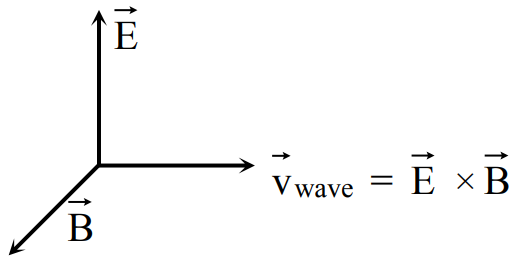
Example: if $\vec{E}$ is along $\hat{i}$ and $\vec{B}$ along $\hat{j}$, the wave travels along $\hat{i} \times \hat{j} = \hat{k}$.
So the velocity of an electromagnetic wave is parallel to $\vec{E} \times \vec{B}$.