Looking for classes? Ksquare Career Institute, Bengaluru →

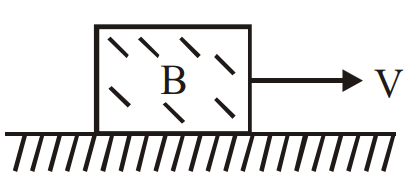
A block B is pushed momentarily along a horizontal surface with an initial velocity $V$. If $\mu$ is the coefficient of sliding friction between B and the surface, block B will come to rest after a time
A
$\dfrac{g\mu}{V}$
B
$\dfrac{g}{V}$
C
$\dfrac{V}{g}$
D
$\dfrac{V}{g\mu}$
Detailed Solution
After the push, friction is the only horizontal force on the block; it is the retarding force.
Normal reaction: $R = mg$
Friction: $F = \mu R = \mu mg$
$F = ma \Rightarrow ma = \mu mg \Rightarrow a = \mu g$ (retardation)
From the first equation of motion: $v = u - at$
The block comes to rest, so $0 = V - \mu g \times t$
$t = \dfrac{V}{\mu g}$
Normal reaction: $R = mg$
Friction: $F = \mu R = \mu mg$
$F = ma \Rightarrow ma = \mu mg \Rightarrow a = \mu g$ (retardation)
From the first equation of motion: $v = u - at$
The block comes to rest, so $0 = V - \mu g \times t$
$t = \dfrac{V}{\mu g}$