Looking for classes? Ksquare Career Institute, Bengaluru →

Friction
Appears in
Concepts tested here
- Friction with accelerating surface
- Relative motion with kinetic friction
All Questions
2011 AIPMT-MAINS 1 question
-
A conveyor belt is moving at a constant speed of 2 m/s. A box is gently dropped on it. The coefficient of friction between them is $\mu = 0.5$. The distance that the box will move relative to belt before coming to rest on it, taking g = 10 m $s^{-2}$, isWork in the frame of the belt. The box is dropped with zero ground velocity, so relative to the belt its initial velocity is u = 2 m/s (backwards).
Kinetic friction opposes the relative sliding: retardation $a = \frac{\mu mg}{m} = \mu g = 0.5\times10 = 5$ m/$s^2$
The box comes to rest relative to the belt, so v = 0.
$v^2 = u^2 - 2as$ gives $0 = 2^2 - 2\times5\times s$
$s = \frac{4}{10} = 0.4$ m
2010 AIPMT-PRE 1 question
-
A block of mass m is in contact with the cart C as shown in the figure. The coefficient of static friction between the block and the cart is $\mu$. The acceleration $\alpha$ of the cart that will prevent the block from falling satisfies
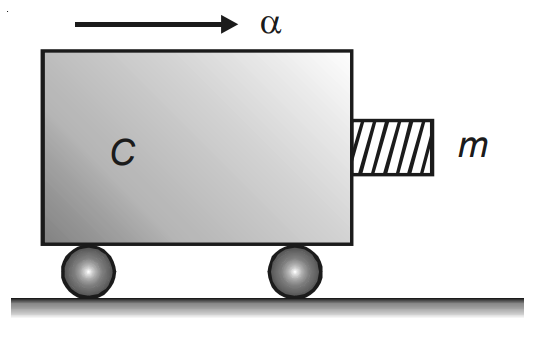 The block is pressed against the vertical face of the cart. When the cart accelerates with $\alpha$, the cart pushes the block with a normal force N that gives the block the same acceleration: $N = m\alpha$
The weight mg acts downward and can be balanced only by static friction acting upward along the face.
Maximum static friction: $f_{max} = \mu N = \mu m\alpha$
For the block not to fall: $f_{max} \geq mg$
$\mu m\alpha \geq mg$
$\alpha \geq \frac{g}{\mu}$