Looking for classes? Ksquare Career Institute, Bengaluru →

Friction and pulley systems
Appears in
Concepts tested here
- Acceleration of connected bodies
- Tension with kinetic friction
All Questions
2015 AIPMT-I 1 question
-
A block A of mass $m_1$ rests on a horizontal table. A light string connected to it passes over a frictionless pulley at the edge of table and from its other end another block B of mass $m_2$ is suspended. The coefficient of kinetic friction between the block and the table is $\mu_k$. When the block A is sliding on the table, the tension in the string isFor B: $m_2g - T = m_2a$ ...(i)
For A: $T - \mu_k m_1 g = m_1a$ ...(ii)
Adding (i) and (ii): $a = \frac{(m_2 - \mu_k m_1)g}{m_1 + m_2}$
From (i): $T = m_2(g - a) = m_2g\left[1 - \frac{m_2 - \mu_k m_1}{m_1+m_2}\right]$
$T = \frac{m_1m_2(1+\mu_k)g}{m_1+m_2}$
2014 AIPMT 1 question
-
A system consists of three masses $m_1$, $m_2$ and $m_3$ connected by a string passing over a pulley P. The mass $m_1$ hangs freely and $m_2$ and $m_3$ are on a rough horizontal table (the coefficient of friction = $\mu$). The pulley is frictionless and of negligible mass. The downward acceleration of mass $m_1$ is: (Assume $m_1 = m_2 = m_3 = m$)
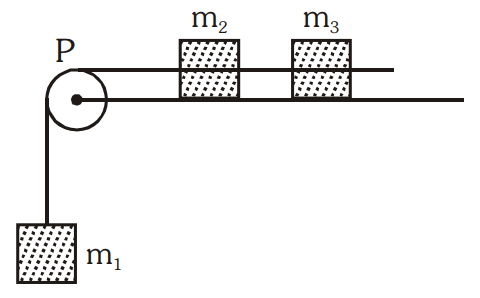 Acceleration $= \frac{\text{Net force in the direction of motion}}{\text{Total mass of system}}$
$a = \frac{m_1g - \mu(m_2 + m_3)g}{m_1 + m_2 + m_3} = \frac{g}{3}(1 - 2\mu)$