2004 AIPMT Laws of MotionStatic Friction Easy Question 1 of 2 in Static Friction

The coefficient of static friction, μₛ, between block A of mass 2 kg and the table as shown in the…

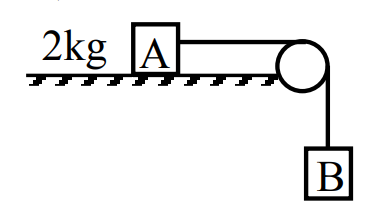
The coefficient of static friction, $\mu_s$, between block A of mass 2 kg and the table as shown in the figure is 0.2. What would be the maximum mass value of block B so that the two blocks do not move ? The string and the pulley are assumed to be smooth and massless. (g = 10 m/s$^2$)
A 4.0 kg
B 0.2 kg
C 0.4 kg
D 2.0 kg

The answer is C.

Solution

For the blocks not to move, the tension T in the string must balance the weight of B, and the friction on A must balance T.
For block B: $T = m_Bg$
For block A, the maximum static friction available is $f_{max} = \mu_s N = \mu_s m_A g$.
For the maximum value of $m_B$ (blocks just on the verge of moving): $T = m_Bg = \mu_s(m_Ag)$
$\Rightarrow m_B = \mu_s m_A = 0.2 \times 2 = 0.4$ kg
So the maximum mass of block B is 0.4 kg.

Concept Limiting friction balancing a hanging mass

Static Friction in past papers

2 questions from this chapter have appeared across 2 exam years.
