Looking for classes? Ksquare Career Institute, Bengaluru →

Physics
Magnetism and Matter
38 questions from 28 papers, each with its answer.
- 38 questions
- 28 papers
- 2.15% of Physics
Oscillation of a Magnetic Needle
-
In a uniform magnetic field of 0.049 T, a magnetic needle performs 20 complete oscillations in 5 seconds as shown. The moment of inertia of the needle is $9.8 \times 10^{-6}$ kg m$^2$. If the magnitude of magnetic moment of the needle is $x \times 10^{-5}$ Am$^2$, then the value of 'x' is;
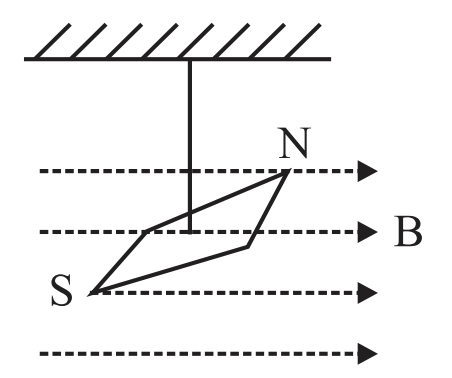 $T = \frac{5}{20}$ s, $I = 9.8 \times 10^{-6}\ kg\,m^2$, $m = x \times 10^{-5}\ Am^2$, B = 0.049 T $T = 2\pi\sqrt{\frac{I}{mB}}$ $\frac{5}{20} = 2\pi\sqrt{\frac{9.8 \times 10^{-6}}{x \times 10^{-5} \times 0.049}} = 2\pi\sqrt{\frac{20}{x}}$ $\frac{25}{400} = 4\pi^2\left(\frac{20}{x}\right)$ $x = 16 \times 4\pi^2 \times 20 = 1280\pi^2$
Magnetic Moment of a Bent Bar Magnet
-
An iron bar of length $L$ has magnetic moment $M$. It is bent at the middle of its length such that the two arms make an angle $60^\circ$ with each other. The magnetic moment of this new magnet is:Initially, M = ml (m = pole strength, l = length). When the rod is bent at the middle, each arm is $\frac{l}{2}$ and the arms make $60^\circ$ with each other. [add image: bar bent at the middle into two arms of length l/2 at $60^\circ$] Effective length $l_{eff} = 2 \times \frac{l}{2}\sin 30^\circ = \frac{l}{2}$ $M' = m \times \frac{l}{2} = \frac{M}{2}$
Force on Magnetic/Conducting Sheets near a Pole
-
A sheet is placed on a horizontal surface in front of a strong magnetic pole. A force is needed to: A. hold the sheet there if it is magnetic. B. hold the sheet there if it is non-magnetic. C. move the sheet away from the pole with uniform velocity if it is conducting. D. move the sheet away from the pole with uniform velocity if it is both, non-conducting and non-polar. Choose the correct statement(s) from the options given below:A. A magnetic sheet experiences a magnetic force (attraction) near the pole, so a force is needed to hold it there – correct. B. A non-magnetic sheet does not interact significantly with the magnetic field, so no force is needed to hold it – incorrect. C. When a conducting sheet is moved away from the pole, eddy currents are induced which oppose the motion (Lenz's law), so a force is needed to keep it moving with uniform velocity – correct. D. A non-conducting, non-polar sheet does not interact significantly with the magnetic field, so no force is needed – incorrect. So A and C only are correct.
Magnetic Susceptibility of Materials
-
Match List-I with List-II regarding the magnetic susceptibility of different classes of materials.
Pick the matching item from Column II for each row.
Column I
- A. Diamagnetic
- B. Ferromagnetic
- C. Paramagnetic
- D. Non-magnetic
Column II
- I. $\chi = 0$
- II. $0 > \chi \geq -1$
- III. $\chi \gg 1$
- IV. $0 < \chi < \varepsilon$ (a small positive number)
Correct answer: A → II, B → III, C → IV, D → I
Diamagnetic material: $0 > \chi \geq -1$ Ferromagnetic material: $\chi \gg 1$ Paramagnetic material: $0 < \chi < \varepsilon$ (a small positive number) Non-magnetic material: $\chi = 0$ Correct match: A-II, B-III, C-IV, D-I.
That is every question in Magnetism and Matter for this filter.
Want a score?
Answers here are not saved. Practise as a test to be marked and see your progress.
Practise as a test