Looking for classes? Ksquare Career Institute, Bengaluru →

Physics
Motion in a Plane
56 questions, each with its answer.
-
A point P considered at contact point of a wheel on ground which rolls on ground without slipping then value of displacement of point P when wheel completes half of rotation (If radius of wheel is 1m) : -In half a rotation, the wheel rolls forward a distance equal to half its circumference: $\pi R$.
The point P, initially touching the ground, reaches the top of the wheel, i.e. a height 2R above the ground.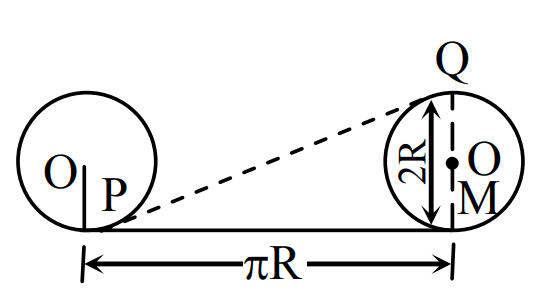
So P has a horizontal displacement $PM = \pi R$ and a vertical displacement $QM = 2R$.
Displacement $PQ = \sqrt{(PM)^2 + (QM)^2} = \sqrt{(\pi R)^2 + (2R)^2}$
With R = 1 m: $PQ = \sqrt{\pi^2 + 4}$ m -
A particle (A) is dropped from a height and another particle (B) is projected in horizontal direction with speed of 5 m/s from the same height then correct statement is : -For particle A (dropped from rest): $h = \dfrac{1}{2}gt_A^2 \Rightarrow t_A = \sqrt{\dfrac{2h}{g}}$
For particle B (projected horizontally), the initial vertical velocity is zero ($u_y = 0$). The horizontal velocity does not affect the vertical motion.
In the vertical direction, using $s = ut + \dfrac{1}{2}at^2$: $h = \dfrac{1}{2}gt_B^2 \Rightarrow t_B = \sqrt{\dfrac{2h}{g}}$
So $t_A = t_B$: both reach the ground simultaneously.
Their speeds on reaching the ground are different, since B also has a horizontal velocity of 5 m/s.
So both particles will reach the ground simultaneously.
That is every 2002 AIPMT question in Motion in a Plane.
Want a score?
Answers here are not saved. Practise as a test to be marked and see your progress.
Practise as a test