Looking for classes? Ksquare Career Institute, Bengaluru →

Physics
Motion in a Plane
56 questions, each with its answer.
-
A particle moving with uniform speed in a circular path maintains;In uniform circular motion, the speed is constant but the direction of velocity changes continuously; since velocity is a vector, it is varying. The centripetal acceleration has constant magnitude $\frac{v^2}{r}$ but its direction (towards the centre) keeps changing, so acceleration is also varying. So the particle has varying velocity and varying acceleration.
-
A football player is moving southward and suddenly turns eastward with the same speed to avoid an opponent. The force that acts on the player while turning is:
Change in velocity points north-east, so the force is along north-east.
Initial velocity $=-v\hat{j}$, final velocity $=v\hat{i}$ Change in velocity $=v\hat{i}-(-v\hat{j})=v(\hat{i}+\hat{j})$ Momentum gain is along $\hat{i}+\hat{j}$ $\Rightarrow$ force experienced is along $\hat{i}+\hat{j}$ $\Rightarrow$ force experienced is in North-East direction. -
A bullet is fired from a gun at the speed of $280\ m/s$ in the direction $30^\circ$ above the horizontal. The maximum height attained by the bullet is ($g=9.8\ ms^{-2}$, $\sin30^\circ=0.5$)
$h_{max}=\frac{u^2\sin^2\theta}{2g}=1000\ m$.
$h_{max}=\frac{u^2\sin^2\theta}{2g}=\frac{280\times280}{2\times9.8}\times\frac{1}{4}=1000\ m$ -
The position of a particle is given by $\vec{r}(t)=4t\hat{i}+2t^2\hat{j}+5\hat{k}$ where t is in seconds and r in metre. Find the magnitude and direction of velocity v(t), at t = 1s, with respect to x-axis$\vec V=\dfrac{d\vec r}{dt}=4\hat i+4t\hat j+0\hat k$. At $t=1$ s, $\vec V=4\hat i+4\hat j$. $|\vec V|=\sqrt{4^2+4^2}=4\sqrt2$. $\tan\alpha=\dfrac{4}{4}=1\Rightarrow\alpha=45^\circ$.
-
A ball is projected from point A with velocity 20 m s$^{-1}$ at an angle $60^\circ$ to the horizontal direction. At the highest point B of the path (as shown in figure), the velocity v m s$^{-1}$ of the ball will be:
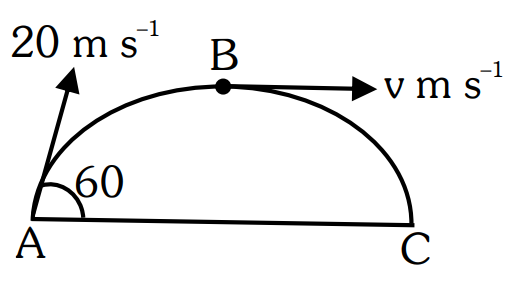 At the topmost point of its trajectory, the particle has only the horizontal component of velocity: $V_{top}=v\cos\theta=20\times\cos60^\circ=20\times\dfrac{1}{2}=10$ m/s.
-
A particle is executing uniform circular motion with velocity $\vec{v}$ and acceleration $\vec{a}$. Which of the following is true?In uniform circular motion, the direction of both velocity and the (centripetal) acceleration changes continuously (even though their magnitudes stay constant), so neither $\vec v$ nor $\vec a$ is a constant vector.
-
A ball is projected with a velocity, $10\ ms^{-1}$, at an angle of $60^\circ$ with the vertical direction. Its speed at the highest point of its trajectory will be :At the highest point, only the horizontal component of velocity remains. Angle with the horizontal $\theta = 90^\circ - 60^\circ = 30^\circ$ $u_x = u\cos\theta = 10\cos 30^\circ = 5\sqrt{3}\ ms^{-1}$
-
A cricket ball is thrown by a player at a speed of 20 m/s in a direction $30^\circ$ above the horizontal. The maximum height attained by the ball during its motion is ($g=10$ m/s$^2$)$H=\frac{u^2\sin^2\theta}{2g}=\frac{(20)^2\times(1/2)^2}{2\times10}=5$ m.
-
If $\vec{F}=2\hat{i}+\hat{j}-\hat{k}$ and $\vec{r}=3\hat{i}+2\hat{j}-2\hat{k}$, then the scalar and vector products of $\vec{F}$ and $\vec{r}$ have the magnitudes respectively as:$\vec{F}\cdot\vec{r}=2\times3+1\times2+(-1)(-2)=10$. $\vec{F}\times\vec{r}=\hat{i}(-2+2)-\hat{j}(-4+3)+\hat{k}(4-3)=\hat{j}+\hat{k}$, so $|\vec{F}\times\vec{r}|=\sqrt{2}$.
-
A particle moving in a circle of radius $R$ with a uniform speed takes a time $T$ to complete one revolution. If this particle were projected with the same speed at an angle $\theta$ to the horizontal, the maximum height attained by it equals $4R$. The angle of projection, $\theta$, is then given by:Speed in circular motion: $T = \frac{2\pi R}{v} \Rightarrow v = \frac{2\pi R}{T}$ $H_{max} = \frac{v^2\sin^2\theta}{2g} = \frac{4\pi^2R^2\sin^2\theta}{2gT^2} = \frac{2\pi^2R^2\sin^2\theta}{gT^2} = 4R$ $\sin\theta = \left(\frac{2gT^2}{\pi^2R}\right)^{1/2}$ $\theta = \sin^{-1}\left(\frac{2gT^2}{\pi^2R}\right)^{1/2}$
-
A car starts from rest and accelerates at $5\ m/s^2$. At $t=4$ s, a ball is dropped out of a window by a person sitting in the car. What is the velocity and acceleration of the ball at $t=6$ s?Velocity of the car at t = 4 s: $v = 0 + 5 \times 4 = 20$ m/s, so the ball has horizontal velocity $v_x = 20$ m/s. After being dropped, the only acceleration of the ball is due to gravity: a = g = 10 $m/s^2$. At t = 6 s (2 s after release): $v_y = 0 + 10 \times 2 = 20$ m/s (downward) $v = \sqrt{v_x^2 + v_y^2} = \sqrt{20^2 + 20^2} = 20\sqrt{2}$ m/s
-
The speed of a swimmer in still water is 20 m/s. The speed of river water is 10 m/s and is flowing due east. If he is standing on the south bank and wishes to cross the river along the shortest path, the angle at which he should make his strokes w.r.t. north is given by:$\vec{V}_{SG}=\vec{V}_{SR}+\vec{V}_{RG}$, with $V_{SR}=20\ m/s$ and $V_{RG}=10\ m/s$ (due east). For the shortest path, the resultant velocity must be due north, so the swimmer must head at angle $\theta$ west of north such that $\sin\theta=\frac{V_{RG}}{V_{SR}}=\frac{10}{20}=\frac{1}{2}$ $\theta=30^\circ$ west
-
Two particles A and B are moving in uniform circular motion in concentric circles of radius $r_A$ and $r_B$ with speed $v_A$ and $v_B$ respectively. The time period of rotation is the same. The ratio of angular speed of A to that of B will be:Given $T_A=T_B=T$. $\omega_A=\frac{2\pi}{T_A}$, $\omega_B=\frac{2\pi}{T_B}$ $\frac{\omega_A}{\omega_B}=\frac{T_B}{T_A}=\frac{T}{T}=1$ Ratio $=1:1$
-
Two bullets are fired horizontally and simultaneously towards each other from roof tops of two buildings 100 m apart and of same height of 200 m with the same velocity of 25 m/s. When and where will the two bullets collide. ($g=10$ m/s$^2$)Relative horizontal speed $=25+25=50$ m/s, so $t=\frac{100}{50}=2$ s. Vertical fall $=\frac{1}{2}\times10\times2^2=20$ m, so they collide at a height of $200-20=180$ m.
-
The x and y coordinates of the particle at any time are $x = 5t - 2t^2$ and $y = 10t$ respectively, where x and y are in meters and t in seconds. The acceleration of the particle at t = 2 s is
Differentiate twice: $a_x = -4$, $a_y = 0$ at all times.
$x = 5t - 2t^2$, $y = 10t$ $v_x = \frac{dx}{dt} = 5 - 4t$, $v_y = \frac{dy}{dt} = 10$ $a_x = \frac{dv_x}{dt} = -4$, $a_y = \frac{dv_y}{dt} = 0$ Acceleration of the particle at t = 2 s is $-4\ m/s^2$. -
If the magnitude of sum of two vectors is equal to the magnitude of difference of the two vectors, the angle between these vectors is
$|P+Q| = |P-Q|$ only when $\cos\theta = 0$.
$|\vec{P} + \vec{Q}| = |\vec{P} - \vec{Q}|$
Squaring: $P^2 + Q^2 + 2PQ\cos\theta = P^2 + Q^2 - 2PQ\cos\theta$
$\Rightarrow 4PQ\cos\theta = 0 \Rightarrow \cos\theta = 0$
$\theta = \frac{\pi}{2} = 90^\circ$ -
A particle moves so that its position vector is given by $\vec{r} = \cos\omega t\,\hat{x} + \sin\omega t\,\hat{y}$, where $\omega$ is a constant. Which of the following is true?
$\vec{a} = -\omega^2\vec{r}$ and $\vec{v}\cdot\vec{r} = 0$.
$\vec{v} = \frac{d\vec{r}}{dt} = \omega(-\sin\omega t\,\hat{x} + \cos\omega t\,\hat{y})$ ...(ii)
$\vec{a} = \frac{d\vec{v}}{dt} = -\omega^2(\cos\omega t\,\hat{x} + \sin\omega t\,\hat{y}) = -\omega^2\vec{r}$ ...(iii)
So the acceleration is antiparallel to r, i.e. directed towards the origin.
$\vec{v}\cdot\vec{r} = \omega(-\sin\omega t\cos\omega t + \sin\omega t\cos\omega t) = 0$, so the velocity is perpendicular to r.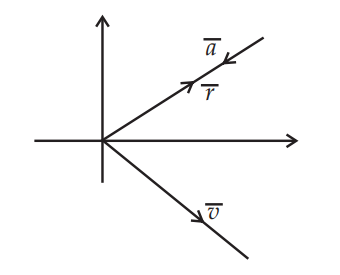
Hence the velocity is perpendicular to r and the acceleration is directed towards the origin. -
A particle of mass 10 g moves along a circle of radius 6.4 cm with a constant tangential acceleration. What is the magnitude of this acceleration, if the kinetic energy of the particle becomes equal to $8 \times 10^{-4}$ J by the end of the second revolution after the beginning of the motion?
Use v from KE, then v² = 2as along the circular path.
$\frac{1}{2}mv^2 = 8\times10^{-4}$ J $\Rightarrow v^2 = \frac{2\times8\times10^{-4}}{10\times10^{-3}} = \frac{16}{100} \Rightarrow v = 0.4$ m/s
Distance in two revolutions $s = 2\times2\pi R = 4\pi R$
$v^2 = u^2 + 2as \Rightarrow \left(\frac{4}{10}\right)^2 = 0 + 2a\times4\pi\times6.4\times10^{-2}$
$a = \frac{16}{100\times8\pi\times6.4\times10^{-2}} = \frac{160}{8\times3.14\times64} \approx 0.1\ m/s^2$ -
In the given figure, a = 15 m/$s^2$ represents the total acceleration of a particle moving in the clockwise direction in a circle of radius R = 2.5 m at a given instant of time. The speed of the particle is:
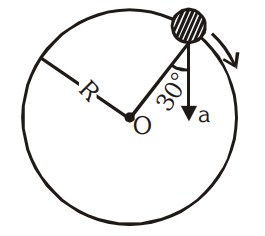
The radial component of the total acceleration equals v²/R.
Centripetal component: $a\cos30^\circ = a_c = \frac{v^2}{R}$
$\Rightarrow v^2 = aR\times\frac{\sqrt{3}}{2} = 15\times2.5\times\frac{\sqrt{3}}{2} = 32.47$
$\Rightarrow v \approx 5.7$ m/s -
A ship A is moving westwards with a speed of 10 km $h^{-1}$ and a ship B 100 km south of A is moving northwards with a speed of 10 km $h^{-1}$. The time after which the distance between them becomes shortest is$\vec v_A = 10(-\hat i)$ km/h and $\vec v_B = 10\hat j$ km/h.
Velocity of B relative to A: $\vec v_{BA} = 10\hat j + 10\hat i$, so $|\vec v_{BA}| = \sqrt{10^2 + 10^2} = 10\sqrt{2}$ km/h, directed at $45^\circ$.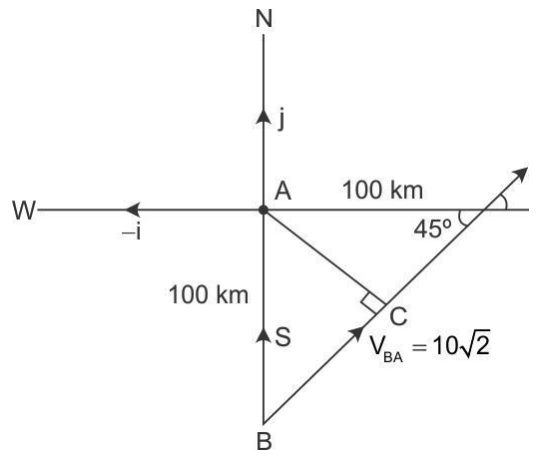
Relative to A, B moves along BC; the distance is least when B reaches the foot C of the perpendicular from A.
$BC = 100\cos 45^\circ = 50\sqrt{2}$ km
$t = \frac{50\sqrt{2}}{10\sqrt{2}} = 5$ h -
If vectors $\vec A = \cos\omega t\,\hat i + \sin\omega t\,\hat j$ and $\vec B = \cos\frac{\omega t}{2}\,\hat i + \sin\frac{\omega t}{2}\,\hat j$ are functions of time, then the value of t at which they are orthogonal to each other is:Orthogonal: $\vec A\cdot\vec B = 0$
$\cos\omega t\cos\frac{\omega t}{2} + \sin\omega t\sin\frac{\omega t}{2} = 0 \Rightarrow \cos\left(\omega t - \frac{\omega t}{2}\right) = \cos\frac{\omega t}{2} = 0$
$\frac{\omega t}{2} = \frac{\pi}{2} \Rightarrow t = \frac{\pi}{\omega}$ -
The position vector of a particle $\vec R$ as a function of time is given by $\vec R = 4\sin(2\pi t)\,\hat i + 4\cos(2\pi t)\,\hat j$, where R is in meters, t is in seconds and $\hat i$ and $\hat j$ denote unit vectors along x and y-directions, respectively. Which one of the following statements is wrong for the motion of particle?$x^2 + y^2 = 16$, so the path is a circle of radius 4 m, and the acceleration is centripetal (along $-\vec R$) with magnitude $\frac{v^2}{R}$.
$\vec v = \frac{d\vec R}{dt} = 8\pi\cos 2\pi t\,\hat i - 8\pi\sin 2\pi t\,\hat j$
$|\vec v| = 8\pi$ m/s, not 8 m/s — so that statement is wrong. -
Two particles A and B, move with constant velocities $\vec u_1$ and $\vec u_2$. At the initial moment their position vectors are $\vec r_1$ and $\vec r_2$ respectively. The condition for particles A and B for their collision is:For collision, the velocity of B relative to A must point along the position of A relative to B.
Direction of relative position of A w.r.t. B: $\frac{\vec r_1 - \vec r_2}{|\vec r_1 - \vec r_2|}$
Direction of velocity of B w.r.t. A: $\frac{\vec u_2 - \vec u_1}{|\vec u_2 - \vec u_1|}$
Condition: $\frac{\vec r_1 - \vec r_2}{|\vec r_1 - \vec r_2|} = \frac{\vec u_2 - \vec u_1}{|\vec u_2 - \vec u_1|}$ -
A projectile is fired from the surface of the earth with a velocity of 5 $ms^{-1}$ and angle $\theta$ with the horizontal. Another projectile fired from another planet with a velocity of 3 $ms^{-1}$ at the same angle follows a trajectory which is identical with the trajectory of the projectile fired from the earth. The value of the acceleration due to gravity on the planet is (in $ms^{-2}$) (given g = 9.8 $ms^{-2}$)Range $= \frac{u^2\sin2\theta}{g}$; for identical trajectories at the same angle, $g \propto u^2$.
$g_{planet} = \left(\frac{3}{5}\right)^2\times 9.8 = 3.5$ $ms^{-2}$ -
A particle is moving such that its position coordinates (x, y) are (2 m, 3 m) at time t = 0, (6 m, 7 m) at time t = 2 s and (13 m, 14 m) at time t = 5 s. Average velocity vector $(\vec V_{av})$ from t = 0 to t = 5 s is:$\vec v_{av} = \frac{\Delta\vec r}{\Delta t} = \frac{(13-2)\hat i + (14-3)\hat j}{5 - 0} = \frac{11}{5}(\hat i + \hat j)$
Want a score?
Answers here are not saved. Practise as a test to be marked and see your progress.
Practise as a test