Looking for classes? Ksquare Career Institute, Bengaluru →

Physics
Motion in a Plane
56 questions, each with its answer.
-
A particle moving with uniform speed in a circular path maintains;In uniform circular motion, the speed is constant but the direction of velocity changes continuously; since velocity is a vector, it is varying. The centripetal acceleration has constant magnitude $\frac{v^2}{r}$ but its direction (towards the centre) keeps changing, so acceleration is also varying. So the particle has varying velocity and varying acceleration.
-
A bullet is fired from a gun at the speed of $280\ m/s$ in the direction $30^\circ$ above the horizontal. The maximum height attained by the bullet is ($g=9.8\ ms^{-2}$, $\sin30^\circ=0.5$)
$h_{max}=\frac{u^2\sin^2\theta}{2g}=1000\ m$.
$h_{max}=\frac{u^2\sin^2\theta}{2g}=\frac{280\times280}{2\times9.8}\times\frac{1}{4}=1000\ m$ -
A cricket ball is thrown by a player at a speed of 20 m/s in a direction $30^\circ$ above the horizontal. The maximum height attained by the ball during its motion is ($g=10$ m/s$^2$)$H=\frac{u^2\sin^2\theta}{2g}=\frac{(20)^2\times(1/2)^2}{2\times10}=5$ m.
-
Two particles A and B are moving in uniform circular motion in concentric circles of radius $r_A$ and $r_B$ with speed $v_A$ and $v_B$ respectively. The time period of rotation is the same. The ratio of angular speed of A to that of B will be:Given $T_A=T_B=T$. $\omega_A=\frac{2\pi}{T_A}$, $\omega_B=\frac{2\pi}{T_B}$ $\frac{\omega_A}{\omega_B}=\frac{T_B}{T_A}=\frac{T}{T}=1$ Ratio $=1:1$
-
The x and y coordinates of the particle at any time are $x = 5t - 2t^2$ and $y = 10t$ respectively, where x and y are in meters and t in seconds. The acceleration of the particle at t = 2 s is
Differentiate twice: $a_x = -4$, $a_y = 0$ at all times.
$x = 5t - 2t^2$, $y = 10t$ $v_x = \frac{dx}{dt} = 5 - 4t$, $v_y = \frac{dy}{dt} = 10$ $a_x = \frac{dv_x}{dt} = -4$, $a_y = \frac{dv_y}{dt} = 0$ Acceleration of the particle at t = 2 s is $-4\ m/s^2$. -
If the magnitude of sum of two vectors is equal to the magnitude of difference of the two vectors, the angle between these vectors is
$|P+Q| = |P-Q|$ only when $\cos\theta = 0$.
$|\vec{P} + \vec{Q}| = |\vec{P} - \vec{Q}|$
Squaring: $P^2 + Q^2 + 2PQ\cos\theta = P^2 + Q^2 - 2PQ\cos\theta$
$\Rightarrow 4PQ\cos\theta = 0 \Rightarrow \cos\theta = 0$
$\theta = \frac{\pi}{2} = 90^\circ$ -
A particle is moving such that its position coordinates (x, y) are (2 m, 3 m) at time t = 0, (6 m, 7 m) at time t = 2 s and (13 m, 14 m) at time t = 5 s. Average velocity vector $(\vec V_{av})$ from t = 0 to t = 5 s is:$\vec v_{av} = \frac{\Delta\vec r}{\Delta t} = \frac{(13-2)\hat i + (14-3)\hat j}{5 - 0} = \frac{11}{5}(\hat i + \hat j)$
-
The velocity of a projectile at the initial point A is $(2\hat i + 3\hat j)$ m/s. Its velocity (in m/s) at point B is:
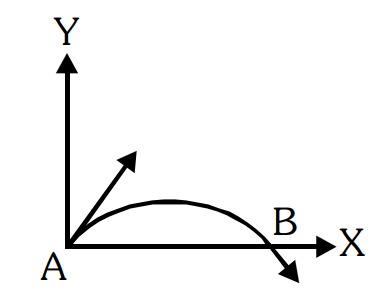 B is at the same level as A. The horizontal component of velocity stays the same and the vertical component is reversed.
So the velocity at B is $2\hat i - 3\hat j$ m/s. -
The horizontal range and the maximum height of a projectile are equal. The angle of projection of the projectile isMaximum height $H = \frac{u^2\sin^2\theta}{2g}$; range $R = \frac{2u^2\sin\theta\cos\theta}{g}$
H = R: $\frac{u^2\sin^2\theta}{2g} = \frac{2u^2\sin\theta\cos\theta}{g}$
$\sin\theta = 4\cos\theta \Rightarrow \tan\theta = 4$
$\theta = \tan^{-1}(4)$ -
A particle has initial velocity $(2\hat i + 3\hat j)$ and acceleration $(0.3\hat i + 0.2\hat j)$. The magnitude of velocity after 10 seconds will be$\vec v = \vec u + \vec at$
$= (2\hat i + 3\hat j) + (0.3\hat i + 0.2\hat j)\times10$
$= (2 + 3)\hat i + (3 + 2)\hat j = 5\hat i + 5\hat j$
$|\vec v| = \sqrt{5^2 + 5^2} = 5\sqrt2$ units -
A particle moves in a circle of radius 5 cm with constant speed and time period $0.2\pi$ s. The acceleration of the particle isR = 5 cm = $5\times10^{-2}$ m, T = $0.2\pi$ s.
Angular speed $\omega = \frac{2\pi}{T} = \frac{2\pi}{0.2\pi} = 10$ rad/s
For constant speed the only acceleration is centripetal: $a = \omega^2R$
$a = (10)^2\times5\times10^{-2} = 100\times0.05$
a = 5 m/$s^2$ -
A body is moving with velocity 30 m/s towards east. After 10 seconds its velocity becomes 40 m/s towards north. The average acceleration of the body isInitial velocity $\vec{v_i} = 30\hat{i}$ m/s (east); final velocity $\vec{v_f} = 40\hat{j}$ m/s (north).
Change in velocity $\Delta\vec{v} = \vec{v_f} - \vec{v_i} = 40\hat{j} - 30\hat{i}$
$|\Delta\vec{v}| = \sqrt{40^2 + 30^2} = \sqrt{1600 + 900} = \sqrt{2500} = 50$ m/s
Average acceleration $= \frac{|\Delta\vec{v}|}{t} = \frac{50}{10}$
= 5 m/$s^2$ -
A missile is fired for maximum range with an initial velocity of 20 m/s. If g = 10 m/$s^2$, the range of the missile isRange of a projectile: $R = \frac{u^2\sin2\theta}{g}$
The range is maximum when $\sin2\theta = 1$, i.e., $\theta = 45^\circ$.
$R_{max} = \frac{u^2}{g}$
$R_{max} = \frac{(20)^2}{10} = \frac{400}{10}$
$R_{max} = 40$ m -
The speed of a projectile at its maximum height is half of its initial speed. The angle of projection isLet the initial speed be $v_0$ and the angle of projection be $\theta$.
At the maximum height the vertical component of velocity is zero; only the horizontal component remains: $v = v_0\cos\theta$
Given $v = \frac{v_0}{2}$: $\frac{v_0}{2} = v_0\cos\theta$
$\cos\theta = \frac{1}{2}$
$\theta = 60^\circ$ -
A particle moves in x-y plane according to rule $x = a\sin\omega t$ and $y = a\cos\omega t$. The particle follows$\frac{x}{a} = \sin\omega t$ and $\frac{y}{a} = \cos\omega t$
Squaring and adding to eliminate t: $\frac{x^2}{a^2} + \frac{y^2}{a^2} = \sin^2\omega t + \cos^2\omega t = 1$
$x^2 + y^2 = a^2$
This is the equation of a circle of radius a centred at the origin.
Hence the particle follows a circular path. -
Six vectors, $\vec{a}$ through $\vec{f}$ have the magnitudes and directions indicated in the figure. Which of the following statements is true?
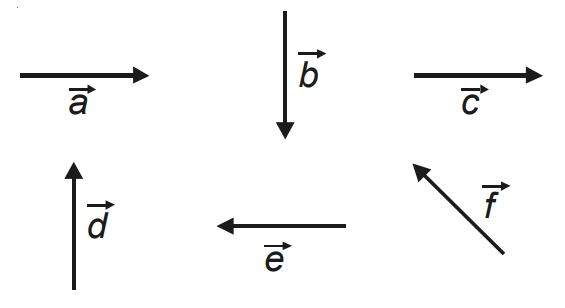 By the triangle law, if two vectors are drawn head to tail, their sum is the vector drawn from the tail of the first to the head of the second.
Using the magnitudes and directions shown in the figure, place the tail of $\vec{e}$ at the head of $\vec{d}$.
The vector from the tail of $\vec{d}$ to the head of $\vec{e}$ then has the same magnitude and direction as $\vec{f}$.
The other combinations ($\vec{b} + \vec{e}$, $\vec{b} + \vec{c}$, $\vec{d} + \vec{c}$) give resultants that do not coincide with $\vec{f}$ in direction.
Hence $\vec{d} + \vec{e} = \vec{f}$. -
A particle has initial velocity $(3\hat{i} + 4\hat{j})$ and has acceleration $(0.4\hat{i} + 0.3\hat{j})$. Its speed after 10 s is$\vec{v} = \vec{u} + \vec{a}t$
$\vec{v} = (3\hat{i} + 4\hat{j}) + (0.4\hat{i} + 0.3\hat{j})\times10$
$\vec{v} = (3 + 4)\hat{i} + (4 + 3)\hat{j} = 7\hat{i} + 7\hat{j}$
Speed $= |\vec{v}| = \sqrt{7^2 + 7^2} = \sqrt{98}$
$= 7\sqrt{2}$ units -
A particle starting from the origin (0, 0) moves in a straight line in the (x, y) plane. Its coordinates at a later time are $(\sqrt{3}, 3)$. The path of the particle makes with the x-axis an angle ofLet $\theta$ be the angle which the path of the particle makes with the x-axis.
The particle moves along the straight line from (0, 0) to $(\sqrt{3}, 3)$.
$\tan\theta = \dfrac{y}{x} = \dfrac{3}{\sqrt{3}}$
$\tan\theta = \sqrt{3}$
$\theta = \tan^{-1}(\sqrt{3}) = 60^\circ$ -
$\vec{A}$ and $\vec{B}$ are two vectors and $\theta$ is the angle between them, if $|\vec{A} \times \vec{B}| = \sqrt{3}\,(\vec{A}\cdot\vec{B})$, the value of $\theta$ is$|\vec{A} \times \vec{B}| = AB\sin\theta$ and $\vec{A}\cdot\vec{B} = AB\cos\theta$
Given $|\vec{A} \times \vec{B}| = \sqrt{3}\,(\vec{A}\cdot\vec{B})$
$\Rightarrow AB\sin\theta = \sqrt{3}\,AB\cos\theta$
$\Rightarrow \tan\theta = \sqrt{3}$
$\Rightarrow \theta = 60^\circ$ -
For angles of projection of a projectile at angles $(45^\circ - \theta)$ and $(45^\circ + \theta)$, the horizontal ranges described by the projectile are in the ratio of :Horizontal range: $R = \dfrac{u^2\sin 2\alpha}{g}$
$R_1 = \dfrac{u^2\sin 2(45^\circ - \theta)}{g} = \dfrac{u^2\sin(90^\circ - 2\theta)}{g} = \dfrac{u^2\cos 2\theta}{g}$
$R_2 = \dfrac{u^2\sin 2(45^\circ + \theta)}{g} = \dfrac{u^2\sin(90^\circ + 2\theta)}{g} = \dfrac{u^2\cos 2\theta}{g}$
$\dfrac{R_1}{R_2} = \dfrac{\cos 2\theta}{\cos 2\theta} = 1$
In other words, $(45^\circ - \theta)$ and $(45^\circ + \theta)$ are complementary angles (their sum is $90^\circ$), and for complementary angles of projection the range is the same.
So the ranges are in the ratio 1 : 1. -
The vectors $\vec{A}$ and $\vec{B}$ are such that $|\vec{A} + \vec{B}| = |\vec{A} - \vec{B}|$. The angle between the two vectors is :-$|\vec{A} + \vec{B}| = |\vec{A} - \vec{B}| \Rightarrow |\vec{A} + \vec{B}|^2 = |\vec{A} - \vec{B}|^2$
$|\vec{A} + \vec{B}|^2 = A^2 + B^2 + 2AB\cos\theta$
$|\vec{A} - \vec{B}|^2 = A^2 + B^2 - 2AB\cos\theta$
$\Rightarrow A^2 + B^2 + 2AB\cos\theta = A^2 + B^2 - 2AB\cos\theta$
$\Rightarrow 4AB\cos\theta = 0 \Rightarrow \cos\theta = 0$
$\Rightarrow \theta = 90^\circ$ -
A stone tied to the end of a string of 1 m long is whirled in a horizontal circle with a constant speed. If the stone makes 22 revolutions in 44 seconds, what is the magnitude and direction of acceleration of the stone -Frequency: $n = \dfrac{22}{44} = \dfrac{1}{2}$ revolution per second
Angular speed: $\omega = 2\pi n = 2\pi \times \dfrac{1}{2} = \pi$ rad/s
Centripetal acceleration: $a_r = \omega^2 r = (2\pi n)^2 r$
$a_r = (\pi)^2 \times 1 = \pi^2$ m s$^{-2}$
The speed is constant, so the tangential acceleration is zero: $a_T = 0$.
So the acceleration is $\pi^2$ m s$^{-2}$, directed along the radius towards the centre. -
If a vector $2\hat{i} + 3\hat{j} + 8\hat{k}$ is perpendicular to the vector $4\hat{j} - 4\hat{i} + \alpha\hat{k}$, then the value of $\alpha$ isTwo vectors are perpendicular when their scalar (dot) product is zero.
$(2\hat{i} + 3\hat{j} + 8\hat{k})\cdot(-4\hat{i} + 4\hat{j} + \alpha\hat{k}) = 0$
$2 \times (-4) + 3 \times 4 + 8 \times \alpha = 0$
$-8 + 12 + 8\alpha = 0$
$8\alpha = -4$
$\alpha = -\dfrac{1}{2}$ -
If the angle between the vectors $\vec{A}$ and $\vec{B}$ is $\theta$, the value of the product $(\vec{B} \times \vec{A})\cdot\vec{A}$ is equal to -$\vec{B} \times \vec{A} = BA\sin\theta\,\hat{n}$, where $\hat{n}$ is a unit vector perpendicular to the plane containing $\vec{A}$ and $\vec{B}$.
$(\vec{B} \times \vec{A})\cdot\vec{A} = (BA\sin\theta)(\hat{n}\cdot\vec{A})$
Since $\hat{n}$ is perpendicular to $\vec{A}$, $\hat{n}\cdot\vec{A} = A\cos 90^\circ = 0$.
$\Rightarrow (\vec{B} \times \vec{A})\cdot\vec{A} = 0$
In general, a scalar triple product with two identical vectors is always zero. -
The vector sum of two forces is perpendicular to their vector differences. In that case, the forces :Two vectors are perpendicular if their dot product is zero.
$(\vec{A} + \vec{B})\cdot(\vec{A} - \vec{B}) = 0$
$\Rightarrow A^2 - \vec{A}\cdot\vec{B} + \vec{B}\cdot\vec{A} - B^2 = 0$
Since $\vec{A}\cdot\vec{B} = \vec{B}\cdot\vec{A}$, the middle terms cancel: $A^2 - B^2 = 0$
$\Rightarrow A = B$
So the forces are equal in magnitude. They need not be equal as vectors, since their directions can be different (if they were equal vectors, their difference would be zero).
Want a score?
Answers here are not saved. Practise as a test to be marked and see your progress.
Practise as a test