Looking for classes? Ksquare Career Institute, Bengaluru →

Thermodynamics
-
A container has two chambers of volumes $V_1 = 2\text{ litres}$ and $V_2 = 3\text{ litres}$ separated by a partition made of a thermal insulator. The chambers contains $n_1 = 5$ and $n_2 = 4\text{ moles}$ of ideal gas at pressures $p_1 = 1\text{ atm}$ and $p_2 = 2\text{ atm}$, respectively. When the partition is removed, the mixture attains an equilibrium pressure of:A 1.3 atmB 1.6 atmC 1.4 atmD 1.8 atm
Total internal energy is conserved, so $P_f V_{total} = P_1 V_1 + P_2 V_2 \implies P_f = \frac{1(2) + 2(3)}{2 + 3} = \frac{8}{5} = 1.6\text{ atm}$.
For ideal gases insulated from the surroundings, internal energy is conserved upon free mixing: $U = U_1 + U_2$. Since internal energy of an ideal gas is $U = \frac{f}{2} n R T = \frac{f}{2} P V$, we have: $\frac{f}{2} P_f (V_1 + V_2) = \frac{f}{2} P_1 V_1 + \frac{f}{2} P_2 V_2 \implies P_f = \frac{P_1 V_1 + P_2 V_2}{V_1 + V_2}$. Substituting the values: $P_f = \frac{(1\text{ atm} \times 2\text{ L}) + (2\text{ atm} \times 3\text{ L})}{2\text{ L} + 3\text{ L}} = \frac{2 + 6}{5} = \frac{8}{5} = 1.6\text{ atm}$. -
Two gases A and B are filled at the same pressure in separate cylinders with movable pistons of radius $r_A$ and $r_B$, respectively. On supplying an equal amount of heat to both the systems reversibly under constant pressure, the pistons of gas A and B are displaced by $16\text{ cm}$ and $9\text{ cm}$, respectively. If the change in their internal energy is the same, then the ratio $r_A / r_B$ is equal to:A $\frac{4}{3}$B $\frac{3}{4}$C $\frac{2}{\sqrt{3}}$D $\frac{3}{2}$
Since $Q$ and $\Delta U$ are equal, work done $W = P \Delta V$ is identical. $\pi r_A^2 (16) = \pi r_B^2 (9) \implies r_A / r_B = 3/4$.
From the first law of thermodynamics: $Q = \Delta U + W$. Since equal heat $Q_A = Q_B$ is supplied and internal energy change is identical $\Delta U_A = \Delta U_B$, the work done by both gases must be equal: $W_A = W_B$. At constant pressure $P$: $W = P \Delta V \implies P \Delta V_A = P \Delta V_B \implies \Delta V_A = \Delta V_B$. For a cylindrical piston of radius $r$ displaced by $d$: $\Delta V = (\pi r^2) d$. Thus: $\pi r_A^2 (16\text{ cm}) = \pi r_B^2 (9\text{ cm}) \implies \frac{r_A^2}{r_B^2} = \frac{9}{16} \implies \frac{r_A}{r_B} = \sqrt{\frac{9}{16}} = \frac{3}{4}$. -
A thermodynamic system is taken through the cycle $abcda$. The work done by the gas along the path $bc$ is:
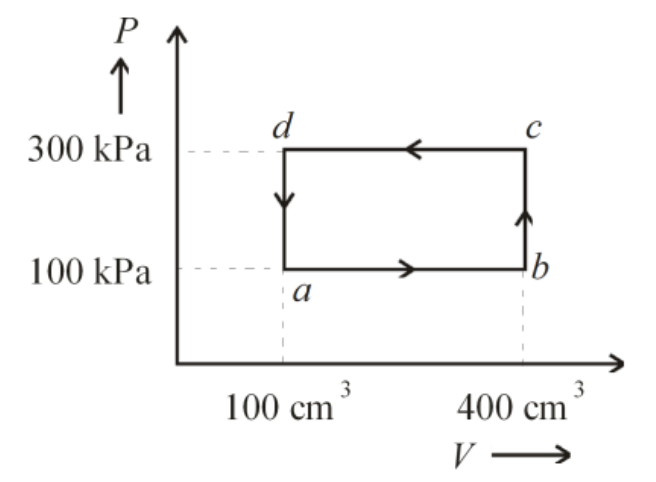 A -90 JB -60 JC zeroD 30 J
 -
A Carnot engine has an efficiency of 50% when its source is at a temperature $327^\circ C$. The temperature of the sink is:A $200^\circ C$B $27^\circ C$C $15^\circ C$D $100^\circ C$
$\eta=1-\frac{T_{sink}}{T_{source}}$ gives $T_{sink}=300\ K=27^\circ C$.
$\eta=1-\frac{T_{sink}}{T_{source}}=0.5\Rightarrow\frac{T_{sink}}{T_{source}}=0.5$ $\Rightarrow T_{sink}=\frac{1}{2}\times(273+327)=\frac{1}{2}\times600=300\ K=27^\circ C$ -
An ideal gas undergoes four different processes from the same initial state as shown in the figure below. Those processes are adiabatic, isothermal isobaric and isochoric. The curve which represents the adiabatic process among 1, 2, 3 and 4 is :
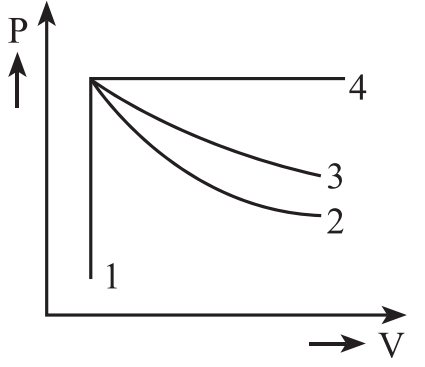 A 4B 1C 2D 3
 -
Two cylinders A and B of equal capacity are connected to each other via a stop cock. A contains an ideal gas at standard temperature and pressure. B is completely evacuated. The entire system is thermally insulated. The stop cock is suddenly opened. The process is:A adiabaticB isochoricC isobaricD isothermal
-
In which of the following processes, heat is neither absorbed nor released by a system?A isothermalB adiabaticC isobaricD isochoric