Looking for classes? Ksquare Career Institute, Bengaluru →

Work, Energy and Power
-
The kinetic energies of two similar cars A and B are $100\text{ J}$ and $225\text{ J}$ respectively. On applying brakes, car A stops after $1000\text{ m}$ and car B stops after $1500\text{ m}$. If $F_A$ and $F_B$ are the forces applied by the brakes on cars A and B, respectively, then the ratio $F_A / F_B$ is:A $\frac{3}{2}$B $\frac{2}{3}$C $\frac{1}{3}$D $\frac{1}{2}$
From work-energy theorem, $F = \frac{KE}{s}$. Therefore, $F_A / F_B = \frac{100/1000}{225/1500} = \frac{0.10}{0.15} = \frac{2}{3}$.
According to the Work-Energy Theorem, work done by the braking force equals the change in kinetic energy: $W = F \cdot s = \Delta KE \implies F = \frac{KE}{s}$. For car A: $F_A = \frac{100\text{ J}}{1000\text{ m}} = 0.10\text{ N}$. For car B: $F_B = \frac{225\text{ J}}{1500\text{ m}} = 0.15\text{ N}$. The ratio is $\frac{F_A}{F_B} = \frac{0.10}{0.15} = \frac{2}{3}$. -
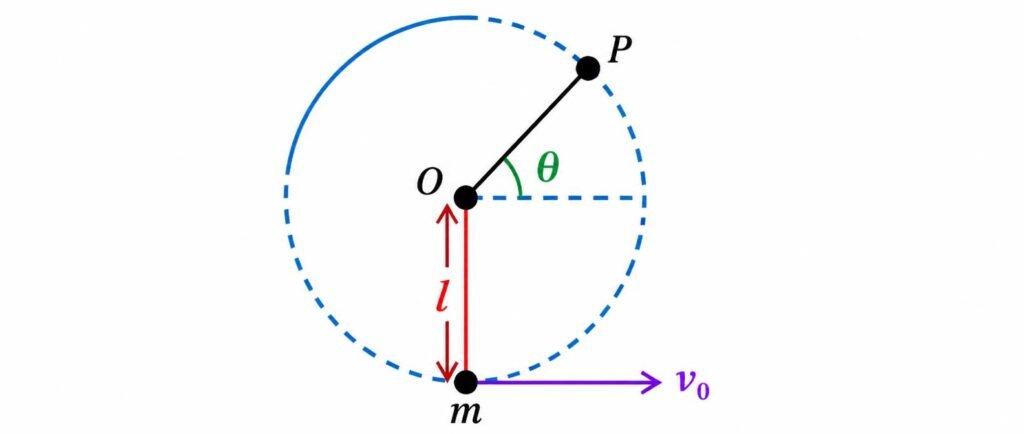
A bob of heavy mass $m$ is suspended by a light string of length $l$. The bob is given a horizontal velocity $v_0$ as shown in figure. If the string gets slack at some point P making an angle $\theta$ from the horizontal, the ratio of the speed $v$ of the bob at point P to its initial speed $v_0$ is:
 A $(\sin\theta)^{1/2}$B $\left(\frac{1}{2 + 3\sin\theta}\right)^{1/2}$C $\left(\frac{\cos\theta}{2 + 3\sin\theta}\right)^{1/2}$D $\left(\frac{\sin\theta}{2 + 3\sin\theta}\right)^{1/2}$
Setting tension $T = 0$ at slack point P gives $v = \sqrt{gl \sin\theta}$. Using conservation of energy gives $v_0 = \sqrt{gl(2 + 3\sin\theta)}$, so $v/v_0 = \sqrt{\frac{\sin\theta}{2 + 3\sin\theta}}$.
At point P where the string goes slack, tension $T = 0$. The radial component of gravity provides the necessary centripetal force: $mg \sin\theta = \frac{m v^2}{l} \implies v^2 = gl \sin\theta$. By conservation of mechanical energy between the lowest point and point P: $\frac{1}{2} m v_0^2 = \frac{1}{2} m v^2 + mg(l + l \sin\theta)$. Multiplying by $2/m$: $v_0^2 = v^2 + 2gl(1 + \sin\theta) = gl \sin\theta + 2gl + 2gl \sin\theta = gl(2 + 3\sin\theta)$. Thus, the ratio of speeds is $\frac{v}{v_0} = \sqrt{\frac{gl \sin\theta}{gl(2 + 3\sin\theta)}} = \left(\frac{\sin\theta}{2 + 3\sin\theta}\right)^{1/2}$. -
At any instant of time $t$, the displacement of any particle is given by $2t-1$ (SI unit) under the influence of force of 5N. The value of instantaneous power is (in SI unit):A 7B 6C 10D 5
-
Two bodies A and B of same mass undergo completely inelastic one dimensional collision. The body A moves with velocity $v_1$ while body B is at rest before collision. The velocity of the system after collision is $v_2$. The ratio $v_1 : v_2$ is;A 4 : 1B 1 : 4C 1 : 2D 2 : 1
-
The potential energy of a long spring when stretched by 2 cm is $U$. If the spring is stretched by 8 cm, potential energy stored in it will be:A $16U$B $2U$C $4U$D $8U$
Spring PE is $\frac{1}{2}kx^2$, so 4 times the stretch gives $16U$.
Potential energy stored in the spring $=\frac{1}{2}kx^2$ Now $\frac{1}{2}k(2)^2=U$ and $\frac{1}{2}k(8)^2=U'$ (say) $\Rightarrow U'=\frac{64}{4}U=16U$ -
A bullet from a gun is fired on a rectangular wooden block with velocity $u$. When bullet travels $24\ cm$ through the block along its length horizontally, velocity of bullet becomes $\frac{u}{3}$. Then it further penetrates into the block in the same direction before coming to rest exactly at the other end of the block. The total length of the block is:A 30 cmB 27 cmC 24 cmD 28 cm
Work-energy theorem for both stages gives total length $d=24\times\frac{9}{8}=27\ cm$.
$\frac{1}{2}m\left(\frac{u}{3}\right)^2-\frac{1}{2}mu^2=-F_R\times24$ $0-\frac{1}{2}mu^2=-F_R\times d$ $\frac{\frac{1}{2}mu^2}{\frac{1}{2}mu^2\times\frac{8}{9}}=\frac{d}{24}$ $d=24\times\frac{9}{8}=27\ cm$ -
An electric lift with a maximum load of 2000 kg (lift + passengers) is moving up with a constant speed of $1.5\ ms^{-1}$. The frictional force opposing the motion is 3000 N. The minimum power delivered by the motor to the lift in watts is : ($g=10\ ms^{-2}$)A 23500B 23000C 20000D 34500
-
The energy that will be ideally radiated by a 100 kW transmitter in 1 hour is :A $1\times10^5\ J$B $36\times10^7\ J$C $36\times10^4\ J$D $36\times10^5\ J$
-
Water falls from a height of 60 m at the rate of 15 kg/s to operate a turbine. The losses due to frictional force are 10% of the input energy. How much power is generated by the turbine? ($g=10\ m/s^2$)A 8.1 kWB 12.3 kWC 7.0 kWD 10.2 kW
-
A ball of mass 0.15 kg is dropped from a height 10 m, strikes the ground and rebounds to the same height. The magnitude of impulse imparted to the ball is ($g=10\ m/s^2$) nearly:A $4.2\ kg\ m/s$B $2.1\ kg\ m/s$C $1.4\ kg\ m/s$D $0\ kg\ m/s$
-
The energy equivalent of 0.5 g of a substance is:A $4.5\times10^{13}\ J$B $1.5\times10^{13}\ J$C $0.5\times10^{13}\ J$D $4.5\times10^{16}\ J$
-
Body A of mass $4m$ moving with speed $u$ collides with another body B of mass $2m$, at rest. The collision is head on and elastic in nature. After the collision the fraction of energy lost by the colliding body A is:A $\frac{1}{9}$B $\frac{8}{9}$C $\frac{4}{9}$D $\frac{5}{9}$
-
A force $F=20+10y$ acts on a particle in $y$-direction where $F$ is in newton and $y$ in meter. Work done by this force to move the particle from $y=0$ to $y=1$ m is:A $30\ J$B $5\ J$C $25\ J$D $20\ J$