Looking for classes? Ksquare Career Institute, Bengaluru →

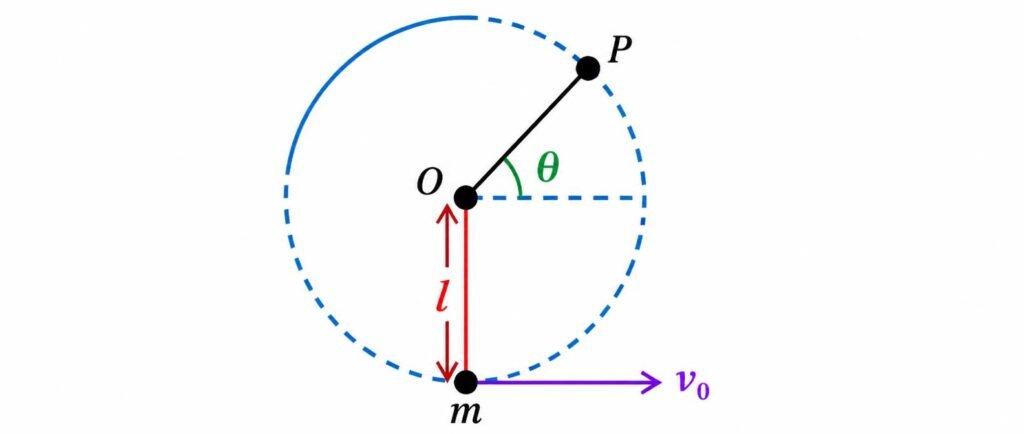
A bob of heavy mass $m$ is suspended by a light string of length $l$. The bob is given a horizontal velocity $v_0$ as shown in figure. If the string gets slack at some point P making an angle $\theta$ from the horizontal, the ratio of the speed $v$ of the bob at point P to its initial speed $v_0$ is:
A
$(\sin\theta)^{1/2}$
B
$\left(\frac{1}{2 + 3\sin\theta}\right)^{1/2}$
C
$\left(\frac{\cos\theta}{2 + 3\sin\theta}\right)^{1/2}$
D
$\left(\frac{\sin\theta}{2 + 3\sin\theta}\right)^{1/2}$
Explanation
Setting tension $T = 0$ at slack point P gives $v = \sqrt{gl \sin\theta}$. Using conservation of energy gives $v_0 = \sqrt{gl(2 + 3\sin\theta)}$, so $v/v_0 = \sqrt{\frac{\sin\theta}{2 + 3\sin\theta}}$.
Detailed Solution
At point P where the string goes slack, tension $T = 0$. The radial component of gravity provides the necessary centripetal force: $mg \sin\theta = \frac{m v^2}{l} \implies v^2 = gl \sin\theta$. By conservation of mechanical energy between the lowest point and point P: $\frac{1}{2} m v_0^2 = \frac{1}{2} m v^2 + mg(l + l \sin\theta)$. Multiplying by $2/m$: $v_0^2 = v^2 + 2gl(1 + \sin\theta) = gl \sin\theta + 2gl + 2gl \sin\theta = gl(2 + 3\sin\theta)$. Thus, the ratio of speeds is $\frac{v}{v_0} = \sqrt{\frac{gl \sin\theta}{gl(2 + 3\sin\theta)}} = \left(\frac{\sin\theta}{2 + 3\sin\theta}\right)^{1/2}$.