Looking for classes? Ksquare Career Institute, Bengaluru →

Three forces acting on a body are shown in the figure. To have the resultant force only along the y-direction, the magnitude of the minimum additional force needed is -
(4 N acts at $30^\circ$ to the +y axis towards the -x side, 1 N acts at $60^\circ$ above the +x axis, and 2 N acts exactly opposite to the 4 N force.)
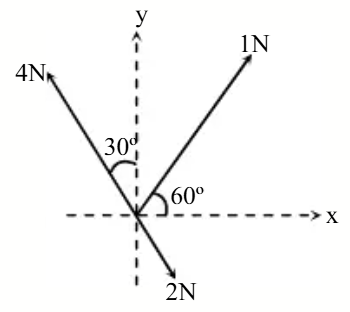
(4 N acts at $30^\circ$ to the +y axis towards the -x side, 1 N acts at $60^\circ$ above the +x axis, and 2 N acts exactly opposite to the 4 N force.)
A
$\dfrac{\sqrt{3}}{4}$ N
B
$\sqrt{3}$ N
C
0.5 N
D
1.5 N
Detailed Solution
The 4 N and 2 N forces are opposite to each other, so their net is $4 - 2 = 2$ N along the direction of the 4 N force.
Now the figure reduces to: 2 N at $30^\circ$ to the +y axis (towards -x) and 1 N at $60^\circ$ to the +x axis.
Horizontal component of the 2 N force along the -ve x-direction: $x_1 = 2\sin 30^\circ = 1$ N
Horizontal component of the 1 N force along the +ve x-direction: $x_2 = 1\cos 60^\circ = \dfrac{1}{2}$ N
Net horizontal force $= 1 - \dfrac{1}{2} = \dfrac{1}{2}$ N along the -ve x-direction.
For the resultant to be only along the y-direction, the net x-component must be zero.
The smallest force that does this is one that just cancels the x-component: $\dfrac{1}{2}$ N along the +ve x-direction.
So the minimum additional force needed is 0.5 N.
Now the figure reduces to: 2 N at $30^\circ$ to the +y axis (towards -x) and 1 N at $60^\circ$ to the +x axis.
Horizontal component of the 2 N force along the -ve x-direction: $x_1 = 2\sin 30^\circ = 1$ N
Horizontal component of the 1 N force along the +ve x-direction: $x_2 = 1\cos 60^\circ = \dfrac{1}{2}$ N
Net horizontal force $= 1 - \dfrac{1}{2} = \dfrac{1}{2}$ N along the -ve x-direction.
For the resultant to be only along the y-direction, the net x-component must be zero.
The smallest force that does this is one that just cancels the x-component: $\dfrac{1}{2}$ N along the +ve x-direction.
So the minimum additional force needed is 0.5 N.