2007 AIPMT-PRE Moving Charges and MagnetismMotion in Combined Electric and Magnetic Fields Easy Question 12 of 13 in Motion in Combined Electric and Magnetic Fields

Under the influence of a uniform magnetic field a charged particle is moving in a circle of radius $R$ with constant speed $v$. The time period of the motion

A depends on both $R$ and $v$
B is independent of both $R$ and $v$
C depends on $R$ and not on $v$
D depends on $v$ and not on $R$

The answer is B.
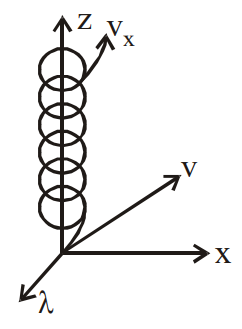
Solution


The magnetic force provides the centripetal force: $qvB = \dfrac{mv^2}{R}$
$\Rightarrow R = \dfrac{mv}{qB}$
Time period: $T = \dfrac{2\pi R}{v} = \dfrac{2\pi}{v} \times \dfrac{mv}{qB}$
$T = \dfrac{2\pi m}{qB}$
The speed $v$ cancels out: a faster particle moves in a proportionally bigger circle, so the time for one revolution is the same.
The time period depends only on the mass, the charge and the magnetic field, so it is independent of both $R$ and $v$.

Concept Cyclotron period

Motion in Combined Electric and Magnetic Fields in past papers

13 questions from this chapter have appeared across 10 exam years.
